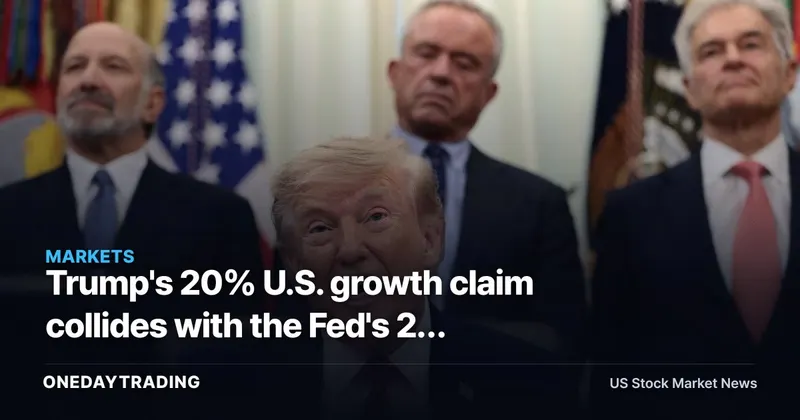
What does 20% U.S. growth mean for stocks and rates?
President Donald Trump's claim that U.S. growth could hit 20% is market-relevant because it collides with the Fed's reaction function, not because the headline is easy to believe. GDP growth is the pace at which the economy expands; in this debate, it matters because stronger nominal growth can change the Fed's policy bias before earnings estimates do.
CNBC's report puts the tension in one place: Trump argued rapid growth should not prompt rate hikes even as inflation remains above the Fed's 2% target. That is the real fault line for investors. If growth is strong but prices stay hot, the bond market usually prices a harder rate backdrop, not a freer one.
Why does the 20% number matter if it happened only once since WWII?
That historical fact matters because it tells investors how far outside the normal macro range this claim sits. A 20% print is not a consensus growth assumption; it is a stress test for rates, multiples and sector leadership. The tape will not price the slogan itself. It will price whether the claim changes the expected path for inflation, Treasury yields and the Fed.
That is why the first read-through is usually not in cyclical earnings, but in valuation. Higher yields hit long-duration assets first. If the market believes growth is accelerating without a clean inflation break, the discount rate goes up before the profit forecast does.
By the Numbers
- 20%: the U.S. growth rate Trump said could be reached.
- Once since WWII: how often that pace has happened.
- 2%: the Fed's inflation target, still below the inflation level referenced in CNBC's report.
Winners & Losers
- XLK: vulnerable if the claim pushes Treasury yields higher, because software and other long-duration names trade on cash flows far into the future.
- VNQ: exposed to a higher discount-rate regime, since real estate is priced off financing costs and yield spreads.
- XLF: can gain if stronger nominal growth steepens the curve and improves loan demand, but only if inflation does not force a harsher Fed stance.
- XLY: can benefit from firmer consumer activity, yet that tailwind fades fast if borrowing costs rise alongside growth.
- IWM: small caps usually pick up the nominal-growth impulse early, but they also absorb the pain fastest if funding costs move up.
Risk Check
- The 20% figure may be rhetoric, not a tradable macro forecast.
- Inflation above 2% keeps the Fed constrained even if growth improves.
- A faster-growth narrative can lift yields faster than it lifts earnings.
- The next catalyst is the next inflation and growth print, not the headline itself.
Bottom Line
Trump's growth claim is not a valuation input until the data confirm it, but the numbers are big enough to matter for rates traders and duration-heavy equity investors. If growth really accelerates while inflation stays above the Fed's target, the market has to price higher yields and tighter multiples. If the claim stays political, the move fades and the only durable signal comes from the next CPI or growth release.
FAQ
Why does 20% U.S. growth matter for stocks?
President Donald Trump's 20% figure matters because it changes the rate conversation before it changes earnings. If investors believe that pace is even partly real, Treasury yields and discount rates move first, and the equity multiples of long-duration sectors feel it next.
What does inflation above the Fed's 2% target mean here?
Inflation above the Fed's 2% target means the central bank has less room to ignore a hot growth print. President Donald Trump's argument that growth should not trigger hikes runs into the basic problem that stronger demand with sticky prices usually keeps policy tighter for longer.
Which sectors are most exposed to a higher-rate reaction?
Rate-sensitive groups such as software, REITs and other duration trades are the first to lose if yields rise. Financials can work better if the curve steepens, but only if the growth impulse does not come with a sharper inflation problem.
📊 Analysis
Signal Neutral
Why The report is a macro claim, not a policy shift; its market impact depends on whether data later validate higher growth or keep inflation and rates constrained.
Tickers$XLK$VNQ$XLF$XLY$IWM
This article was independently written by OneDayTrading from public reporting. Read the original (CNBC)