Key Takeaways
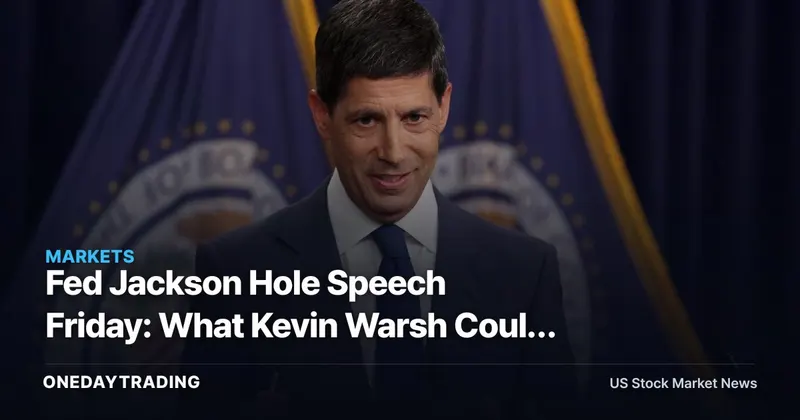
Fed Jackson Hole speech risk for U.S. equities on Friday, Aug. 28, 2026, is less about one headline and more about whether Fed Chairman Kevin Warsh uses the CNBC-described platform to reset the policy framework that drives rates, multiples and sector leadership.
CNBC reports that earlier Fed chairs have used Jackson Hole speeches to outline broad policy frameworks and intentions, which makes Friday a macro event for the S&P 500, Nasdaq growth stocks, banks and the U.S. dollar even without a stated rate decision.
What Happened
CNBC flagged Fed Chairman Kevin Warsh's key Jackson Hole speech for Friday, Aug. 28, 2026, and framed the question around what investors should expect from the annual central-bank venue. The source reporting gives no policy number, no dot-plot estimate and no explicit rate guidance.
That absence matters. A Jackson Hole address is not an FOMC statement, but CNBC notes that prior Fed chairs have used the stage to set policy frameworks and intentions, so the tradable variable is language: inflation tolerance, labor-market emphasis, financial-conditions sensitivity and the reaction function.
Jackson Hole is the Federal Reserve's high-profile policy symposium where central bankers can describe the framework behind future rate decisions, with framework meaning the rule set investors infer for how inflation, employment and financial conditions translate into policy.
Background & Context
The market impact runs through the discount rate first. If Warsh's Aug. 28 speech sounds more restrictive than investors expect, Treasury yields can pressure long-duration equities because higher rates lower the present value assigned to future cash flows.
If Warsh's Aug. 28 speech emphasizes policy patience, the tape is more likely to reward growth and rate-sensitive assets because lower expected real rates support equity multiples. The source does not establish which message Warsh will deliver, so positioning matters more than prediction.
Market & Stock Impact
- JPMorgan Chase (JPM): Banks can benefit if the Fed message supports a steeper rate curve, but a tighter-for-longer tone can also raise credit-cost concerns for lenders.
- Bank of America (BAC): Bank of America is rate-sensitive through net interest income, so the Aug. 28 speech matters if investors revise the path for deposits, loan demand and securities yields.
- Nvidia (NVDA): AI and semiconductor leaders carry high growth expectations, so a rate shock can compress multiples even when company-specific demand remains intact.
- Apple (AAPL): Mega-cap technology acts as a duration asset when rates move, making Fed language a valuation input rather than a direct revenue catalyst.
- Homebuilders and REITs: Rate-sensitive real estate equities react to mortgage-rate and cap-rate expectations, which can shift if Jackson Hole changes the perceived Fed path.
Investor Checkpoints
- Watch whether Warsh's Friday, Aug. 28, 2026, speech prioritizes inflation control, labor-market risk or financial conditions.
- Track the U.S. 10-year Treasury yield after the speech because rates are the first transmission channel into equity valuation.
- Compare Nasdaq leadership against bank stocks during the session to see whether the tape is pricing lower-duration growth or higher-rate financials.
- Use the next FOMC communication after Jackson Hole as the test of whether the speech was framework-setting or merely rhetorical.
Outlook
The bull case for equities is that Warsh uses Jackson Hole to reduce uncertainty around the Fed's intentions, allowing investors to price policy with fewer tail risks. The risk is that a framework speech can tighten financial conditions without a formal hike if investors hear a higher bar for easing or a longer inflation fight.
FAQ
Why does the Fed Jackson Hole speech matter for stocks?
The Fed Jackson Hole speech matters for stocks because CNBC reports that prior Fed chairs have used the venue to explain policy frameworks and intentions. U.S. equity investors translate that language into rate expectations, and rate expectations feed directly into valuations for banks, technology and real estate.
What time is Kevin Warsh speaking at Jackson Hole on Friday?
CNBC identifies Friday, Aug. 28, 2026, as the date for Fed Chairman Kevin Warsh's key Jackson Hole speech, but the provided source text does not include a speech time. Investors should treat the confirmed date, not an unreported clock time, as the factual anchor.
Which stocks are most exposed to the Fed Jackson Hole speech?
JPMorgan Chase (JPM), Bank of America (BAC), Nvidia (NVDA) and Apple (AAPL) are exposed through different rate channels. Banks respond to yield-curve and credit assumptions, while large technology stocks respond mainly through valuation multiples tied to long-term rates.
📊 Analysis
Signal Neutral
Why The CNBC item identifies a potentially market-moving Fed policy speech, but the provided facts do not establish whether the message will be dovish or hawkish.
Tickers$JPM$BAC$NVDA$AAPL
This article was independently written by OneDayTrading from public reporting. Read the original (CNBC)