What Changes
Prediction markets are trading venues where users buy contracts tied to event outcomes, and the investable issue is whether state legal pressure limits scale before the category proves durable demand.
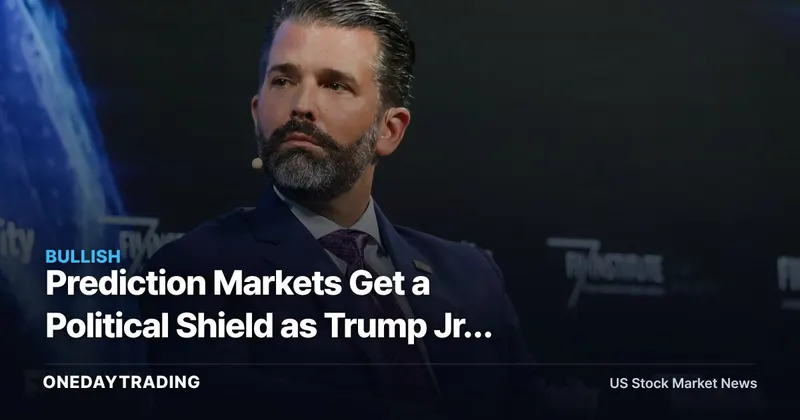
CNBC reported that Donald Trump Jr. told Republican state attorneys general not to fight prediction markets, citing New York Times reporting. That matters because state attorneys general can shape enforcement pressure even when federal rules and platform-specific legal positions remain the heavier machinery.
The balance-sheet channel is straightforward. A prediction market platform that spends less time defending state-by-state access can spend more on liquidity, user acquisition and product breadth; a platform facing fragmented state opposition burns capital on lawyers before it earns a stable take rate.
By the Numbers
The source gives one concrete count: Donald Trump Jr. advises two prediction market platforms. The source does not provide revenue, trading volume, market share, valuation or the number of Republican attorneys general contacted, so those figures should not be inferred.
The absence of operating data keeps the investment case policy-led rather than KPI-led. In fintech, that distinction matters: regulation can open distribution faster than revenue proves quality, but regulation can also reverse before customer economics become visible.
Winners & Losers
- Prediction market platforms: The sector benefits if Republican state attorneys general reduce legal opposition, because lower enforcement friction can support state access and user growth.
- Fintech platforms: Event-contract businesses sit inside the broader fintech policy debate, where licensing, consumer protection and market integrity can decide the cost of scale.
- Sports betting and gaming operators: The competitive read-through is mixed because prediction markets can overlap with consumer behavior around event wagering, but the source does not identify any listed operator.
- State regulators: Attorneys general remain the constraint because a political request does not eliminate their authority to challenge products they view as unlawful or harmful.
Risk Check
- CNBC attributed the report to The New York Times, and the source does not include a formal policy change by any attorney general.
- Donald Trump Jr.'s advisory role with two prediction market platforms creates a perceived-interest question that could sharpen scrutiny instead of reducing it.
- The source does not establish whether Republican state attorneys general accepted the request, rejected it or changed enforcement plans.
- The source does not provide platform financials, so investors cannot translate the political signal into revenue, margin or valuation math.
Bottom Line
The reported message is a bullish policy signal for prediction markets as a fintech category, not a confirmed legal victory. If state opposition eases, platform expansion gets cleaner; if attorneys general press ahead, the sector's next chapter will be written in enforcement actions rather than user growth.
FAQ
Why are prediction markets in the news today?
Prediction markets are in the news because CNBC reported that Donald Trump Jr. told Republican state attorneys general not to fight the industry, citing New York Times reporting. The report matters because Donald Trump Jr. is an advisor to two prediction market platforms, according to the source.
What are prediction markets for investors?
Prediction markets are platforms where users trade contracts linked to event outcomes. For investors, prediction markets are a fintech policy story because state legal pressure can affect distribution, compliance spending and the speed of product expansion.
Which stocks are tied to the prediction markets report?
The source does not name a U.S.-listed prediction market company or provide public-company exposure. The cleanest market read-through is the fintech sector, not a specific ticker, because the reported event concerns state attorneys general and an industry category.
📊 Analysis
Signal Bullish
Why The report points to reduced Republican state-level opposition as a potential policy tailwind for prediction market platforms, though no formal enforcement change was reported.
This article was independently written by OneDayTrading from public reporting. Read the original (CNBC)