At a Glance
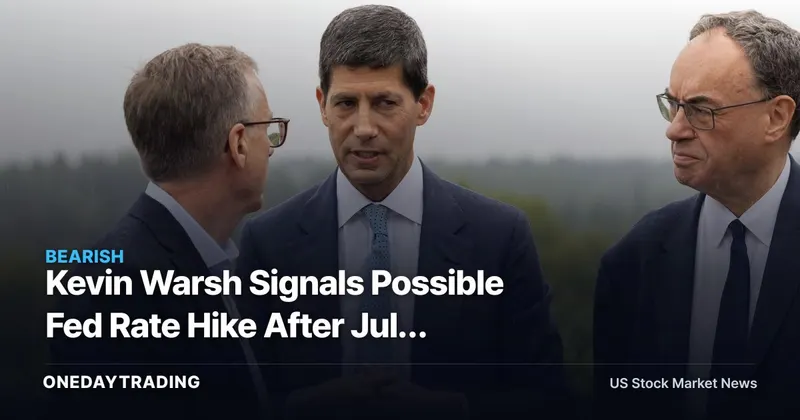
Kevin Warsh and the Fed rate hike debate matter because CNBC reported that Fed Chairman Kevin Warsh used Jackson Hole to clarify the case for higher interest rates after a confusing July press conference, putting pressure back on equity multiples, rate-sensitive sectors and bank earnings assumptions.
A Fed rate hike is an increase in the central bank’s policy rate, which raises the discount rate investors apply to future cash flows and can lift funding costs across the U.S. economy.
Why It Matters Now
The market issue is not only whether Fed Chairman Kevin Warsh sounds hawkish at Jackson Hole. The market issue is whether investors already priced the July confusion as communication noise while leaving too little room for a cleaner inflation warning to reset the path of rates.
Higher interest rates usually hit long-duration equities first because more of their value sits in earnings expected years ahead. CNBC’s source report gave no basis-point figure, so the investable signal is the direction of policy language rather than a quantified rate path.
Fed Chairman Kevin Warsh’s Jackson Hole message also changes the leadership test inside U.S. equities. Banks such as JPMorgan Chase and Bank of America can benefit when asset yields reprice upward, but that benefit weakens if higher rates damage loan demand, deposit costs or credit quality.
Key Debates
- Inflation persistence: Fed Chairman Kevin Warsh sharpened the inflation warning at Jackson Hole, per CNBC, so the next test is whether inflation data validates the case for tighter policy.
- Communication reset: CNBC reported that Kevin Warsh confused markets at the July press conference, which makes Jackson Hole important as a repair of guidance rather than only a policy signal.
- Multiple pressure: A possible rate hike raises the discount rate applied to equities, and that mechanism weighs most on growth sectors whose earnings are valued far into the future.
- Bank trade limits: Higher rates can support net interest income for large banks, but the same policy can pressure borrowers and raise credit-cost risk.
Related Stocks & Sectors
- JPMorgan Chase JPM: JPMorgan Chase has direct exposure to U.S. lending and deposit spreads, so a higher-rate path can help asset yields if credit demand holds.
- Bank of America BAC: Bank of America is sensitive to rate expectations because deposit costs and loan yields both move through the income statement.
- Goldman Sachs GS: Goldman Sachs can feel rate volatility through trading activity and dealmaking appetite, with tighter policy usually complicating valuation-driven issuance.
- Microsoft MSFT: Microsoft represents large-cap growth exposure where higher rates can compress valuation multiples even when operating fundamentals remain intact.
- Real estate investment trusts: REITs face a higher hurdle rate when Treasury yields rise, because income alternatives compete more directly with property dividends.
What to Watch
- Watch the next inflation release after Jackson Hole for confirmation or rejection of Fed Chairman Kevin Warsh’s tighter-policy argument.
- Watch the next FOMC decision date for whether the Jackson Hole warning becomes an actual rate increase.
- Watch Treasury yields because the 10-year rate is the transmission channel from Fed language to equity multiples.
- Watch JPMorgan Chase and Bank of America commentary on deposit betas, loan growth and credit costs at their next earnings updates.
Overall Outlook
The immediate read-through is bearish for broad equity duration and cautiously constructive for selected large banks. If inflation data backs Fed Chairman Kevin Warsh’s Jackson Hole warning, the market must reprice the probability of higher rates; if inflation cools, the July confusion becomes less important than the next data print.
FAQ
Why did Kevin Warsh signal a possible Fed rate hike?
CNBC reported that Fed Chairman Kevin Warsh used Jackson Hole to give a clearer view of the case for higher interest rates. The stated driver in the source was a sharper inflation warning after a confusing July press conference.
How do higher interest rates affect U.S. stocks?
Higher interest rates affect U.S. stocks by raising the discount rate investors use to value future earnings. Growth stocks and REITs usually face more valuation pressure, while banks can benefit if loan yields rise faster than funding costs.
What stocks are tied to the Fed rate hike debate?
JPMorgan Chase, Bank of America and Goldman Sachs are tied to the Fed rate hike debate through lending spreads, deposits, trading and capital-market activity. Microsoft is tied to the rate debate through the valuation pressure that higher yields place on large-cap growth stocks.
📊 Analysis
Signal Bearish
Why A clearer Fed case for higher interest rates is negative for broad equity multiples even though large banks may see selective spread benefits.
This article was independently written by OneDayTrading from public reporting. Read the original (CNBC)