Summary
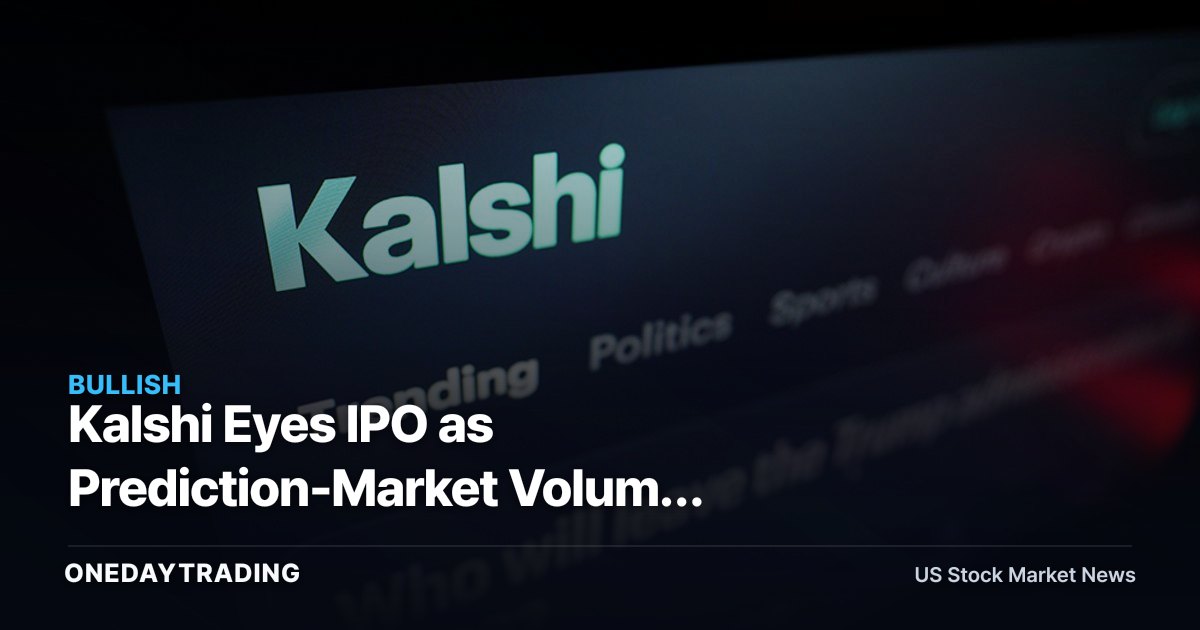
Kalshi, the CFTC-regulated event-contract exchange, is reportedly weighing an initial public offering as trading on its prediction markets surges. Kalshi itself is private, so the readable signal for public-market investors runs through its distribution partners and the exchange operators whose turf event contracts increasingly overlap.
The Full Story
A Kalshi IPO would be the first chance for public investors to own a pure-play prediction-market venue rather than a gambling or brokerage business that bolts the product on. The fact that Kalshi is exploring a listing now, on the back of surging volume, tells you the category has moved from novelty to a revenue line large enough to interest public-market underwriters.
The more immediate read-through is for the firms already plugged into Kalshi. Robinhood distributes Kalshi-powered event contracts to its retail base, turning prediction markets into a new transaction-revenue stream that sits alongside equities, options and crypto. A louder, better-capitalized Kalshi is a stronger supply partner — but also a reminder that the underlying economics accrue first to the exchange, with the broker taking a slice.
Structural Background
Event contracts let users trade yes or no outcomes on real-world questions, settling like a derivative rather than a sportsbook bet. That regulatory framing — overseen as a designated contract market rather than under state gaming rules — is what lets Kalshi scale nationally and is the same framing that pulls it into the same conversation as established derivatives venues.
Stock & Sector Ripple
- Robinhood (HOOD): Direct beneficiary of prediction-market adoption; event contracts add a high-engagement, low-cost product that lifts active users and transaction take rates, though Kalshi captures the core exchange margin.
- DraftKings (DKNG): Faces a structural threat as regulated event contracts offer sports-adjacent wagering nationwide without state-by-state licensing, pressuring the moat behind its sportsbook model.
- Intercontinental Exchange (ICE): Owner of large derivatives and data franchises; prediction markets are both a competitive nibble at retail derivatives flow and a potential acquisition or partnership target.
- CME Group (CME): Established event and micro-contract issuer; a fast-growing Kalshi validates retail demand for outcome trading but also raises competition for that wallet.
- Cboe Global Markets (CBOE): Retail-options and volatility venue exposed to the same shift in how individuals trade short-dated, outcome-based risk.
Bull vs Bear Scenarios
Bull: Prediction markets become a durable fourth asset class for retail, expanding the addressable pie for distribution partners like Robinhood and giving a listed Kalshi a scarcity premium as the category leader.
Bear: No financials have been disclosed, surging volume can be event-driven and cyclical, and regulatory posture toward sports-linked contracts remains the central variable — an adverse CFTC or court ruling could compress the entire category before any IPO prices.
Investor Action Points
- Watch for a confidential filing or S-1 that finally discloses Kalshi revenue, take rate and volume — the first hard numbers to anchor valuation.
- Track Robinhood quarterly transaction-revenue disclosure for a separately broken-out prediction-market or event-contract line.
- Monitor CFTC actions and court rulings on sports-related event contracts as the key regulatory catalyst for the whole group.
- Compare DraftKings user and handle trends against rising event-contract adoption as an early displacement signal.
Market data check: HOOD
HOOD last traded near $108.15 (+2.80%). Our composite signal — blending price momentum and news flow — reads 🟡 neutral. Price momentum scores 72/100 (firm).
Data as of publication. Price via market feeds; for reference only, not investment advice.
📊 Analysis
Signal Bullish
Why A surging prediction-market category and a potential first pure-play IPO is a positive demand and validation catalyst for distribution partners and the broader event-contract ecosystem.
Tickers$HOOD$DKNG$ICE$CME$CBOE
This article was independently written by OneDayTrading from public reporting. Read the original (Yahoo Finance)