Key Takeaways
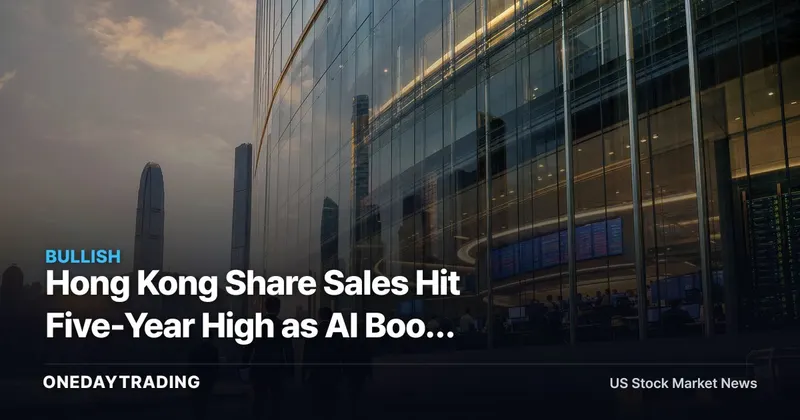
Hong Kong equity fundraising has climbed to a five-year high, with the global AI boom acting as the catalyst that reopened a market frozen since 2021. For investors, the read-through is two-fold: capital is flowing back into China-exposed equities, and the underwriting fee pool that global banks gave up for dead is refilling.
What Happened
Share sales in Hong Kong, including initial public offerings and follow-on placements, reached their highest level in five years. The driver is demand for exposure to artificial intelligence, which has pulled issuers back to a listing venue that spent three years in a deep freeze after the 2021 regulatory crackdown and rate-shock selloff.
The mechanism is straightforward. A reopened primary market signals that institutional appetite for risk in the region has returned. Companies do not price IPOs and large placements into hostile tape; they issue when books can be filled at acceptable valuations. A five-year high in volume is therefore a demand signal as much as a supply one.
Background and Context
Hong Kong's listings pipeline collapsed after 2021 as China tech faced antitrust action, delisting fears in the U.S. and a property downturn that drained domestic liquidity. The AI cycle has reframed the China story from regulatory risk toward growth optionality, giving global funds a reason to rebuild positions rather than simply hedge them.
Market and Stock Impact
- Chinese tech (BABA, BIDU, JD): Dual-listed names benefit directly. A liquid, rising Hong Kong market lifts their HK lines, narrows the discount to fundamentals and lowers their own cost of raising AI capex.
- Global underwriters (GS, MS): Goldman Sachs and Morgan Stanley earn fees on every IPO and placement; a revived Hong Kong ECM calendar restores a profit line that withered after 2021.
- China internet basket (KWEB): Renewed primary-market demand tends to feed the secondary market, supporting the broad China-tech complex that AI sentiment is repricing.
Investor Checkpoints
- Track monthly Hong Kong IPO and placement volumes to confirm the trend is broadening, not a single-quarter spike.
- Watch post-listing performance: strong aftermarket trading sustains the pipeline; weak debuts choke it.
- Monitor Goldman and Morgan Stanley investment-banking fee disclosures for Asia ECM contribution at next earnings.
- Follow the Fed rate path and the dollar; a higher-for-longer stance pressures the liquidity feeding this rotation.
Outlook
The bull case is a self-reinforcing cycle: AI demand draws issuers, successful deals draw capital, and deeper liquidity draws more issuers. The risk is that this is sentiment riding a single theme. If AI enthusiasm cools, or U.S.-China tension and a stronger dollar tighten financial conditions, a fundraising peak can mark a top rather than a base. The tell will be whether deals keep clearing after the first wave of marquee AI names is priced.
Market data check: BABA
BABA last traded near $94.81 (-0.27%). Our composite signal — blending price momentum and news flow — reads 🟡 neutral. Price momentum scores 48/100.
Data as of publication. Price via market feeds; for reference only, not investment advice.
📊 Analysis
Signal Bullish
Why A five-year high in Hong Kong share sales signals returning risk appetite that benefits Chinese tech issuers and global underwriters.
Tickers$BABA$GS$MS$BIDU$JD$KWEB
This article was independently written by OneDayTrading from public reporting. Read the original (Investing.com)