Summary
A Yosemite land swap under review by the Trump administration is not an earnings story yet; it is a land-value and permitting story. The market read-through is limited but real: any benefit would likely accrue to the private developer seeking better access, while the larger risk is precedent, delay and a tougher political price for future federal land deals.
A land exchange swaps one parcel or use right for another, usually to solve an access problem without a straight cash sale. In this case, the key investor question is whether the process creates a cleaner path for development or a more contested one.
The Full Story
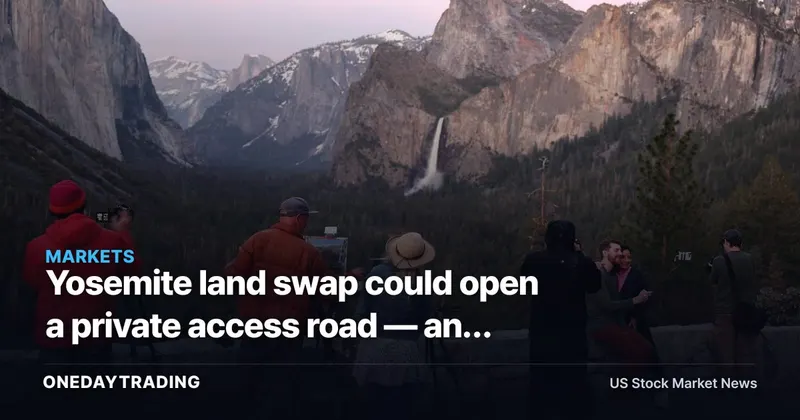
CNBC reported that the Trump administration is considering a Yosemite land exchange that could give a private developer more direct park access. The immediate issue is physical access, not operating leverage. When road access is the bottleneck, the value is often trapped in the land itself, not in whatever can be built on it.
That matters because access drives feasibility. A parcel with awkward entry points, longer haul routes or constrained infrastructure can trade at a discount to a similar site with simpler logistics. If the exchange goes forward, the upside is not a broad re-rating of the sector; it is a narrower improvement in project optionality for the developer involved.
Structural Background
The policy layer is the real story. Federal land swaps tend to pull in land-use politics, environmental scrutiny and local opposition, which makes the process slower and less predictable than a normal real-estate transaction. That uncertainty is part of the cost structure, even before a single shovel moves.
For investors, the signal is not that Yosemite itself becomes investable. The signal is that access rights, permit risk and land control remain the first-order variables in park-adjacent and infrastructure-sensitive development. Where the road is the constraint, the road can become the asset.
Stock & Sector Ripple
- Private developers with land banks near constrained sites could benefit if access costs fall and project timelines shorten.
- Construction and infrastructure contractors could see cleaner project economics if the swap reduces site logistics friction.
- Regional real estate and land-heavy developers may trade on precedent risk if the deal makes future swaps more politically visible.
- Materials and transport names tied to the buildout would only benefit if a later project phase converts the land deal into actual construction spend.
Bull vs Bear Scenarios
The bullish case is straightforward: better access can unlock land that was previously hard to monetize, which improves feasibility and could raise the implied value of the parcel. If the swap also reduces delay, the developer gains time value as well as land value.
The bearish case is just as clear: the administration is only weighing the exchange, not approving it, and the political backlash could make the process slower or more conditional. If the market starts pricing a clean outcome before terms are set, it is likely moving ahead of the facts.
Investor Action Points
- Watch whether the administration moves from consideration to a formal proposal.
- Track whether the road access solution is narrow or broad, because scope changes the land value impact.
- Look for local and federal reaction, since opposition can stretch timelines materially.
- Separate the land-value effect from the construction effect; approval alone does not create revenue.
FAQ
What is a Yosemite land swap?
A Yosemite land swap is a proposed exchange of land or land use rights involving property tied to access near the park. The CNBC report says the Trump administration is weighing such a deal to give a private developer more direct access.
The market relevance comes from control of access, not from Yosemite as a tourism asset. If access improves, the underlying development site can become more usable and more valuable.
Why does private road access matter to investors?
Private road access matters because it can determine whether a project is practical or stalled. Better access can reduce logistics costs, shorten schedules and improve the economics of a parcel.
That said, the value only shows up if the access deal survives review and leads to actual development activity. Until then, it is a policy headline, not a cash-flow event.
What should the market watch next?
Investors should watch whether the administration formalizes the land exchange and how narrow the access solution is. The more specific the terms, the easier it is to judge who benefits and by how much.
The key risk is that politics turns a land-use fix into a long approval process. In that case, the headline may move sentiment, but the balance sheet stays unchanged.
📊 Analysis
Signal Neutral
Why The report signals a potential land-use and permitting change, but it is only under consideration and does not yet create a clear, immediate earnings catalyst for listed U.S. equities.
This article was independently written by OneDayTrading from public reporting. Read the original (CNBC)