Summary
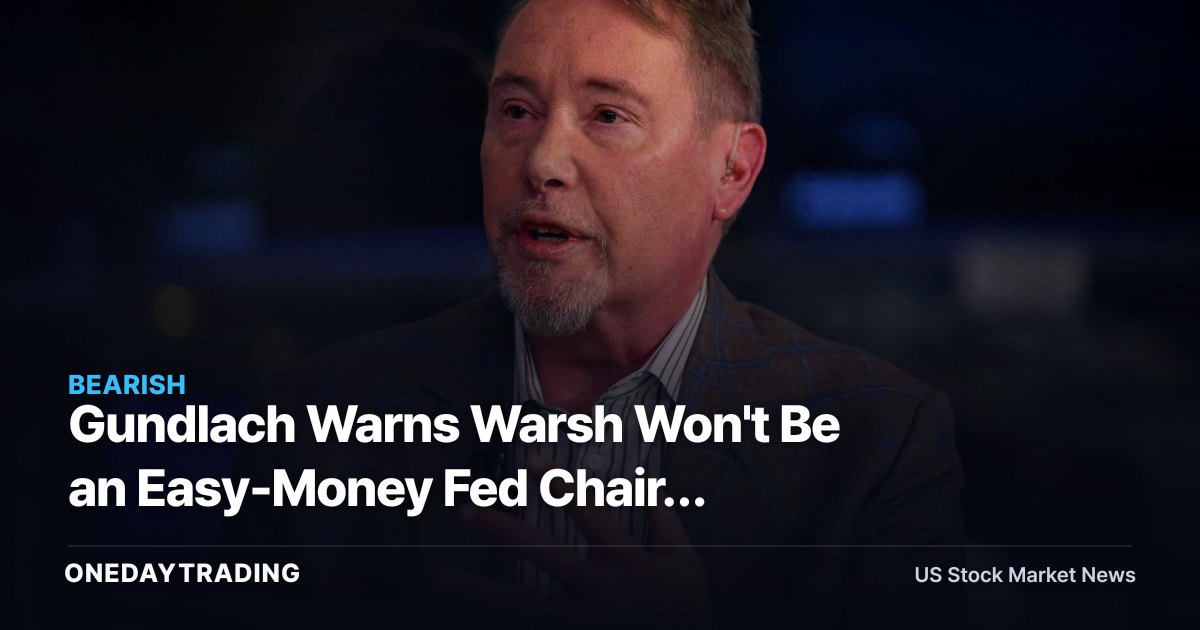
Investor and DoubleLine chief Jeffrey Gundlach is pushing back on the market narrative that a Federal Reserve under Kevin Warsh would deliver a wave of cheap money. His read is that Warsh would keep policy tighter than the dovish camp hopes, curbing the risk of reigniting inflation and pushing longer-dated yields higher. For investors, the takeaway is a discount-rate story: the assets that win and lose are sorted by their sensitivity to long-term interest rates, not by hopes for aggressive cuts.
The Full Story
Gundlach argues that Warsh, if he leads the Fed, is unlikely to be the accommodative chairman that parts of the market have priced in. The core of his point is risk management: a less dovish chair lowers the odds of policy that overstimulates demand and lets inflation flare again. That same discipline, in his framing, helps contain longer-term borrowing costs rather than letting them spike as inflation expectations drift higher.
The distinction matters because much of the recent equity rally has leaned on an assumption of a fast, deep easing cycle. If the next chair anchors policy to inflation control rather than growth support, the path of the long end of the curve becomes the key variable. Bond traders, mortgage borrowers, and long-duration equity holders all sit downstream of that single decision.
Structural Background
Long-term yields are set by more than the Fed's overnight rate; they embed inflation expectations and a term premium. A chair seen as tolerant of inflation can paradoxically push the long end up, raising real borrowing costs across the economy. A chair perceived as credible on inflation can do the opposite, which is the channel Gundlach is highlighting. This is why a hawkish-leaning successor can be friendlier to long bonds than an aggressively dovish one.
Stock & Sector Ripple
- Long-duration growth and tech: highest sensitivity to long rates because their value sits in distant cash flows; a higher-for-longer long end compresses valuation multiples.
- Banks (JPM, BAC): a steeper, higher long end widens net interest margins on lending, while disciplined policy supports credit quality.
- Long-dated Treasuries (TLT): directly priced off the 10- and 30-year yield; benefit if credible inflation control keeps the term premium contained.
- Rate-sensitive real estate and utilities: capital-intensive and dividend-driven, they lag when long yields stay elevated.
- Homebuilders: mortgage rates track the long end, so borrowing-cost expectations feed straight into affordability and demand.
Bull vs Bear Scenarios
The constructive case: a credible inflation-fighter stabilizes the long end, supports the dollar, and rewards banks and bondholders with steadier real returns. The cautionary case: this is one prominent investor reading the intentions of a chair who is not confirmed in the role, and policy can shift with data. If growth slows faster than inflation falls, a tighter stance risks pressuring cyclicals and credit even as it protects the long bond.
Investor Action Points
- Watch the 10-year Treasury yield (^TNX) as the cleanest gauge of whether the market believes the inflation-discipline thesis.
- Track each FOMC statement and dot plot for signals on the terminal rate and the pace of cuts.
- Stress-test long-duration tech holdings against a scenario where long yields stay elevated rather than falling.
- Monitor CPI and inflation-expectation prints, since they drive the term premium that sets long-term borrowing costs.
📊 Analysis
Signal Bearish
Why A less accommodative Fed chair than markets hoped keeps rate-cut expectations and long-duration equity valuations under pressure.
This article was independently written by OneDayTrading from public reporting. Read the original (CNBC)