Key Takeaways
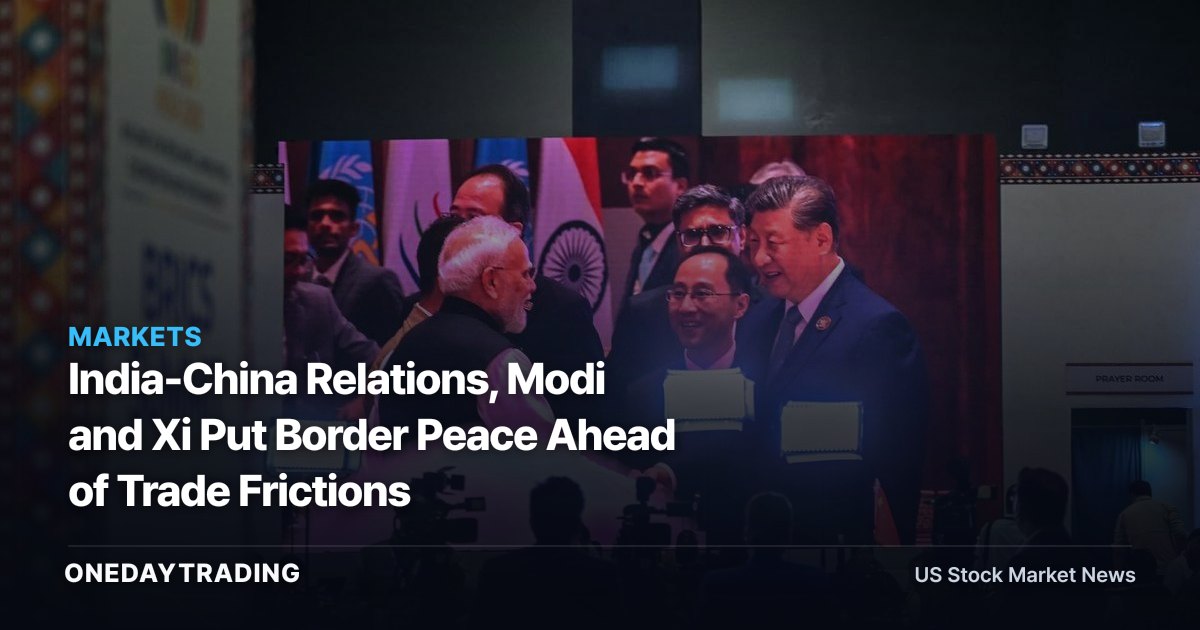
Indian Prime Minister Narendra Modi and Chinese President Xi Jinping used a bilateral meeting on the sidelines of the BRICS Summit to place border stability at the center of their relationship. CNBC reported on September 12, 2026, that Modi said “peace and tranquility” in border areas is essential to developing ties, while the Indian government said both leaders backed a “fair, reasonable, and mutually acceptable” resolution of border issues.
For investors, the signal is one of managed risk rather than a completed breakthrough. The two governments also acknowledged economic friction: China is India’s largest business partner, yet bilateral trade reached a record $151.1 billion in the year ending March 2026 while India’s deficit reached $112.16 billion, compared with $99.21 billion previously, according to CNBC.
What Happened at the Modi-Xi Meeting
The leaders agreed to view bilateral ties from a “strategic and long-term perspective” and not allow differences to become disputes, the Indian government said in the readout cited by CNBC. The statement links political stability to the ability of the neighboring countries to develop broader relations, but it does not specify a new border settlement or an implementation timetable.
The encounter follows a period of strained relations after a deadly India-China border skirmish in 2020. Xi’s visit to India was described by CNBC as his first in seven years. The specific date of the bilateral meeting was not provided in the source.
Last month, India and China held their 25th round of talks and reached eight points of outcomes and consensus, CNBC reported. The source does not disclose the content of those eight points, so their practical effect on troop positions, administration, or commercial activity cannot be assessed from the available information.
Background & Context for India-China Economic Ties
Border tensions and trade dependence have developed together. The two countries fought a war in 1962, and the 2020 skirmish again sharply damaged relations. The latest diplomatic language therefore matters as a risk-management signal, but the facts supplied by CNBC show that political reassurance has not yet altered the headline trade imbalance.
China remained India’s largest business partner as total trade reached $151.1 billion for the year ending March 2026. India’s deficit with China was $112.16 billion in that same period, up from $99.21 billion. The source does not provide the composition of imports, exports, or the sectors responsible for the change.
According to the bilateral readout cited by CNBC, Modi and Xi agreed to address structural trade imbalance, supply-chain issues, and predictable market access. These are policy priorities rather than reported results. CNBC also reported that direct flights have resumed, some old Silk Road trade routes have reopened, and India relaxed rules around investment from Beijing in March.
Market & Stock Impact
- India-focused macro exposure: A calmer border relationship could reduce the geopolitical risk investors attach to cross-border commerce, logistics, and investment. That is an analytical possibility, not a reported market reaction; CNBC provides no stock-price or index response.
- Trade-sensitive industries: The record $151.1 billion trade flow shows the scale of commercial interdependence. Companies dependent on Chinese inputs could be affected by any improvement in supply-chain access, while businesses exposed to import competition could face a different outcome. The source does not identify individual companies or product categories.
- Transport and travel links: Resumed direct flights and reopened trade routes provide channels for greater movement of people and goods. Their financial effect cannot be quantified because CNBC gives no passenger, freight, revenue, or capacity data.
- Investment policy: India’s relaxation of rules around investment from Beijing in March may widen potential capital access if diplomatic conditions hold. No transaction, company, approval value, or investment outcome is reported.
Investor Checkpoints
- Track whether the eight points from last month’s 25th round of talks are publicly detailed or followed by an implementation schedule. CNBC says the points exist but does not describe them.
- Watch official statements for evidence that “peace and tranquility” is translating into sustained border stability. The leaders’ commitment is documented; a specific settlement is not.
- Monitor future trade releases for movement in India’s deficit from the $112.16 billion recorded for the year ending March 2026, against the prior $99.21 billion figure.
- Check policy announcements on predictable market access, supply-chain concerns, flights, trade routes, and investment rules for concrete changes. The bilateral readout identifies these areas but reports no completed economic adjustment.
Outlook
The constructive case rests on repetition and follow-through. Modi and Xi have established a framework that emphasizes a mutually acceptable border resolution, long-term strategic ties, and preventing differences from becoming disputes. Continued talks, restored connectivity, and clearer market-access rules could make the relationship more predictable for companies operating across the border.
The counter-scenario is that diplomatic language coexists with unresolved territorial and commercial tensions. The record trade deficit—$112.16 billion in the year ending March 2026—shows the imbalance remains substantial, and the source offers no evidence that it has narrowed. Until the eight-point consensus is explained and implementation is visible, investors have a signal of intent rather than a measurable change in earnings, supply, or valuation.
FAQ
What did Modi and Xi agree about the India-China border?
The Indian government said the leaders committed to a “fair, reasonable, and mutually acceptable” resolution of border issues. They also agreed to take a strategic, long-term view and not let differences become disputes, according to CNBC.
How large was India’s trade deficit with China?
India’s deficit with China reached $112.16 billion in the year ending March 2026, up from $99.21 billion, CNBC reported. Total India-China trade reached $151.1 billion during that year.
What were the eight points from the latest border talks?
India and China reached eight points of outcomes and consensus in their 25th round of talks last month. CNBC does not provide the specific content of those points, so their operational impact cannot be determined from the source.
📊 Analysis
Signal Neutral
Why The meeting signals diplomatic stabilization, but the source reports no settlement, implementation timetable, or reduction in India’s record trade deficit.
This article was independently written by OneDayTrading from public reporting. Read the original (CNBC)