What Changes
White House ballroom construction now has enough legal room to keep moving, per CNBC's report, which shifts the immediate issue from permission to execution. For investors, the event is not large enough on the supplied facts to move U.S. construction, building materials or engineering services as a sector call.
The sharper read is about policy channel risk. When a controversial federal construction project survives an interim Supreme Court challenge, the near-term probability of work stoppage falls, but the source does not identify contractors, budget size, materials volumes or completion schedule.
That absence matters. Without a named builder, disclosed contract value or procurement terms, no listed stock earns a direct revenue thesis from the White House ballroom decision. The tape can price political attention; it cannot price margin without a contract.
By the Numbers
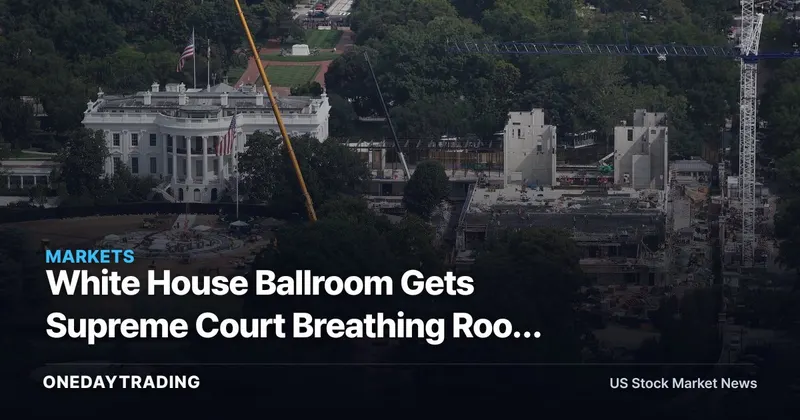
CNBC reported that President Donald Trump had the White House's East Wing demolished in 2025 to make way for the planned ballroom. The supplied CNBC facts include one concrete date, 2025, and no project cost, square footage, contractor name or completion target.
The Supreme Court allowed President Donald Trump to continue White House ballroom construction for now, per CNBC's headline. The phrase for now is the operational number investors should respect: the legal gate opened temporarily, not permanently.
Winners & Losers
- Federal construction contractors: The Supreme Court action lowers immediate stoppage risk for the White House ballroom project, but the supplied source names no contractor or public company.
- Building materials suppliers: Continued construction would support material demand at the project level, but the supplied source provides no volume, budget or supplier data.
- Engineering and project-management firms: Legal continuity improves planning visibility, but the supplied source does not show whether any listed firm is attached to the work.
- Policy-sensitive infrastructure names: The decision shows courts can affect project timing, but this White House ballroom case is too specific to generalize into a sector-wide catalyst.
Risk Check
- The Supreme Court allowed White House ballroom construction to continue for now, and that wording leaves further legal or procedural risk alive.
- The CNBC report does not provide a budget, so investors cannot translate the White House ballroom project into revenue or backlog impact.
- The CNBC report does not name contractors, so any single-stock trade tied to the White House ballroom decision would rest on facts not in the source.
- The White House East Wing demolition in 2025 raises execution stakes because delay risk now sits on a changed physical site.
Bottom Line
The Supreme Court's action is a narrow continuation signal for White House ballroom construction, not a tradable construction boom signal. If future filings or official disclosures identify contractors, budget and schedule, the story can move from political controversy to backlog analysis; until then, the clean investor stance is neutral and fact-limited.
FAQ
Why can White House ballroom construction continue for now?
White House ballroom construction can continue for now because the Supreme Court allowed President Donald Trump to proceed, per CNBC's report. The supplied facts do not say the dispute is permanently resolved.
What happened to the White House East Wing in 2025?
President Donald Trump had the White House's East Wing demolished in 2025 to make way for the planned ballroom, per CNBC's description. The demolition makes timing and legal certainty more important because the project site has already changed.
What stocks are directly tied to the White House ballroom project?
The supplied CNBC facts do not name any contractor, supplier or public company tied to the White House ballroom project. Without a contract value or company name, no U.S.-listed ticker has a direct fact-based link to the decision.
📊 Analysis
Signal Neutral
Why The Supreme Court action supports project continuity, but the source provides no public company, contract value or sector-scale financial impact.
This article was independently written by OneDayTrading from public reporting. Read the original (CNBC)