At a Glance
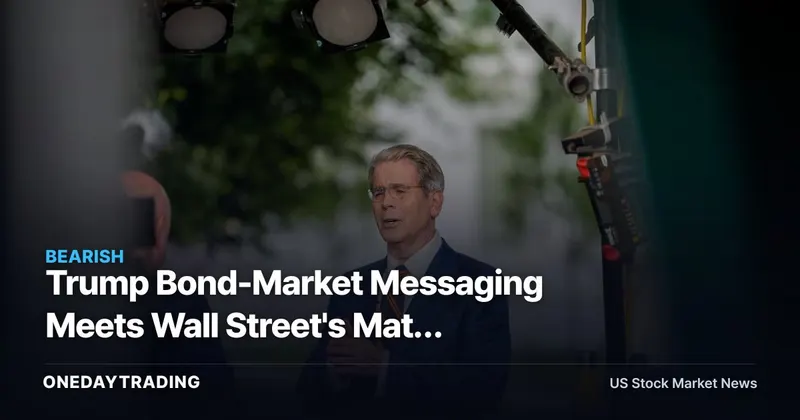
Trump bond market messaging matters because U.S. Treasury investors price credibility through yields, term premium and the dollar, not through campaign-style reassurance. MarketWatch reported that Donald Trump, JD Vance and Scott Bessent tried to calm the bond market with claims the outlet framed as political spin.
The investor read-through is Rates and Macro first: if Wall Street doubts the arithmetic behind fiscal, inflation or debt claims, longer-dated bonds demand compensation and equity multiples face pressure.
Why It Matters Now
The U.S. bond market is the funding base for mortgages, corporate credit, bank balance sheets and equity valuation. A political attempt to calm Treasurys becomes market-relevant when investors treat the message as less important than the math behind deficits, inflation expectations and policy credibility.
A bond-market selloff transmits through rates before it reaches stocks. Higher Treasury yields raise the discount rate on future earnings, which tends to hit long-duration growth shares first, while banks can benefit from wider reinvestment yields only if credit stress does not rise at the same time.
The source does not provide Treasury yield levels, price moves or fiscal figures, so the responsible conclusion is narrower: MarketWatch's report signals a credibility test, not a quantified shock. The tape already prices political noise as background risk; what it may not price is a sustained loss of confidence if investors conclude the official narrative conflicts with countable market data.
Key Debates
- Credibility versus rhetoric: Trump, Vance and Bessent can influence headlines, but Treasury buyers ultimately compare public claims with inflation, issuance and debt-service math.
- Rates versus equities: A higher-yield regime compresses price-to-earnings multiples, especially in growth sectors whose cash flows sit farther in the future.
- Banks versus borrowers: Financials can earn more on assets when rates rise, but households and companies absorb higher financing costs through mortgages, loans and refinancing.
- Dollar channel: If bond investors view policy communication as credible, the U.S. dollar can stabilize; if confidence erodes, foreign demand for Treasurys becomes the live variable.
Related Stocks & Sectors
- Rates: The U.S. Treasury curve is the core asset because the story is about bond-market confidence rather than a single issuer.
- JPM: JPMorgan Chase is exposed through net interest income and credit quality, the two bank variables most sensitive to rate volatility.
- BAC: Bank of America has a large deposit and securities-book sensitivity to Treasury yields, making duration and funding costs central to the stock response.
- XLRE: U.S. real estate investment trusts are rate-sensitive because higher Treasury yields raise cap-rate pressure and refinancing costs.
- QQQ: Nasdaq growth shares are exposed through valuation multiples when Treasury yields reset discount rates higher.
What to Watch
- Watch the 10-year Treasury yield because the bond market will show whether investors accept or reject the political message.
- Watch Treasury auction demand because bid strength reveals whether domestic and foreign buyers require more yield to finance U.S. issuance.
- Watch the U.S. dollar because currency strength or weakness will show whether global investors separate politics from credit confidence.
- Watch the next inflation and Federal Reserve signals because sticky price data would make reassuring rhetoric less persuasive to bond buyers.
Overall Outlook
The bull case for equities is that bond investors dismiss the political theater, Treasury demand stays orderly and yields stop pressuring valuation multiples. The risk case is that repeated attempts to reframe countable fiscal or inflation facts deepen the credibility discount and push rate-sensitive assets into a tougher repricing cycle.
For international retail investors, the actionable point is not partisan. The U.S. bond market will arbitrate the story through yields, auction demand and the dollar, and those signals will matter more for JPMorgan Chase, Bank of America, real estate and Nasdaq growth stocks than the language used in Washington.
FAQ
Why does Trump bond market messaging matter to investors?
Trump bond market messaging matters because Treasury yields anchor borrowing costs, equity valuation and the U.S. dollar. MarketWatch reported that Trump, Vance and Bessent tried to calm the bond market, but Wall Street typically prices measurable fiscal and inflation risk over political framing.
What happens to stocks when Treasury yields rise?
When U.S. Treasury yields rise, equity investors use a higher discount rate for future earnings. Growth stocks and real estate usually face the most pressure, while banks can benefit only if higher rates do not damage loan demand or credit quality.
What should investors watch after the MarketWatch report?
Investors should watch the 10-year Treasury yield, Treasury auction demand and the U.S. dollar after the MarketWatch report on Trump, Vance and Bessent. If those indicators stabilize, the market is treating the episode as political noise; if those indicators weaken together, the credibility risk is becoming tradable.
📊 Analysis
Signal Bearish
Why The report frames the attempt to calm bonds as a credibility problem, which is negative for rate-sensitive equities if Treasury investors demand higher yields.
This article was independently written by OneDayTrading from public reporting. Read the original (MarketWatch)