At a Glance
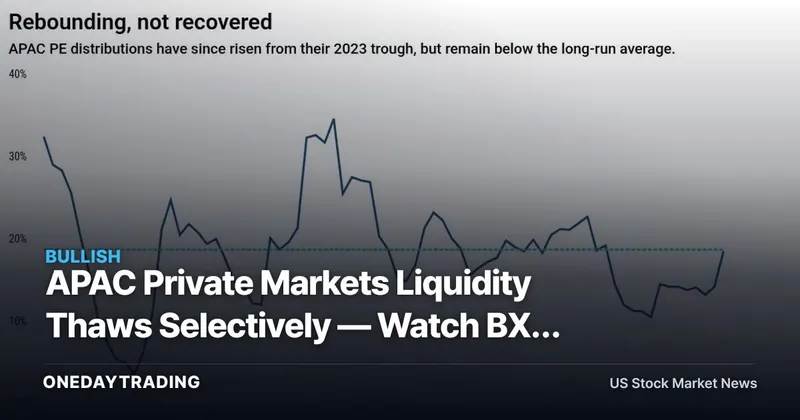
Liquidity is creeping back into Asia-Pacific private markets, but on a selective basis rather than a broad re-opening. For investors, the read-through runs straight to the listed alternative asset managers whose fee engines depend on deals closing, funds raising and assets exiting.
The word doing the work here is selective. A partial thaw rewards scale, track record and the ability to underwrite across cycles — and leaves smaller, single-strategy sponsors behind.
Why It Matters Now
Private markets ran cold for the better part of two years as higher rates lifted discount rates, widened the bid-ask spread between buyers and sellers, and stalled exits. When exits stall, distributions to limited partners dry up, and starved LPs slow their commitments to new funds. That feedback loop is what a returning bid begins to break. The mechanism that matters for equity holders is the chain from realizations to distributions to fresh fundraising to fee-paying assets under management.
APAC is the marginal signal, not the whole story. The region spans deep-pocketed institutional capital in Japan, Korea and Australia and a still-recalibrating China exposure. A selective reopening favors managers with regional platforms already on the ground and dry powder ready to deploy — Blackstone, KKR, Apollo, Carlyle and Brookfield sit at the center of that map. The transmission to their stocks comes through realization-based incentive fees, deployment pace and the durability of fundraising cycles, not through any single transaction.
The counter-case is that selective means narrow. If the bid concentrates in a few sectors and a few sponsors, headline liquidity can improve while the median fund still cannot exit. Distribution-to-paid-in capital — the cash actually returned to LPs — remains the honest scoreboard, and it lags sentiment.
FAQ
- What does selective liquidity mean? Capital is flowing to specific high-quality assets, sectors and managers rather than across the whole market — a quality bid, not a tide that lifts everything.
- Who benefits most? Large, diversified alternative asset managers with established APAC platforms and dry powder to deploy into a less crowded field.
- Why does APAC matter to U.S.-listed managers? Firms like Blackstone and KKR run global funds; a regional thaw adds exit windows and deployment opportunities that feed group-level fee and realization income.
- What is the main risk? A narrow reopening can flatter sentiment while most funds still struggle to return cash to investors.
Related Stocks & Sectors
- Blackstone (BX) — the scale leader in alternatives; realization-based fees and AUM growth track exit and fundraising conditions.
- KKR (KKR) — deep Asia franchise; a regional thaw supports both deployment and monetization.
- Apollo (APO) — credit-heavy model leveraged to private-market financing activity reviving.
- Carlyle (CG) — Asia-focused funds make it directly geared to APAC sentiment.
- Brookfield (BN) — infrastructure and real assets exposure aligned with institutional APAC capital.
What to Watch
- Distribution-to-paid-in (DPI) and realized performance fees in the next quarterly manager updates.
- Fundraising momentum for APAC-dedicated vehicles and the pace of dry-powder deployment.
- Whether the bid broadens beyond a few sectors or stays concentrated.
- Rate-path signals, since exit math improves as discount rates fall.
Overall Outlook
A selective return of liquidity is a genuine positive for the largest alternative managers — it reopens the exit-to-distribution-to-fundraising loop that drives their fee base, and scale players are positioned to capture it first. The risk is that selective stays narrow: if cash returns to LPs lag the sentiment shift, multiple re-rating could outrun the underlying realizations. The cash-return data, not the mood, settles it.
Market data check: BX
BX last traded near $115.4 (+1.07%). Our composite signal — blending price momentum and news flow — reads 🟡 neutral. Price momentum scores 59/100.
Data as of publication. Price via market feeds; for reference only, not investment advice.
📊 Analysis
Signal Bullish
Why A returning bid in APAC private markets reopens the exit-to-distribution-to-fundraising loop that drives fee income for large alternative asset managers, though the selective nature caps the upside.
This article was independently written by OneDayTrading from public reporting. Read the original (Yahoo Finance)