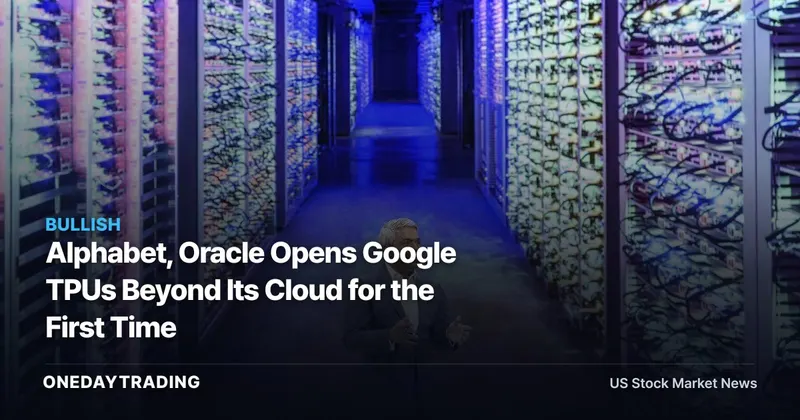
Alphabet’s Oracle Deal Changes the TPU Investment Case
Alphabet’s Tuesday announcement that Oracle will offer Google tensor processing units turns a proprietary cloud advantage into a product that can reach customers outside Google’s infrastructure for the first time. For Alphabet investors, the opportunity is a larger addressable TPU business; the trade-off is that externally sold chips may generate lower margins than Google Cloud’s integrated services. Oracle gains a differentiated AI-computing offering, while Nvidia faces a credible custom-silicon challenge whose actual market-share impact remains unproven.
A tensor processing unit, or TPU, is Google’s custom AI chip, developed since 2013 and optimized as part of the company’s broader computing stack. The significance of the Oracle arrangement lies in distribution: customers no longer have to remain inside Google’s infrastructure to access the silicon. Google had already opened TPUs to outside data centers in the second quarter, and Oracle now gives that strategy a named partner.
Oracle Extends Google’s AI-Chip Distribution
CNBC reported that Alphabet announced the Oracle offering on Tuesday, without specifying when Oracle will begin providing access. That missing launch date matters because the announcement establishes a new sales channel but does not show when orders, deployments or revenue recognition will follow.
The strategy also marks an evolution in how Google commercializes technology developed for its own operations. Thomas Kurian joined Google in late 2018 after spending more than 20 years at Oracle. Uday Cheruvu of Harding Loevner, which owns Alphabet shares, described the shift as a change from building primarily for Google’s own use toward serving external customers.
Distribution through a partner can extend TPU availability without requiring every customer relationship to originate inside Google Cloud. It can also separate the appeal of Google silicon from the decision to buy the rest of Google’s cloud stack. That distinction is central to the thesis: Alphabet may gain chip customers that would not have selected its complete infrastructure offering.
TPU Growth Estimates Are Large—and Far Apart
The financial expectations attached to this strategy vary sharply. TD Cowen models $9.4 billion of Google TPU sales in the second half of this year and $62.5 billion in 2027. Wells Fargo expects about $9 billion in third-quarter sales and $99 billion next year. The range signals substantial uncertainty around order conversion, delivery and revenue timing rather than an established run rate.
Anat Ashkenazi supplied an important recognition constraint on the July earnings call. She said only a small portion of TPU revenue from existing agreements would be recognized this year, with the “vast majority” expected in 2027. Investors therefore need to distinguish announced capacity and contracted access from revenue recorded in a given period.
Google Cloud provides the operating base for that expansion. Google Cloud generated $25 billion of second-quarter revenue, compared with $42 billion for Amazon Web Services and $29 billion for Microsoft Azure. Its second-quarter growth was 82%, and analysts expect about 90% year-over-year growth in the third quarter. Those figures frame TPUs as an additional growth engine inside a cloud business that still trails the two named rivals in second-quarter revenue.
Why Silicon Economics Matter More Than the Sales Headline
Google’s strongest economic argument is control over the full technology stack. At a Goldman Sachs conference in September, Thomas Kurian said Google AI servers pay for themselves in under 2 years, while servers running Google’s own silicon reach payback in roughly half that time. He attributed the difference to optimization across the stack.
SemiAnalysis estimates that Google’s Ironwood TPU costs about 44% less to own and operate than an Nvidia GB200 server. That estimate supports the price-performance case for wider TPU adoption, though it does not establish future sales or prove that Google will take share from Nvidia. Chris Ballard of Check Capital Management said Google could eventually gain Nvidia market share, explicitly presenting that outcome as a possibility.
The margin comparison introduces the principal counterweight. TD Cowen estimates a 20% operating margin on Google TPU sales, versus about 35% for Google Cloud last quarter. Cheruvu said he did not expect the cloud operating margin to expand much beyond the mid-30s. A mix shift toward external hardware could expand revenue and customer reach while producing less operating profit per sales dollar than the overall cloud business.
Anthropic Shows the Scale—and the Strategic Tension
Anthropic agreed last October to use up to 1 million Google TPUs in an arrangement worth tens of billions of dollars. Mizuho says the agreement brings nearly 1 gigawatt of capacity online this year. The customer relationship is strategically unusual because Anthropic’s Claude models compete with Google’s Gemini.
That tension does not invalidate the sale; it shows the economics of infrastructure can differ from the economics of models. Supplying a model competitor can increase utilization and TPU revenue, while also giving that competitor access to Google-designed compute. Anthropic said it uses silicon from Google, Amazon, Nvidia and Advanced Micro Devices, selecting among chips according to price-performance and efficiency for each workload.
Financing is another part of the deployment mechanism. Broadcom, which works with Google on TPUs, detailed a $63 billion vehicle backed by Blackstone and 3 big banks. The vehicle will buy TPUs and networking equipment from Broadcom and lease them to Anthropic for 5 years. William Blair said the plan covers about half of Anthropic’s 2027 needs, linking chip demand to the availability of additional financing.
OpenAI adds a separate potential demand channel. CNBC confirmed, after The Information reported the plan on Tuesday, that the ChatGPT maker intends to buy Google TPUs. The quantity and purchase timing are unknown, so this plan should not be treated as booked revenue.
Stock and Sector Read-Through
- Alphabet: Oracle distribution could expand TPU access beyond Google’s own infrastructure and diversify the ways Alphabet monetizes its custom silicon. The key risk is mix: a 20% estimated TPU operating margin sits below Google Cloud’s about 35% margin last quarter.
- Oracle: Offering Google TPUs gives Oracle a role in distributing an established AI accelerator outside Google’s infrastructure. The exact start date and commercial contribution have not been disclosed.
- Nvidia: Google’s cost and payback claims create a competitive benchmark, and Chris Ballard identified possible share pressure. No supplied evidence establishes that Nvidia has already lost share.
- Broadcom: Its relationship with Google and the $63 billion Anthropic financing vehicle connect Broadcom to TPU and networking-equipment deployment. Execution still depends on purchases and the 5-year lease structure described for Anthropic.
- Amazon and Advanced Micro Devices: Anthropic lists both companies among its silicon suppliers. That multi-vendor approach means Google TPU adoption does not imply that every workload shifts to a single architecture.
Investor Checkpoints for Alphabet’s TPU Expansion
- Oracle availability: Watch for the exact date Oracle begins offering Google TPUs and whether the offering produces identifiable customer access outside Google’s infrastructure.
- Revenue recognition: Compare reported TPU revenue with Anat Ashkenazi’s statement that only a small portion of revenue from existing agreements arrives this year and the vast majority in 2027.
- Margin mix: Track whether greater external TPU sales pull profitability toward TD Cowen’s estimated 20% operating margin or whether Google Cloud remains near its about 35% last-quarter level.
- Customer conversion and financing: Look for the quantity and timing of OpenAI purchases, execution of Anthropic’s up-to-1-million-TPU agreement, and financing for the portion of Anthropic’s 2027 needs not covered by the Broadcom vehicle.
The Live Risk Is Conversion, Not Technical Credibility
The bullish case is that Alphabet can sell the economics of its optimized silicon without requiring customers to move their entire infrastructure into Google Cloud. Oracle broadens distribution, Anthropic demonstrates potential scale, and OpenAI supplies another planned customer relationship. Lower stated ownership costs and faster internal payback provide a concrete commercial argument.
The risk is that revenue scale arrives with weaker unit economics or later recognition than headline agreements suggest. Forecasts from TD Cowen and Wells Fargo differ materially, external TPU sales carry a lower estimated margin than Google Cloud overall, and the financing structure around Anthropic shows that deployment depends on more than chip availability. The next decisive evidence will be Oracle’s launch timing, recognized TPU revenue, operating-margin performance and disclosed customer orders—not the size of forecasts alone.
Market data check: Alphabet Inc.
Alphabet Inc. last traded near $324.99 (+1.38%). Our composite signal — blending price momentum and news flow — reads 🟡 neutral. Price momentum scores 61/100 (firm).
Data as of publication. Price via market feeds; for reference only, not investment advice.
📊 Analysis
Signal Bullish
Why Oracle distribution could expand Alphabet’s TPU customer base, though external chip sales may carry lower margins than Google Cloud overall.
Tickers$GOOGL$ORCL$NVDA$AVGO$AMZN$AMD
This article was independently written by OneDayTrading from public reporting. Read the original (CNBC)