Summary
The House vote on a resolution condemning socialism matters less for policy than for positioning: Republicans have tied the controversial SAVE America Act, a voter-ID bill, to the same measure ahead of the November election, so investors should read it as a signal on campaign risk, not a direct earnings catalyst. The legislative content is symbolic; the market relevance comes from how much partisan noise it adds to the policy tape.
The Full Story
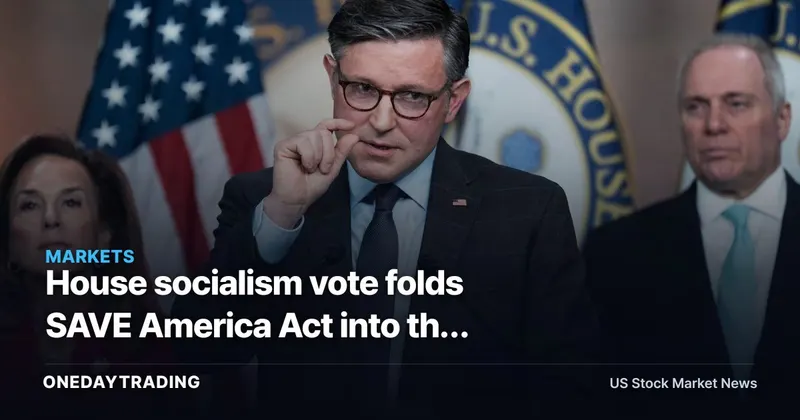
The House is preparing to vote on a measure condemning socialism, and Republicans have inserted a call to pass the SAVE America Act into that resolution. That makes the vote a bundled political message rather than a clean policy test.
The SAVE America Act is a voter-ID bill. Its presence inside a socialism resolution broadens the debate from ideology into election administration, which is why the measure is drawing attention beyond Capitol Hill. For investors, the point is not the bill itself but the fact that election-year messaging is being packed into House procedure.
Structural Background
This is not a first-order corporate or earnings story. The source names no company, no sector revenue exposure, and no direct fiscal number, so the read-through is second order: policy theater can move sentiment, but it does not by itself change margins, cash flow, or guidance.
The key distinction is between symbolism and implementation. A House vote that condemns socialism is a signal. A broader legislative push on voter-ID rules would be a different event, because then the issue moves from messaging into policy design and possible legal friction.
What does the House socialism vote mean for investors?
For investors, the House socialism vote mainly means election-year volatility can show up in policy headlines before it shows up in fundamentals. The immediate market effect should be limited unless the fight spreads into broader legislation or becomes a sustained procedural battle.
Stock & Sector Ripple
- Banks: mostly indirect exposure. A symbolic House vote does not alter net interest income, but louder election-year conflict can widen the political-risk discount on regulated sectors.
- Payments: little direct impact. The sector cares more about consumer activity and regulation than about a standalone voter-ID fight, though headline noise can affect sentiment.
- Media: higher near-term relevance. Political messaging can lift attention and ad inventory, but the effect is usually short-lived unless it escalates into a larger campaign story.
- REITs: no direct operating read-through. The only market link is through broader policy uncertainty if the debate spills into tax or regulatory expectations.
- Retail: indirect at best. Election-law rhetoric can color consumer sentiment, but this resolution does not change demand, pricing, or traffic on its own.
Bull vs Bear Scenarios
Bull case: The vote stays symbolic and clarifies the partisan frame ahead of November, which lowers uncertainty because investors can price it as messaging rather than policy execution.
Bear case: The SAVE America Act attachment turns the vote into a wider fight over election rules, extending political volatility and keeping policy risk in the headlines longer than the market wants.
Investor Action Points
- Watch whether the House vote stays symbolic or opens a larger procedural fight.
- Track whether the SAVE America Act gains traction beyond messaging.
- Keep election-sensitive sectors on a sentiment watchlist, especially media, banks, payments, retail, and REITs.
- Treat the headline as a policy-volatility event, not an earnings variable.
FAQ
What is the SAVE America Act?
The SAVE America Act is a voter-ID bill. Republicans attached a call to pass it to the socialism resolution, which turns the House vote into both a policy signal and an election-year message.
Why is the House voting on socialism now?
The source ties the vote to the November election. The timing suggests messaging discipline more than legislative urgency, with the resolution used to frame a partisan contrast.
Will this move stocks?
Probably not in a direct way. The House vote does not change company earnings, but it can add noise around election risk, and that matters most for politically sensitive sectors and sentiment-driven trading.
What should investors watch next?
Investors should watch whether the resolution remains symbolic or becomes a gateway to broader election-law debate. If that happens, the market impact shifts from headlines to a wider policy-risk premium.
📊 Analysis
Signal Neutral
Why The House vote is a political messaging event with no direct earnings or policy implementation shown in the source, so the market read-through is indirect and mainly about headline risk.
This article was independently written by OneDayTrading from public reporting. Read the original (CNBC)