At a Glance
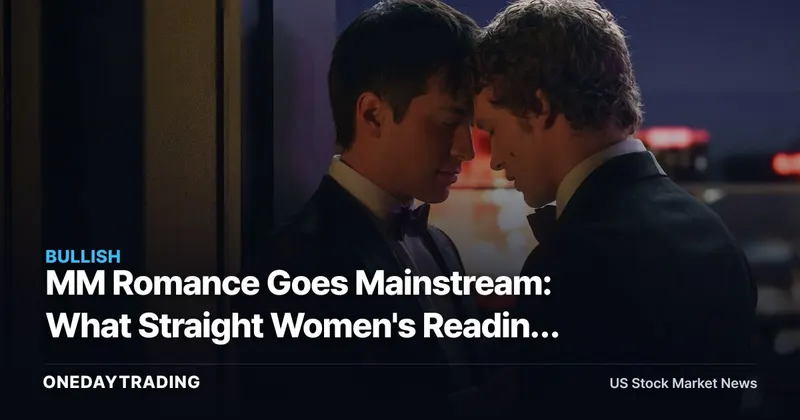
A content demographic story is quietly reshaping acquisition strategy on streaming platforms and publishing slates: straight women have become the dominant consumer base for MM (male-male) romance, a subgenre historically niche but now clearly moving mainstream. Titles like Red, White and Royal Blue — adapted for Amazon Prime Video — and Heated Rivalry illustrate how this audience is not a curiosity but a recurring, monetizable segment. For investors, the read-through lands hardest at AMZN, the only major platform that has already bet production capital on the trend.
Why It Matters Now
Olivia Bennett's framework starts with the shopper: straight women consuming MM romance are not a passive audience — they are active buyers of books, subscribers who select platforms based on library, and repeat viewers. That behavioral profile — high intent, genre-loyal, digitally engaged through communities like BookTok — maps directly to the metrics streaming CFOs care about: subscriber retention and content ROI per dollar of spend. When a content category generates organic community amplification without proportional marketing spend, the unit economics look meaningfully better than a standard tentpole acquisition.
Amazon's decision to greenlight Red, White and Royal Blue as a Prime Video original was an early validation of this thesis. The source confirms the audience extends well beyond the LGBTQ+ community itself — the core viewership is heterosexual women, a demographic that overlaps substantially with Prime's existing high-LTV subscriber base. That alignment reduces churn risk: content that locks in an already-paying subscriber is more valuable than content that acquires a new one at elevated CAC. The question for competitors — principally NFLX and Apple TV+ (AAPL) — is how quickly they fill the same content gap.
On the publishing side, the trend benefits whoever owns the backlist and the pipeline. HarperCollins, a division of News Corp (NWSA), and other legacy publishers have historically underweighted romance subgenres in their prestige marketing. If MM romance is moving from niche to mainstream, the implication is a revaluation of romance imprint economics — higher print runs, better royalty leverage, and adaptation rights that now attract streaming bids rather than being optioned cheaply. That is a margin-accretive shift, not merely a volume story.
FAQ
- Why are straight women the core audience for gay male romance? Genre scholars and the source both note that the appeal centers on emotional dynamics and narrative tension between leads, untethered from female-character tropes that some readers find limiting. The audience is buying a story structure, not simply identification with a protagonist.
- Which streaming platform benefits most directly? Amazon Prime Video has the clearest near-term claim — it produced and distributed Red, White and Royal Blue, giving AMZN first-mover data on viewership, completion rates, and subscriber behavior for this content type.
- Is this a durable trend or a BookTok moment? Genre loyalty in romance historically runs deep; readers in this category tend toward prolific consumption and series follow-through rather than one-off engagement, which supports duration of demand.
- What is the publishing analog to streaming competition? Rights for Heated Rivalry and comparable titles sit with independent or mid-tier publishers; as adaptation demand rises, major publishers will compete on advance rates, compressing margins at the acquisition stage.
Related Stocks and Sectors
- AMZN — Prime Video holds the most explicit asset in the space with its Red, White and Royal Blue adaptation; incremental content investment in the genre leverages an already-sunk production infrastructure.
- NWSA — News Corp's HarperCollins division benefits if MM romance demand lifts romance imprint revenue, print volume, and adaptation licensing fees across its backlist.
- NFLX — Lacks a flagship MM romance title in its current slate; the competitive gap is an opportunity cost that grows as AMZN establishes audience data advantages in the genre.
- AAPL — Apple TV+ competes for prestige original content; if the genre moves upmarket in production value, it becomes a viable target for Apple's quality-over-quantity slate strategy.
- META — BookTok, which lives on TikTok (private), is the primary organic amplification engine for the genre; Meta's Reels competes for that same creator community, making any shift in short-form video market share relevant to which platform captures genre discovery traffic.
What to Watch
- Amazon Prime Video viewership disclosures or third-party engagement data for Red, White and Royal Blue — completion rate and rewatch behavior would confirm or challenge the retention thesis.
- Slate announcements from NFLX, Apple TV+, or Max for MM romance originals, signaling competitive recognition of the audience segment.
- Publishing earnings from NWSA that break out romance imprint performance or adaptation licensing revenue — a line item shift here would quantify the mainstream crossover.
- BookTok and Goodreads trending data on MM titles: sustained shelf velocity across 2026 would indicate structural demand rather than a cycle peak.
Overall Outlook
The bull case is straightforward: a proven, monetizable audience segment with documented genre loyalty is under-served by major streaming platforms outside of AMZN, creating a content arbitrage opportunity for any platform willing to allocate production capital. If AMZN's Prime Video data supports the retention thesis internally, it will continue investing, widening its lead. The bear case — or at minimum the limiting factor — is that content trends driven by social-media amplification can plateau abruptly; BookTok has already cycled through several genre moments (romantasy, dark romance) without all of them translating into durable subscriber behavior. Valuation is a second-order risk: at current multiples, AMZN is not priced specifically for this content niche, meaning the upside is incremental rather than transformative unless the genre scales to the level of prestige drama or unscripted. The more testable question is on the publishing side, where a sustained rights-pricing escalation in MM romance would appear in adaptation licensing revenue within two to three earnings cycles.
Market data check: AMZN
AMZN last traded near $232.69 (+2.50%). Our composite signal — blending price momentum and news flow — reads 🟡 neutral. Price momentum scores 70/100 (firm).
Data as of publication. Price via market feeds; for reference only, not investment advice.
📊 Analysis
Signal Bullish
Why Documented mainstream crossover of MM romance consumption creates durable content demand that directly benefits AMZN Prime Video as first mover and pressures streaming competitors to fill the gap.
Tickers$AMZN$NWSA$NFLX$AAPL$META
This article was independently written by OneDayTrading from public reporting. Read the original (CNBC)