At a Glance
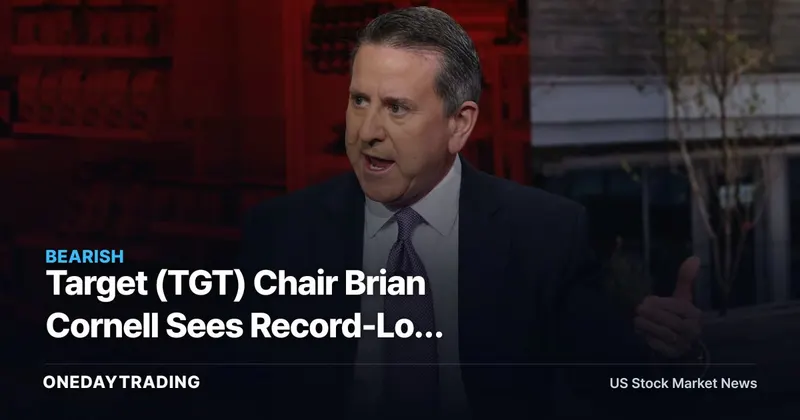
Shareholder support for Target chair Brian Cornell has dropped to the lowest level on record, with some investors framing his continued leadership as a reward for failure. The vote pressure lands on a company Cornell helped scale past 100 billion dollars in value, but one whose recent operating performance has lagged.
Why It Matters Now
Governance votes are usually a formality. When support for a long-tenured chair collapses to a record low, it signals that institutional holders have run out of patience with the explanation that weak results are temporary. For Target (TGT), the channel is concrete: investors who control large blocks of stock are using the proxy as the only lever they have to force a change in strategy, capital allocation, or leadership when the share price and traffic trends disappoint.
The deeper issue is that Cornell is both the architect of the modern Target and the face of its current slump. That dual role makes the protest vote symbolically loud but operationally messy. A retailer that built scale through grocery, owned brands, and same-day fulfillment now has to prove those advantages still convert into market-share gains rather than margin-dilutive promotions. Until comparable sales and merchandise margins stabilize, every governance event becomes a referendum on whether the board is holding management accountable.
For shareholders, the practical question is not whether Cornell survives a single vote, but whether the board responds with succession clarity, sharper targets, or capital returns. A record-low tally rarely removes a chair outright, yet it raises the cost of inaction.
FAQ
- What happened? Investor support for Target chair Brian Cornell fell to its lowest level ever, reflecting frustration over recent struggles and underperformance.
- Why are investors upset? Some view continued backing of a chair presiding over weak results as rewarding failure rather than demanding accountability.
- Does a low vote remove him? Typically no — such votes are advisory pressure, but a record-low result increases scrutiny on the board and on succession planning.
- What does it mean for the stock? Governance friction itself does not change earnings, but it spotlights the gap between Target's 100 billion-dollar scale and its current performance.
Related Stocks and Sectors
- Target (TGT) — the direct subject; leadership credibility and strategy execution are now under active investor scrutiny.
- Walmart (WMT) — the scale competitor whose grocery and value positioning has pressured Target's traffic, making relative performance a key benchmark.
- Costco (COST) — membership-driven consistency highlights the volatility in Target's discretionary-heavy mix.
- Big-box and general retail sector — discretionary-exposed names share Target's sensitivity to cautious consumer spending and promotional pressure.
What to Watch
- Next quarterly results: comparable sales, traffic versus ticket, and merchandise margin trend.
- Any board statement on succession planning or governance changes following the vote.
- Capital allocation signals — buyback pace, dividend posture, and inventory discipline.
- Relative share performance against Walmart and Costco as a read on share shifts.
Overall Outlook
The bull case rests on Target's installed scale: a 100 billion-dollar footprint, owned brands, and fulfillment assets that can re-accelerate if discretionary demand recovers and management tightens execution. The risk case is that a record-low support vote reflects a structural credibility problem, not a one-quarter stumble, and that pressure on the chair distracts from the merchandising fixes the business actually needs. The decisive variable is whether the next set of operating metrics shows stabilization or continued share loss.
Market data check: TGT
TGT last traded near $132 (+0.96%). Our composite signal — blending price momentum and news flow — reads 🟡 neutral. Price momentum scores 58/100.
Data as of publication. Price via market feeds; for reference only, not investment advice.
📊 Analysis
Signal Bearish
Why Record-low investor support for the chair underscores ongoing underperformance and governance pressure, a negative signal for TGT sentiment.
This article was independently written by OneDayTrading from public reporting. Read the original (CNBC)