Key Takeaways
Fiserv's abrupt CEO departure crystallizes a credibility problem, not just a price problem: a 71% stock decline during a short tenure signals the market has lost confidence in the strategy, not merely the quarter. For investors, the read-through is that payments incumbents without a clear growth narrative are being repriced, and leadership transitions at scale rarely fix execution overnight.
What Happened
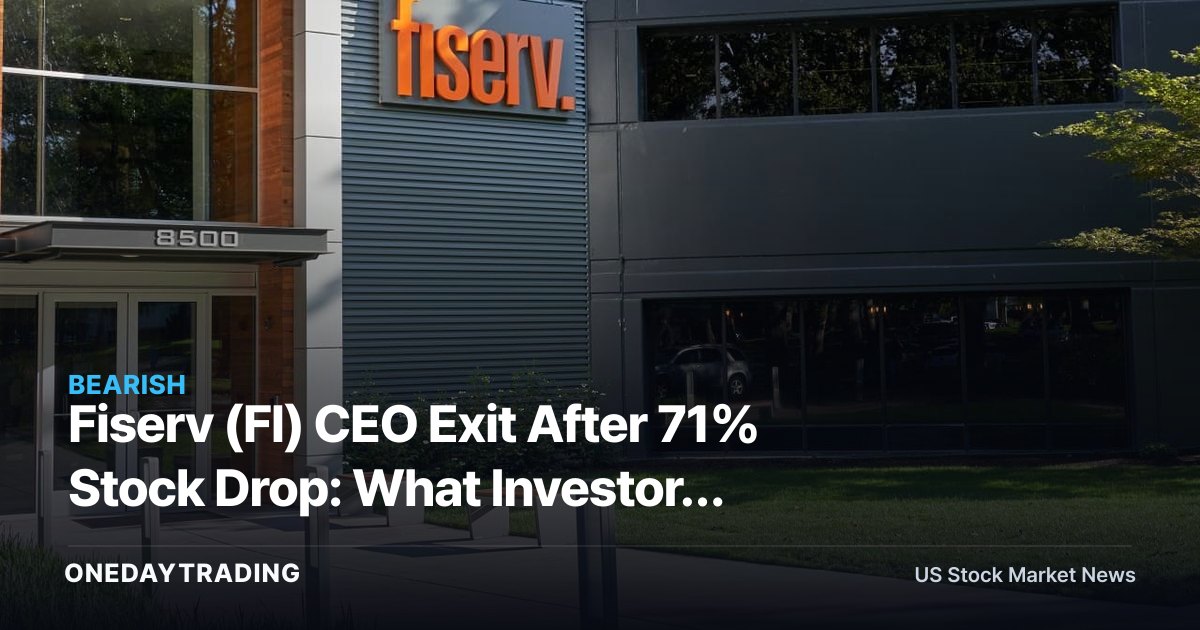
The chief executive of Fiserv is stepping down after overseeing a 71% slide in the company's share price over a brief period in the role. The exit lands while the stock continues to fall, suggesting the resignation is being read by the market as confirmation of internal trouble rather than a clean reset.
An analyst characterized the financial-services and payments processor as continuing to look strategically adrift. That phrasing matters: it points to a perceived absence of direction on capital allocation, product roadmap, and competitive positioning rather than a single operational miss. When the narrative shifts from execution to strategy, the multiple the market is willing to pay tends to compress further.
Background and Context
Fiserv sits at the center of merchant acquiring, card processing, and core banking technology, businesses that are cash-generative but increasingly contested. A 71% drawdown of this magnitude in a large-cap payments name is unusual and reflects compounding concerns: decelerating organic growth perceptions, integration questions across its merchant and fintech platforms, and skepticism that the firm can defend share against more nimble payment networks and software-led rivals.
Market and Stock Impact
- Fiserv (FI) — The immediate subject. Leadership uncertainty raises the equity risk premium; until a permanent CEO and a refreshed strategy are articulated, the stock may trade on sentiment rather than fundamentals, and continued declines after the news show buyers are not yet stepping in.
- Fidelity National Information Services (FIS) — Direct peer in core banking and payments. A high-profile stumble at one incumbent invites investors to reassess the whole legacy-processor cohort on growth durability and management quality.
- Global Payments (GPN) — Another merchant-acquiring peer; sector de-rating pressure can spill over even when company-specific results differ, as the market questions terminal growth across traditional acquirers.
- PayPal (PYPL) and Block (XYZ) — Fintech challengers positioned as share-takers; incumbent disarray strengthens the bull thesis that newer platforms are winning merchant and consumer payment flows.
Investor Checkpoints
- Permanent CEO appointment and the strategic plan unveiled alongside it — interim leadership tends to cap any re-rating.
- The next earnings report: organic revenue growth, merchant volume trends, and whether guidance is reset lower or reaffirmed.
- Capital allocation signals — buyback pace, debt levels, and any divestiture or restructuring announcements that address the adrift critique.
- Analyst rating and price-target revisions in the days after the exit, which gauge whether the Street sees value or a falling knife.
Outlook
The bull case is straightforward: a 71% decline can leave a profitable, cash-flowing processor trading at a discounted multiple, and a credible new leader with a sharper plan could unlock a recovery from depressed expectations. The risk is equally clear — a leadership vacuum amid an unconvincing strategy can let declines feed on themselves, and structurally slowing growth in legacy payments is not solved by a personnel change alone. The decisive variable is whether the board pairs a new CEO with a concrete, measurable turnaround, not just a fresh face.
📊 Analysis
Signal Bearish
Why A CEO exit confirming a 71% stock collapse and an analyst calling the firm strategically adrift, with shares still falling, is a clear negative catalyst.
Tickers$FI$FIS$GPN$PYPL$XYZ
This article was independently written by OneDayTrading from public reporting. Read the original (MarketWatch)