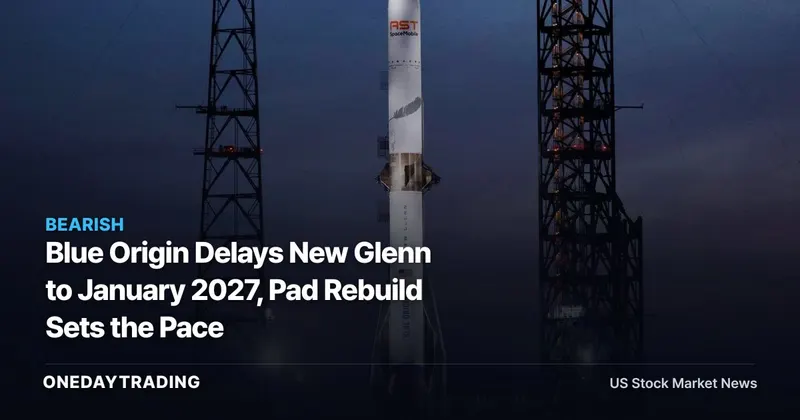
Blue Origin’s New Glenn Delay at a Glance
Blue Origin has delayed New Glenn’s return to flight to January 2027, shifting the aerospace investment question from rocket availability to whether a reconstructed Cape Canaveral launch pad can support a durable operating cadence. For investors exposed through Amazon’s Leo deployment or the broader launch industry, the immediate read-through is bearish: physical infrastructure remains the constraint, while the timing of a successful return is still uncertain.
CNBC reported that the January 2027 timeframe is about 10 days later than Blue Origin’s earlier target. The move is modest on the calendar, but it confirms that the launch system cannot return on the December schedule previously expected.
A return to flight is the resumption of launches after work intended to address the conditions surrounding an earlier failure. In this case, the work follows a May explosion during a New Glenn hot-fire test that badly damaged Blue Origin’s Florida launchpad.
Why the Cape Canaveral Rebuild Controls the Schedule
The central issue is not simply whether New Glenn itself can operate. A launch requires the rocket and its ground infrastructure to function as one system, so a repaired vehicle cannot restore service while the pad remains unavailable or its revised configuration is incomplete.
Dave Limp, CEO of Blue Origin, told employees that reconstruction delays, including bad weather over the summer, pushed the launch timing. The company has repaired the facility and reworked its pad configuration, making the next flight an operational test of both the rocket and the rebuilt ground system.
That distinction matters for the capital cycle. Blue Origin’s announced investment in its Florida facilities targets multiple flights per week by the end of the decade, an objective that requires more than a single successful return. The facilities must support repeated preparation and launch activity; the January 2027 mission therefore represents an early checkpoint for a much larger capacity ambition, not proof that the ambition has been achieved.
Limp described the return as the company’s top priority and acknowledged that rebuilding at this pace had been difficult. He also said Blue Origin completed work in six months that many expected would take years. Those comments establish management’s urgency, while the schedule change shows why execution evidence must carry more weight than the pace claimed in an internal assessment.
Amazon Leo Bears the Clearest Customer-Side Exposure
Amazon was slated to deploy 48 satellites for its Leo service a few days after the May explosion, directly linking the pad damage to a planned customer mission. Because Amazon relies on Blue Origin for part of Leo’s launch program, unavailable New Glenn capacity narrows one route for moving those satellites toward deployment.
Amazon has used United Launch Alliance and Arianespace in the interim. That response reduces dependence on New Glenn for every launch, though it does not erase the significance of Blue Origin’s assigned share of the program. The operating question is whether those alternative providers can continue covering missions while the January 2027 timeframe remains subject to change.
For investors, the mechanism is scheduling rather than a disclosed financial charge. Delayed Blue Origin capacity can keep Amazon reliant on other providers, while a successful return could restore another launch path for Leo. The fact sheet provides no repair cost, launch economics or measurable income-statement effect, so a stronger company-specific earnings conclusion would outrun the available evidence.
New Glenn’s Competitive and Government Stakes
- Commercial launch capacity: Blue Origin is working to raise its launch cadence while SpaceX is described as its chief rival. The relevant test is whether New Glenn can progress from returning to flight to supporting repeat missions.
- Amazon’s provider mix: United Launch Alliance and Arianespace have supplied alternatives for Leo. Continued diversification may cushion scheduling risk, while dependence on substitutes also highlights the capacity New Glenn has not yet restored.
- NASA program execution: NASA has awarded Blue Origin contracts connected to the Artemis program, including a lunar lander. A New Glenn return would not by itself establish performance on every Artemis obligation, though launch-system reliability and infrastructure readiness remain relevant indicators of execution discipline.
- Cadence credibility: Blue Origin’s target of multiple flights per week by the end of the decade is a plan, not an achieved rate. The gap between one return mission and sustained high-frequency operations is the core industrial risk.
The Bull Case and the Execution Risk
The constructive case starts with completed physical work. Blue Origin repaired the launch facility, changed the pad configuration and continued its return-to-flight effort after severe damage. A January 2027 launch would demonstrate that the reconstructed site can again support New Glenn and could reopen the company’s planned role in Leo missions.
The countercase is that a narrow calendar adjustment does not define the full technical or operating risk. The exact January 2027 launch date is unknown, as are the repair cost and precise extent of the pad damage. The timeframe may change again, leaving investors without a fixed date on which to assume capacity returns.
There is also a scale question. One mission can validate a return to service, but it cannot establish the repeatability required for multiple flights per week by the end of the decade. The stronger signal would be a sequence in which pad readiness, rocket operations and customer missions proceed without another infrastructure-driven interruption.
What Investors Should Check Before New Glenn Flies Again
- A firm launch date: The present guidance extends only to January 2027. Confirmation of an exact date would narrow the scheduling uncertainty without guaranteeing a launch.
- Pad readiness: The next meaningful disclosure is whether Blue Origin’s repaired facility and revised configuration are ready to support the return mission.
- The Leo assignment: Investors should check whether the next New Glenn flight carries the Amazon Leo mission that was disrupted after the May test or whether Amazon continues using United Launch Alliance and Arianespace.
- Evidence of repeatability: After any return flight, the key industrial indicator is preparation for another mission. That would begin to test whether Blue Origin’s Florida investment can move toward its end-of-decade cadence target.
New Glenn’s January 2027 Investment Read-Through
The delay is negative because it extends the period in which Blue Origin lacks operational New Glenn capacity and Amazon must manage Leo launches through a broader provider mix. Its severity is limited by the reported 10-day shift in the January 2027 timeframe and by the reconstruction work already completed.
The decisive evidence will come from the hardware and the pad. A completed flight would address the immediate return-to-service question; subsequent mission preparation would test whether Blue Origin has built dependable capacity rather than delivered a one-off recovery. Until those checkpoints arrive, the physical rebuild is real, the timetable is provisional, and the multiple-flights-per-week objective remains an unproven target.
📊 Analysis
Signal Bearish
Why The delay extends execution risk for Blue Origin and keeps Amazon’s Leo deployment dependent on alternative launch providers.
This article was independently written by OneDayTrading from public reporting. Read the original (CNBC)