What Changes
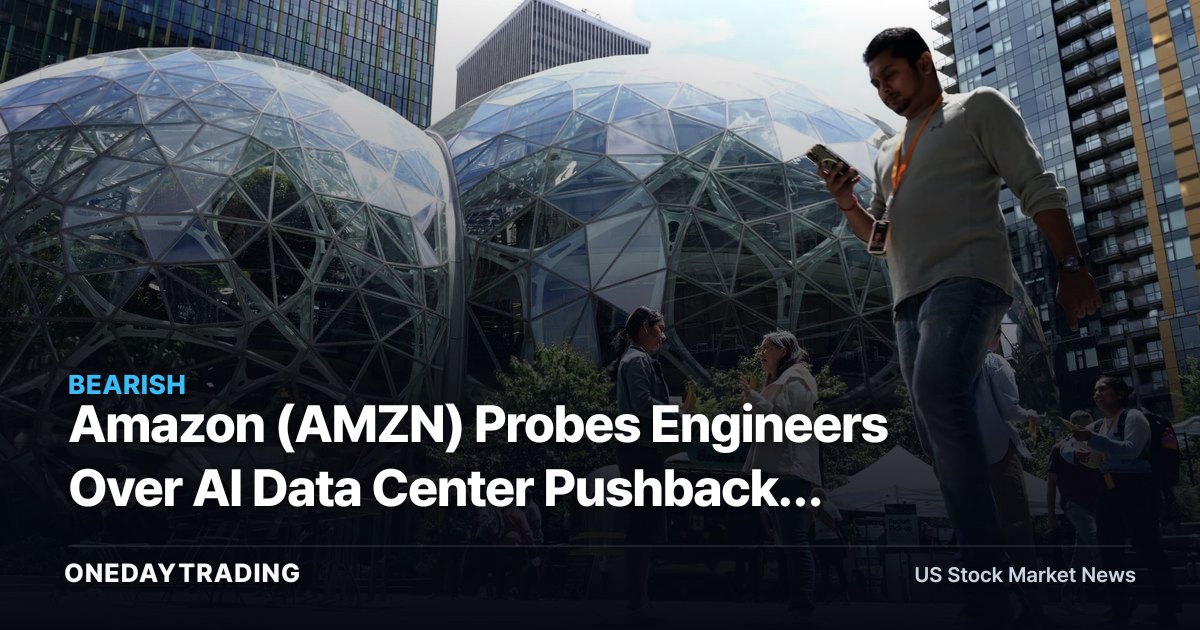
The headline reads like an internal HR matter, but for investors the real signal is structural. AI compute growth depends on a physical pipeline of power, land, water and municipal approval — and that pipeline is now drawing organized local resistance, in this case backed by Amazon's own engineers. When a city the size of Seattle openly debates a year-long construction pause, it puts a clock on the assumption that hyperscalers can scale capacity wherever and whenever demand appears.
For Amazon, AWS is the profit engine that funds the rest of the company, and data center throughput is the gating factor on how fast that engine can grow into AI demand. Anything that slows permitting or siting pushes capacity online later, raises the cost per megawatt, or forces buildout into less optimal regions. The employee investigation also carries reputational weight: it converts an internal dissent story into a public governance question at a moment when Big Tech labor scrutiny is already elevated.
By the Numbers
The concrete facts are narrow but pointed: five Amazon employees testified, the city sought feedback on a proposed one-year construction pause, and the events took place at Seattle City Council meetings. There are no disclosed financial figures here — which is precisely why the read-through matters. The market prices hyperscaler capex on the belief that construction timelines are reliable; a 12-month pause in a major metro is a tangible variable against that assumption.
Winners & Losers
- Amazon (AMZN) — most exposed. AWS capacity expansion is the growth thesis; local pauses and a public dissent fight add timeline and reputational friction.
- Microsoft (MSFT), Alphabet (GOOGL), Meta (META) — same structural risk. All are racing to add AI data centers and face identical power, water and permitting bottlenecks in contested jurisdictions.
- Nvidia (NVDA) — indirect drag. If buildout slows on the ground, GPU deployment timing — not just order books — becomes the bottleneck.
- Power and grid suppliers — mixed. Constrained urban siting can push demand toward firms that solve power and cooling, but pauses also delay near-term orders.
Risk Check
- This is a single-city, single-company episode; it is not yet evidence of a broad national permitting freeze.
- No financial guidance was changed — the capex impact is potential, not confirmed.
- The employee probe could resolve quietly and fade from the narrative without affecting timelines.
- Demand for AI compute remains strong, which gives hyperscalers incentive to route around any single jurisdiction.
Bottom Line
The financial damage today is negligible, but the precedent is the point: local resistance and internal dissent are becoming measurable inputs to the AI capex cycle that underpins AMZN, MSFT, GOOGL and the NVDA supply chain. Watch whether Seattle's pause is adopted, whether similar measures spread, and whether hyperscalers flag siting or permitting as a constraint on the next earnings calls.
Market data check: AMZN
AMZN last traded near $243.69 (+2.61%). Our composite signal — blending price momentum and news flow — reads 🟡 neutral. Price momentum scores 71/100 (firm).
Data as of publication. Price via market feeds; for reference only, not investment advice.
📊 Analysis
Signal Bearish
Why Local construction pauses and a public employee-dissent probe introduce timeline and reputational friction to Amazon's AI data center buildout, the core driver of AWS growth.
Tickers$AMZN$MSFT$GOOGL$META$NVDA
This article was independently written by OneDayTrading from public reporting. Read the original (CNBC)