Summary
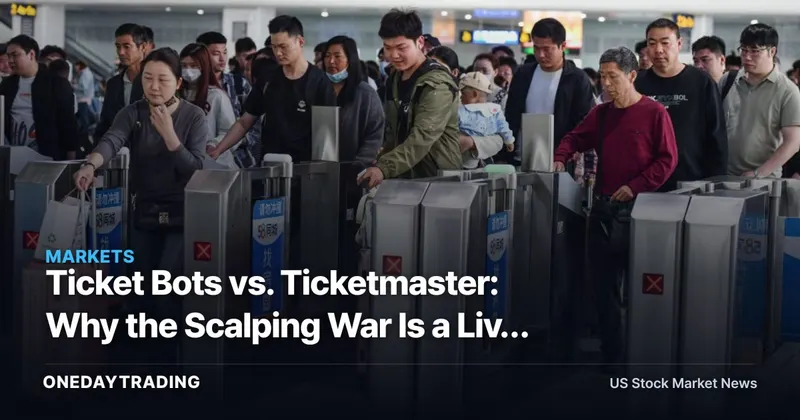
Bots that buy tickets faster than humans have moved from a fan grievance to a structural problem spanning concerts and even train reservations. For investors, this is less a technology story than a question of who captures the resale spread — and how much regulation will reshape it. The exposed names sit across the live-event and ticketing chain, led by Live Nation.
The Full Story
The complaint is familiar: automated software snaps up inventory the instant it goes on sale, then the same seats reappear on resale markets at a markup. The sharper point is that bots are only part of the problem. The economics reward whoever controls scarce inventory at the moment of sale, and that incentive does not vanish when you ban a script.
Ticketmaster, owned by Live Nation, sits at the primary sale and frequently re-collects fees on the resale leg too. That dual exposure is the crux. Bot-driven scarcity inflates the visible price fans pay, which feeds political pressure — yet the same volume drives the per-ticket fee income that underpins the ticketing segment.
The gap between face value and resale clearing price is the prize. Bots are the tool used to capture it; brokers and resale platforms monetize it. That is why enforcement aimed only at bots tends to disappoint — it attacks the instrument, not the arbitrage.
Structural Background
The U.S. live-event market is concentrated, with Live Nation combining promotion, venue operations and ticketing. The 2024 federal antitrust suit against Live Nation and Ticketmaster put that integration under direct legal scrutiny. Resale, meanwhile, is fragmenting across StubHub, Vivid Seats and independent brokers, each dependent on a steady supply of marked-up inventory.
Stock & Sector Ripple
- Live Nation (LYV) — the subject. Fee income scales with ticket volume and price, so near term it rides demand; longer term it carries the heaviest regulatory and reputational risk as the face of the system.
- StubHub (STUB) — pure resale take-rate model; its revenue is the markup bots help create, leaving it directly exposed to any cap on resale prices or fees.
- Vivid Seats (SEAT) — smaller resale marketplace with the same dependency on the price gap and a thinner cushion to absorb fee rules.
- Payments and platforms — every transaction routes through card networks and processors, a quiet beneficiary of higher all-in ticket prices regardless of who wins the fan fight.
Bull vs Bear Scenarios
Bull: live demand stays strong, anti-bot and verified-fan systems let incumbents keep more resale value in-house, and Live Nation turns enforcement into a moat that favors scale. Bear: legislation caps resale prices or service fees, the antitrust case forces structural separation of ticketing from promotion, and the high-margin fee stream compresses just as scrutiny peaks.
Investor Action Points
- Track Live Nation segment disclosure for ticketing fee revenue and per-fan economics, not just concert attendance.
- Watch the federal antitrust case calendar — any remedy touching Ticketmaster ownership is the dominant variable.
- Monitor state and federal bills on bot bans and resale fee caps; pricing rules hit StubHub and Vivid Seats hardest.
- For resale names, follow take-rate and gross transaction trends as the cleanest read on whether the spread is holding.
Market data check: LYV
LYV last traded near $179.46 (+2.48%). Our composite signal — blending price momentum and news flow — reads 🟡 neutral. Price momentum scores 70/100 (firm).
Data as of publication. Price via market feeds; for reference only, not investment advice.
📊 Analysis
Signal Neutral
Why The bot and scalping spotlight cuts both ways for Live Nation and resale platforms — supporting near-term fee volume while raising regulatory and antitrust risk, with no clear directional catalyst.
This article was independently written by OneDayTrading from public reporting. Read the original (CNBC)