At a Glance
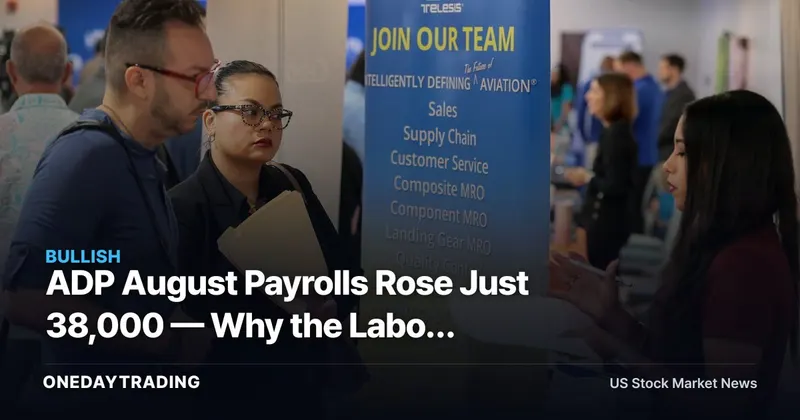
ADP private payrolls increased by 38,000 in August, according to CNBC’s report, marking the smallest monthly gain since January and undershooting expectations. The signal matters because a cooler labor market can lower pressure on the Federal Reserve to keep interest rates elevated, supporting rate-sensitive equity multiples while challenging lenders and economically cyclical shares.
ADP’s private-payroll measure tracks employment at nongovernment employers; it is an early labor-market indicator, not the government’s monthly employment report. The immediate read-through is slower hiring, not a confirmed contraction in total employment.
Why It Matters Now
The transmission runs from jobs to rates, then from rates to valuation. A 38,000 increase gives bond investors another reason to price less urgency for additional tightening, although the source provides no new inflation data or Federal Reserve guidance. Lower expected rates reduce the discount applied to future cash flows, a mechanism that tends to favor long-duration technology and growth stocks.
The market has already absorbed the headline that hiring is cooling; the unresolved question is whether August represents a one-month floor or the next leg of a broader slowdown. CNBC described the gain as positive but the weakest since January, framing deterioration in momentum rather than outright job losses. If subsequent labor data confirms deceleration without a sharp rise in unemployment, equities could receive a soft-landing boost. If hiring weakens alongside consumer demand, earnings estimates become the larger risk.
Key Debates
- How much does ADP move Fed expectations? The 38,000 figure eases labor-market pressure, but monetary policy also depends on inflation and the official jobs report.
- Is the slowdown valuation-positive? Falling-rate expectations can lift multiples, yet a persistent hiring decline would eventually pressure revenue across cyclical industries.
- What did the market already price? Investors commonly anticipate moderation after a long expansion; the surprise lies in the pace, which was the weakest since January.
- Where is the asymmetry? Growth stocks gain from lower discount rates, while banks face pressure if falling yields narrow lending spreads.
Related Stocks & Sectors
- Microsoft (MSFT): A lower-rate backdrop can support the valuation of cloud and software cash flows, though enterprise hiring weakness could restrain technology budgets.
- Nvidia (NVDA): The AI infrastructure leader is sensitive to its premium multiple; easier-rate expectations help valuation, while a broad economic slowdown could test customer capital spending.
- JPMorgan Chase (JPM): Banks may benefit from resilient employment and credit quality, but lower rates can compress net interest margins.
- QQQ and growth equities: Nasdaq-oriented portfolios typically respond positively to declining discount rates, with performance hinging on whether earnings remain intact.
What to Watch
- The next official U.S. employment report for confirmation of August hiring momentum.
- Upcoming consumer-price data, which determines whether softer payrolls translate into a credible easing case.
- Federal Reserve communications and the policy-rate path, especially any change in the threshold for further tightening.
- Technology spending guidance and bank net-interest-margin commentary in the next earnings cycle.
Overall Outlook
The August ADP report is mildly bullish for rate-sensitive equities because it weakens the case for higher rates, but it is not an all-clear for risk assets. The bull case is a controlled cooling that lets inflation moderate without breaking demand. The risk is that 38,000 jobs becomes an early warning of a sharper employment and earnings slowdown; the official payroll report and inflation data will decide which probability gains weight.
FAQ
Why did ADP private payrolls rise only 38,000 in August?
ADP reported a 38,000 increase in private-sector employment in August, the smallest gain since January. CNBC characterized the result as evidence of broader labor-market slowing, while still noting that job creation remained positive.
What does the August ADP report mean for Federal Reserve interest rates?
Slower private hiring reduces pressure for additional rate increases because labor demand appears less overheated. The report alone cannot determine policy; inflation readings and the official employment report remain decisive inputs.
Which stocks benefit if weaker jobs data lowers interest-rate expectations?
Long-duration growth shares such as Microsoft and Nvidia can benefit when discount rates fall because more of their valuation depends on future cash flows. Banks such as JPMorgan face a different channel, as lower yields can reduce net-interest-margin support even if credit losses stay contained.
📊 Analysis
Signal Bullish
Why The weakest ADP payroll gain since January lowers near-term pressure for further Federal Reserve tightening, supporting rate-sensitive growth valuations while leaving cyclical and bank risks conditional on whether the slowdown deepens.
This article was independently written by OneDayTrading from public reporting. Read the original (CNBC)