What Changes
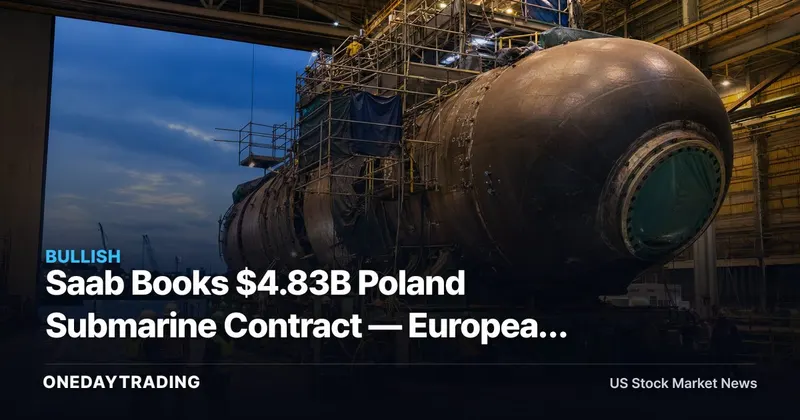
Poland has assembled one of NATO's most aggressive defense build-outs over the past three years, and a submarine contract at this scale is not a line item — it is a structural industrial commitment. Submarine programs carry 10-to-15-year delivery timelines, generate sustained maintenance and upgrade revenue that can equal or exceed the original contract value, and almost never get cancelled once construction begins. For Saab, the $4.83 billion order converts directly into backlog density that supports revenue visibility well into the next decade. The operative question is whether Saab's shipbuilding capacity — submarines are among the most manufacturing-intensive platforms in defense, requiring precision steelwork, propulsion integration, and acoustic-dampening systems assembled in sequence — can absorb the contract without schedule pressure, because in fixed-price defense work, late delivery erodes margins faster than any cost overrun.
For U.S. defense majors, this outcome matters beyond one lost competition. General Dynamics' Electric Boat and Huntington Ingalls Industries constitute the only two U.S. shipbuilders capable of delivering military submarines. Poland's decision to route $4.83 billion to a Swedish industrial base rather than either of those two is consistent with a structural pattern now visible across multiple European procurement cycles: as rearmament accelerates, NATO allies are deliberately building regional supplier relationships over U.S. dependency. That is a durable headwind for HII and GD's international naval pipeline, not a one-off outcome.
By the Numbers
At $4.83 billion, this is a contract large enough to reshape Saab's forward revenue profile materially. Milestone-based revenue recognition — spread across design phases, detailed engineering, hull construction, sea trials, and final acceptance — means the income flows over years rather than landing immediately. But the conversion quality is high by defense standards: government submarine programs have among the lowest cancellation rates of any major platform category. The critical disclosure investors still lack is contract structure. A fixed-price arrangement shifts cost-overrun risk entirely onto Saab; a cost-plus structure preserves margin but signals lower government confidence in the budget. That distinction will define whether this win is as clean as the headline number implies.
Winners & Losers
- SAABF (Saab) — Direct primary winner; $4.83B adds decade-long backlog with high-confidence revenue conversion, reinforcing Saab's credibility for future European naval competitions.
- European defense supply chain — Sub-tier manufacturers in steel, sonar electronics, and propulsion systems that partner with Saab stand to capture substantial secondary contract value across the program life.
- HII (Huntington Ingalls Industries) — Indirect loser; the result confirms European allies are not routing submarine spend toward U.S. shipyards, directly narrowing HII's international growth narrative.
- GD (General Dynamics) — Electric Boat's European market case weakens further; Poland's choice reinforces that the international submarine market is structurally closed to U.S. primes outside direct U.S. government-to-government arrangements.
- LMT (Lockheed Martin) — Peripheral risk if Poland's multi-year budget allocation to submarine construction crowds out future procurement of U.S.-supplied air and missile platforms in defense budget cycles ahead.
Risk Check
- Production capacity ceiling — Submarine construction is low-volume and high-complexity; Saab may require new facility investment to meet delivery schedules, introducing both capital expenditure drag and schedule slippage risk.
- Cost-overrun precedent — Military submarine programs globally carry a well-documented history of exceeding initial cost estimates; under a fixed-price structure, that exposure sits entirely on Saab's income statement.
- Polish fiscal sustainability — Poland's defense-to-GDP ratio has been exceptionally elevated; a future political shift or fiscal consolidation could trigger contract restructuring, though outright program cancellation remains rare once hull construction begins.
- Multi-year FX exposure — Saab reports in Swedish kronor; a contract priced in euros or zloty introduces sustained currency translation risk that can distort margin visibility even when operational execution is on track.
Bottom Line
A $4.83 billion submarine order is a decade-defining backlog event for Saab — the revenue is real, the strategic signal is unambiguous, and the competitive read-through for HII and GD is negative in a way that one quarter's results will not reverse. The upside case rests on contract structure and production throughput: if the terms are cost-plus and Saab has adequate shipyard capacity, margin on this backlog is genuinely attractive. The live risk is execution — submarine programs punish bottlenecks with compound margin erosion, and Saab's ability to deliver on schedule without a cost spiral is the variable no announcement resolves. Watch for contract-structure disclosure and Saab's next production capacity guidance; those two data points will tell investors whether this is a decade of durable earnings or a headline the delivery timeline eventually complicates.
Market data check: SAABF
SAABF last traded near $50.5 (+0.60%). Our composite signal — blending price momentum and news flow — reads 🟡 neutral. Price momentum scores 55/100.
Data as of publication. Price via market feeds; for reference only, not investment advice.
📊 Analysis
Signal Bullish
Why A $4.83B submarine contract adds decade-long, high-confidence backlog to Saab's revenue pipeline at the peak of European defense procurement acceleration, with minimal cancellation risk once construction begins.
This article was independently written by OneDayTrading from public reporting. Read the original (Investing.com)