At a Glance
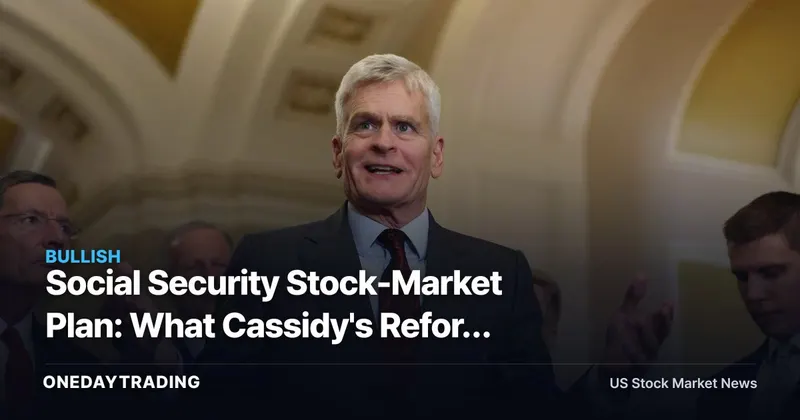
Sen. Bill Cassidy says he has a plan to shore up Social Security by investing on the program's behalf in the stock market, an idea he intends to push in his final days in office as the program faces an imminent funding shortfall. For investors, the signal is not the bill's odds of passing but the policy channel it reopens: routing a slice of one of the world's largest entitlement programs into equities.
Why It Matters Now
Social Security has historically held its trust-fund reserves in special-issue U.S. Treasurys, not equities. Any move to invest even a fraction of those flows in stocks would create a large, price-insensitive, long-duration buyer — the kind of structural demand that tends to support valuations across the broad market rather than any single name. That is why a sovereign-style equity allocation, even as a proposal, draws attention to index-tracking vehicles and the firms that run them.
The mechanics matter more than the headline. A government-managed equity pool would almost certainly be deployed through low-cost, broad-based index strategies to avoid stock-picking and political controversy. That funnels the benefit toward scaled passive managers and custodians — firms whose economics are driven by assets under management and servicing fees, not active outperformance. The flip side is governance risk: critics of public equity ownership cite concerns over state influence on corporate voting and the exposure of retirement benefits to market drawdowns.
Crucially, this is a late-term proposal from a departing senator, not enacted law. The probability of near-term passage is low, and the funding gap itself is the more durable market variable — it pressures long-term fiscal math, Treasury issuance, and the entitlement debate that shapes rate expectations.
FAQ
- What is the core idea? Investing Social Security assets in the stock market to generate higher returns and help close the program's projected shortfall, rather than relying solely on Treasury holdings.
- Who benefits if it happens? Large index-fund and asset-servicing firms positioned to manage or custody government equity flows.
- What is the main risk? Market downturns would directly hit retirement reserves, and public equity ownership raises corporate-governance and political concerns.
- Is this likely soon? No — it is a proposal from a senator leaving office, with no guarantee of legislative traction.
Related Stocks & Sectors
- BlackRock (BLK) — the largest index and ETF manager; any mandate steered into passive equities favors scaled, low-fee providers.
- State Street (STT) — major custodian and SPDR ETF sponsor; benefits from both fund management and asset-servicing flows.
- Broad index ETFs (SPY, VOO) — direct proxies for the kind of diversified exposure a public fund would seek.
- Asset management sector — structurally levered to AUM growth from large new institutional inflows.
What to Watch
- Whether the proposal attracts co-sponsors or committee support before the senator's term ends.
- Updated Social Security Trustees projections on the shortfall timeline, the harder market variable.
- Any specified allocation size or percentage — the scale determines real flow impact.
- Treasury-market reaction, since shifting reserves out of special-issue bonds touches federal financing.
Overall Outlook
The bull case is straightforward: a permanent, mechanical equity buyer of this magnitude would be a long-run tailwind for broad indices and the managers that intermediate the flows. The countervailing reality is that this remains an early-stage idea with steep legislative odds and genuine downside — exposing retirement benefits to equity volatility and inviting governance disputes. Treat it as a directional policy signal worth tracking, not a near-term flow event to position around.
📊 Analysis
Signal Bullish
Why A proposal to channel Social Security funds into equities implies a large new structural buyer that would favor broad indices and scaled asset managers, though passage is uncertain.
This article was independently written by OneDayTrading from public reporting. Read the original (CNBC)