What Changes
Affirm (AFRM) surged because investors treated the strong outlook as evidence that merchant demand and consumer use can hold up even as inflation bites. For a buy now pay later platform, the revenue mechanism starts at checkout: if shoppers still complete purchases, Affirm (AFRM) can keep feeding transaction volume through retail, travel, and e-commerce partners.
The pressure point is not abstract inflation; CNBC reported the national average gasoline price at $4.09 per gallon, and CNBC reported gasoline was last below $3 on March 2. That matters because fuel is a frequent purchase, so higher gas prices reduce the cash left for discretionary baskets before a shopper ever reaches an Affirm (AFRM) payment option.
Olivia Bennett read: the stock move says the market is paying for resilience, not ignoring stress. The shopper may use installment credit to smooth the hit, but the lender still has to prove that demand growth does not arrive with weaker repayment behavior or lower-quality volume.
By the Numbers
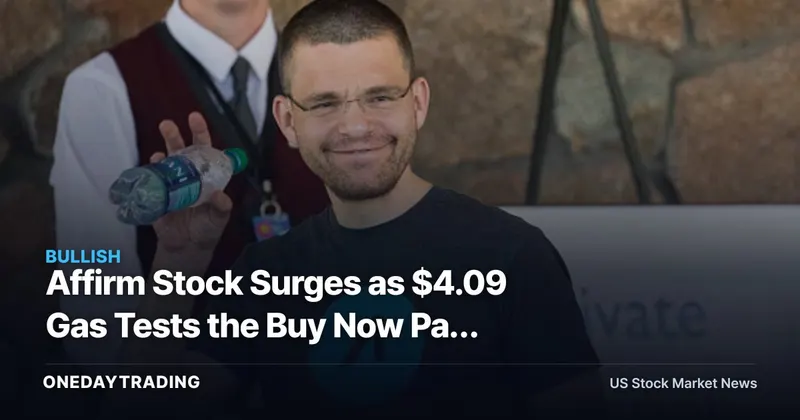
CNBC reported Affirm (AFRM) surged on a strong outlook, but CNBC did not provide a percentage move in the supplied source. CNBC also reported Affirm (AFRM) CEO Max Levchin said high gas prices are hitting U.S. shoppers, which frames the outlook around consumer cash flow rather than only fintech adoption.
CNBC reported the U.S. national average gasoline price was $4.09 per gallon, and CNBC reported the national average gasoline price was last below $3 on March 2. The gap between those two fuel-price markers is the consumer balance-sheet story behind the Affirm (AFRM) stock reaction.
Winners & Losers
- Affirm (AFRM): Affirm (AFRM) benefits if a strong outlook reflects durable checkout demand, but Affirm (AFRM) faces risk if $4.09 gasoline shifts users from discretionary financing to necessity-driven borrowing.
- PayPal (PYPL): PayPal (PYPL) competes in digital payments and installment checkout, so stronger Affirm (AFRM) demand can validate the category while pressuring take-rate discipline across payment platforms.
- Block (SQ): Block (SQ) is exposed to consumer payment flows, and high gas prices can redirect wallet share away from merchants that depend on discretionary traffic.
- Retail and e-commerce: Retailers using financing options can protect conversion when shoppers feel fuel pressure, but higher gasoline costs can still shrink baskets before payment choice matters.
Risk Check
- Affirm (AFRM) bulls need the next company update to show the strong outlook is supported by transaction quality, not only higher checkout usage.
- Affirm (AFRM) bears need evidence that $4.09 gasoline is translating into weaker consumer repayment or softer discretionary demand.
- Affirm (AFRM) valuation risk rises when the stock surges before investors can see whether high gas prices change credit behavior.
- Affirm (AFRM) can still gain share if merchants lean harder on buy now pay later tools to defend conversion during consumer stress.
Bottom Line
Affirm (AFRM) has a bullish catalyst in a strong outlook, but the cleaner checkpoint is whether the next earnings commentary separates healthy payment demand from gasoline-driven budget strain. If U.S. gasoline stays around $4.09 per gallon, Affirm (AFRM) must prove that growth comes with controlled credit risk and not just a shopper stretching harder.
FAQ
Why did Affirm stock surge after the CNBC report?
Affirm (AFRM) stock surged after CNBC reported the company had a strong outlook. Investors treated the outlook as a sign that buy now pay later demand can hold up even while U.S. shoppers face $4.09 gasoline.
How do high gas prices affect Affirm and buy now pay later stocks?
High gas prices affect Affirm (AFRM) because gasoline is a recurring household expense that reduces discretionary spending power. CNBC reported the U.S. national average gasoline price was $4.09 per gallon and was last below $3 on March 2.
What should investors watch next for Affirm?
Investors should watch Affirm (AFRM) next earnings commentary for transaction quality, repayment behavior, and merchant demand. Affirm (AFRM) needs to show that the strong outlook can survive a consumer environment shaped by $4.09 gasoline.
Market data check: AFRM
AFRM last traded near $81.41 (+5.06%). Our composite signal — blending price momentum and news flow — reads 🟡 neutral. Price momentum scores 90/100 (firm).
Data as of publication. Price via market feeds; for reference only, not investment advice.
📊 Analysis
Signal Bullish
Why Affirm’s strong outlook and stock surge are positive catalysts, although high gasoline prices create a clear consumer-credit risk.
This article was independently written by OneDayTrading from public reporting. Read the original (CNBC)