Key Takeaways
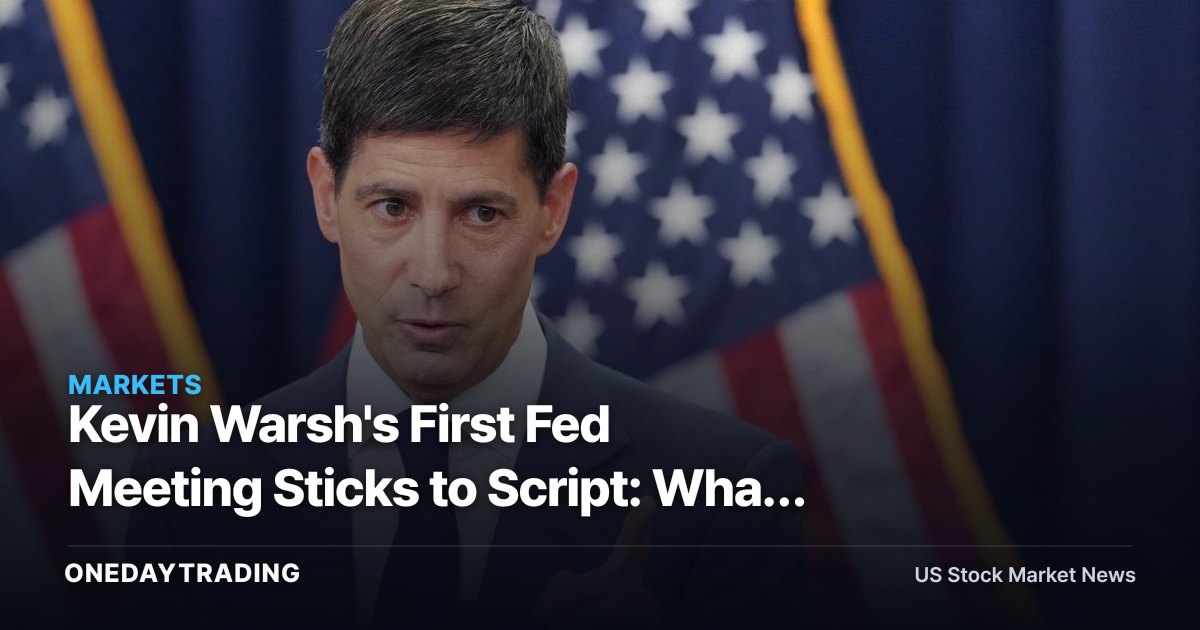
Kevin Warsh used his first meeting as Federal Reserve chairman on Wednesday to signal continuity rather than rupture, with the central bank closely following market expectations on interest rates. For investors, the absence of a hawkish or dovish surprise is itself the story: a smooth handoff lowers the policy-uncertainty premium that had been attached to a leadership change at the most important institution in global markets.
What Happened
Warsh chaired his inaugural Federal Open Market Committee meeting and, per CNBC's reading of the five main takeaways, hewed to the script on rates. That matters because a new chair often arrives with the market pricing a wide band of possible outcomes, fearing either a credibility-driven tightening or a politically influenced easing. Sticking to consensus narrows that band.
A first meeting is as much about tone, language and forward communication as about the rate decision itself. Markets parse word changes, the framing of the inflation outlook, and how the new chair handles questions for clues about the reaction function going forward. A by-the-book debut suggests Warsh, at least initially, is prioritizing institutional stability and predictability over reshaping the Fed's stance.
Background and Context
Leadership transitions at the Fed are scrutinized because the chair sets the agenda, frames the consensus and is the primary voice the market trades on. Warsh is a former Fed governor, so the bar was whether he would deviate from the established path. By following expectations, he buys credibility and time, deferring the harder question of whether his Fed will lean more or less restrictive than the prior regime.
Market and Stock Impact
- Banks (JPM, BAC, WFC): Lenders are the most direct read on rate policy. Stable, predictable guidance supports net interest margin planning and reduces the tail risk of a disruptive policy lurch that could pressure loan demand or bond portfolios.
- Financials sector (XLF): The broad financials complex benefits when policy continuity keeps the yield curve and funding costs within an expected range, easing the discount-rate volatility that whipsaws the group.
- Rate-sensitive growth and tech: Long-duration equities are highly sensitive to the path of rates because future cash flows are discounted; no surprise on policy removes a near-term valuation shock.
- Homebuilders and REITs: These groups trade closely with the rate outlook through mortgage costs and cap rates, so a status-quo message limits downside catalysts tied to a policy jolt.
Investor Checkpoints
- Watch the language in the official policy statement and Warsh's press-conference tone for any shift in the framing of inflation versus growth.
- Track the next FOMC meeting and any updated projections for confirmation that this debut sets a durable path, not a one-off.
- Monitor the 10-year Treasury yield and the 2s10s curve as the cleanest market verdict on whether the Fed is seen as more or less restrictive.
- Follow bank earnings commentary on net interest margins and loan growth for the real-economy transmission of policy.
Outlook
The bull case is straightforward: a credible, predictable transition removes an overhang and lets equities trade on fundamentals rather than Fed-personality risk. The counter-scenario is that a smooth first meeting reveals little about Warsh's true reaction function, and the harder test comes when data force a genuine choice between fighting inflation and supporting growth. A debut that follows the script can mask divergence that surfaces only under pressure, so the durability of this continuity remains the key variable for rate-sensitive positioning.
📊 Analysis
Signal Neutral
Why A by-the-book first meeting signals policy continuity with no directional rate surprise, removing uncertainty without delivering a clear positive or negative catalyst.
This article was independently written by OneDayTrading from public reporting. Read the original (CNBC)