At a Glance
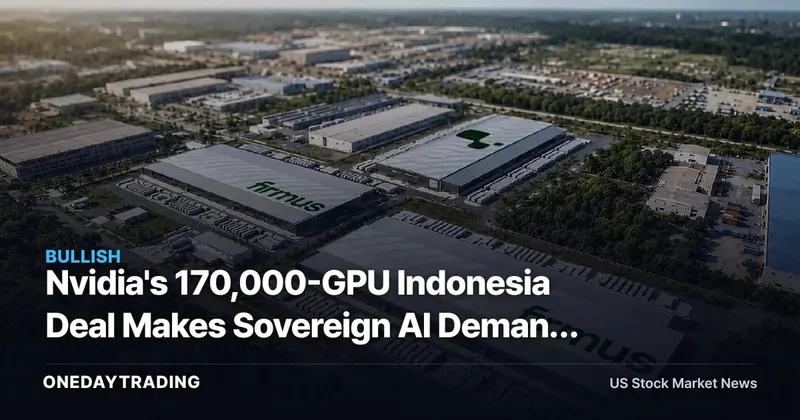
Indonesian AI infrastructure developer Firmus is partnering with Nvidia to build a 170,000-GPU facility — a commitment hyperscaler-comparable in raw unit count and one of the largest sovereign AI hardware deployments yet announced in Southeast Asia. For Nvidia, the deal moves the sovereign AI narrative from policy discussion into purchase-order territory, adding demand outside its concentrated U.S. cloud-provider customer base.
Why It Matters Now
Nvidia's data center revenue has been driven overwhelmingly by a handful of large U.S. operators. A single greenfield deployment of 170,000 GPUs from an Indonesian infrastructure developer signals that the sovereign AI buildout wave is reaching procurement stage, not just headline stage. That distinction matters for Nvidia's demand durability: if hyperscaler capex growth moderates from its current pace, sovereign and national AI projects represent a second demand layer that was not in most consensus models twelve months ago.
Indonesia's logic is the same logic driving similar buildouts in the Gulf and Japan — keeping training and inference capacity inside national borders is both a policy priority and a data-sovereignty argument. With a population exceeding 270 million and one of Southeast Asia's fastest-growing digital economies, Indonesia has the strategic scale to justify sovereign compute infrastructure, and Firmus is positioning as that national infrastructure layer. At deployment volumes this large, Nvidia's CUDA ecosystem lock-in is near-total; operators building greenfield at 170,000 GPUs are not splitting workloads across incompatible software stacks, which structurally disadvantages any competing GPU vendor at the initial design-win stage.
A cluster of this size also carries significant supply-chain implications beyond the GPUs themselves. High-bandwidth memory — HBM3 or HBM3E stacked dies — is required at scale for every high-end Nvidia accelerator, meaning Micron and SK Hynix absorb incremental demand if the deployment ramp proceeds on schedule. Advanced packaging capacity (CoWoS) at TSMC and rack-scale server systems from integrators like Super Micro are additional dependencies. The deployment rate, not the announcement, determines when each link in that chain recognizes the revenue.
FAQ
- Why is 170,000 GPUs significant? Major U.S. hyperscalers deploy GPU clusters in the tens of thousands to low hundreds of thousands per campus. A single sovereign operator in Indonesia committing to that range places this deal in the same order-of-magnitude conversation — unusual for any non-hyperscaler outside the U.S. and Gulf.
- What is the primary execution risk? Timeline. Large sovereign AI projects have a track record of announcing ambitious GPU counts and delivering on longer-than-expected schedules. The gap between hardware commitment and actual powered-on deployment is the variable that controls when Nvidia books revenue and when the facility generates workload.
- Does this shift Nvidia's customer concentration risk? Directionally yes — sovereign operators in emerging markets are structurally less correlated to U.S. hyperscaler capex cycles, which are the primary sensitivity in current Nvidia models. Whether the aggregate volume of sovereign deals becomes large enough to move the needle on concentration depends on how many comparable announcements follow.
- What does this mean for AMD's competitive position? At greenfield scale, CUDA ecosystem inertia is Nvidia's strongest moat. AMD's MI-series GPUs remain a credible alternative in incremental or cost-sensitive deployments; they are less likely to displace Nvidia in a clean-slate sovereign buildout at this size.
Related Stocks & Sectors
- NVDA (Nvidia) — Direct GPU supplier; the 170,000-unit commitment adds material data-center backlog volume outside the hyperscaler concentration that dominates current sell-side models.
- MU (Micron Technology) — HBM supplier; each high-end accelerator at this scale requires stacked HBM dies, making a deployment of this magnitude a meaningful incremental demand signal for HBM3/HBM3E capacity allocations.
- SMCI (Super Micro Computer) — Rack-scale GPU server integrator; large sovereign AI deployments depend on dense server systems at exactly the scale where Super Micro competes most actively.
- AMD — Competitive read-through; the deal reinforces how difficult it is for ROCm-stack alternatives to win clean-slate sovereign deployments against an established CUDA install base.
What to Watch
- Deployment timeline disclosure: When Firmus provides a construction and power-on schedule, that calendar will map directly to the quarters in which Nvidia recognizes data-center revenue from the commitment.
- Nvidia earnings commentary on sovereign AI: Watch whether management explicitly references sovereign operators as a growing demand category on the next earnings call and whether backlog composition reflects non-hyperscaler diversification.
- HBM supply tightness signals: Any commentary from Micron or SK Hynix on allocation pressure in coming quarters is a read-through to whether a ramp of this scale encounters supply constraints that could push the deployment schedule.
- Comparable Southeast Asia announcements: If Malaysia, Vietnam, or other regional sovereigns announce GPU infrastructure commitments of similar scale, it validates the demand layer as structural; if this remains an isolated announcement, the pipeline story loses near-term conviction.
Overall Outlook
The bull case for Nvidia here is that sovereign AI infrastructure demand is less cyclically correlated than hyperscaler capex and more policy-driven — meaning it could provide demand support precisely in quarters when large U.S. cloud operators pause or slow GPU procurement. A 170,000-GPU commitment from a single Indonesian operator is a data point that makes the sovereign pipeline tangible, and if analogous deals materialize across the region, the aggregate GPU demand implied is not reflected in models that still weight hyperscaler capex as the near-exclusive driver of Nvidia data-center revenue.
The risk worth holding in parallel: sovereign AI announcements have a history of ambitious scale and stretched timelines. The question is not whether Indonesia wants domestic AI compute — it clearly does — but whether Firmus can secure the power infrastructure, financing, and operational capacity to deploy at the pace the headline implies. Revenue recognition timing is Nvidia's key variable here; the strategic demand signal is real, but the financial impact is gated by execution on the ground in Indonesia.
Market data check: NVDA
NVDA last traded near $194.57 (+1.06%). Our composite signal — blending price momentum and news flow — reads 🟡 neutral. Price momentum scores 58/100.
Data as of publication. Price via market feeds; for reference only, not investment advice.
📊 Analysis
Signal Bullish
Why A 170,000-GPU sovereign AI deployment commitment adds large-scale demand outside Nvidia's concentrated hyperscaler customer base, validating a structurally durable second demand layer that current consensus models underweight.
This article was independently written by OneDayTrading from public reporting. Read the original (Yahoo Finance)