Summary
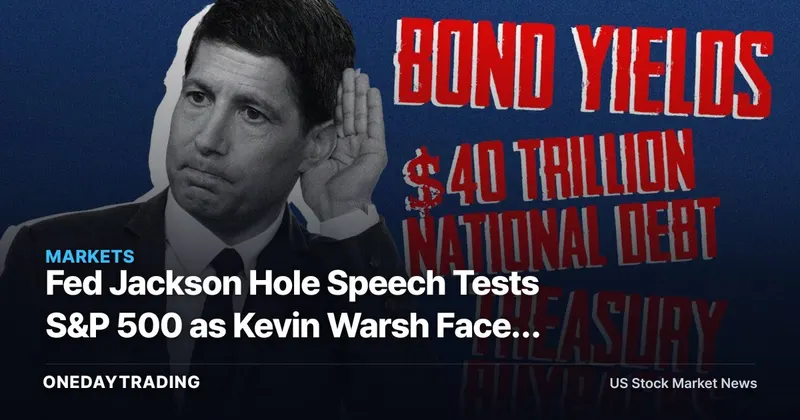
Fed Jackson Hole speech risk matters for the S&P 500 because Kevin Warsh is due to deliver his first Jackson Hole address since taking the helm at the Federal Reserve, per MarketWatch's reporting. The investor issue is not the podium; the issue is whether Warsh's language changes the market's assumed path for rates, which flows directly into equity multiples, bank margins and long-duration technology stocks.
Jackson Hole is the Federal Reserve's annual late-summer policy forum, and markets use the Fed chair's speech as a read on inflation tolerance, labor-market concern and the reaction function behind future rate decisions.
The Full Story
Kevin Warsh's first Jackson Hole speech as Federal Reserve chair is a rates event before it is an equity event. If Warsh validates lower-rate expectations, the S&P 500 and Nasdaq 100 get support through lower discount rates; if Warsh keeps inflation risk in front, the same speech can pressure high-multiple software, internet and semiconductor shares.
MarketWatch framed the setup around how stocks perform when the Fed chair speaks at Jackson Hole, but the provided source details do not include a historical return percentage or a stated market forecast. That absence matters: investors should treat the speech as a volatility trigger, not as a statistically quantified edge from the facts supplied here.
The tape will separate tone from policy. A dovish sentence helps equities only if Treasury yields fall with it; a hawkish sentence hurts more if the dollar and yields rise together, because that combination compresses overseas earnings translation and raises the hurdle rate for future cash flows.
Structural Background
The Federal Reserve affects U.S. equities through the policy-rate channel, where expected short-term rates shape Treasury yields and Treasury yields set the discount rate investors apply to corporate profits. Growth sectors such as AI infrastructure, cloud software and internet platforms are more sensitive to that math because more of their valuation rests on earnings expected further in the future.
Banks sit on the other side of the rate trade. JPMorgan Chase, Bank of America and other lenders can benefit from firmer rate expectations through net interest income, but that benefit weakens if tighter policy raises credit stress or slows loan demand.
Stock & Sector Ripple
- SPDR S&P 500 ETF Trust SPY: SPY is the broadest listed proxy for a Jackson Hole equity reaction because the Fed chair's message changes index-level valuation through rates and risk appetite.
- Invesco QQQ Trust QQQ: QQQ is more exposed if Warsh's Fed language lifts yields, because long-duration technology earnings carry higher sensitivity to discount-rate changes.
- JPMorgan Chase JPM: JPM can gain from a firmer rate path if net interest income expectations rise, but the bank trade reverses if investors hear higher credit-loss risk in a slower economy.
- Bank of America BAC: BAC has a direct read-through from the yield curve because deposit costs, loan yields and bond-portfolio marks move with rate expectations.
Bull vs Bear Scenarios
The bull case is simple: Kevin Warsh uses his first Jackson Hole speech as Federal Reserve chair to avoid tightening the policy message, Treasury yields ease, and investors extend the multiple on the S&P 500 and Nasdaq-linked growth stocks. The bear case is equally direct: Warsh emphasizes inflation discipline, yields rise, and the market reprices rate-sensitive equity leadership.
The counterweight is positioning. If investors already expect a careful Fed message, a neutral speech may not add enough new information to move stocks beyond the first reaction.
Investor Action Points
- Watch the 10-year Treasury yield immediately after Kevin Warsh's Jackson Hole speech; equities need the rates move to confirm the headline interpretation.
- Track SPY and QQQ relative performance after the speech; QQQ underperformance signals multiple pressure from higher discount rates.
- Compare JPM and BAC against growth ETFs after the speech; bank strength with tech weakness points to a higher-rate interpretation.
- Use the next Fed communication and inflation data as confirmation; Jackson Hole starts the repricing only if later data support the same policy path.
FAQ
Why does the Fed Jackson Hole speech move stocks?
The Fed Jackson Hole speech moves stocks because the Federal Reserve chair can change expectations for future interest rates in a single policy signal. Higher expected rates usually weigh on the S&P 500 through lower valuation multiples, while lower expected rates usually support equities through cheaper discount rates.
What does Kevin Warsh's first Jackson Hole speech mean for the S&P 500?
Kevin Warsh's first Jackson Hole speech as Federal Reserve chair means the S&P 500 faces a communication test, per MarketWatch's reporting. The S&P 500 reaction depends on whether Warsh reinforces or challenges the rate path investors have already priced.
Which stocks are most sensitive to a hawkish Fed speech?
QQQ-linked technology shares are most sensitive to a hawkish Fed speech because higher yields reduce the present value of future earnings. JPMorgan Chase and Bank of America can initially benefit from higher-rate expectations, but bank gains depend on credit quality and loan demand holding up.
📊 Analysis
Signal Neutral
Why The story is a clear market catalyst, but the provided facts give no speech text, historical return figures or policy signal strong enough to assign a bullish or bearish direction.
This article was independently written by OneDayTrading from public reporting. Read the original (MarketWatch)