At a Glance
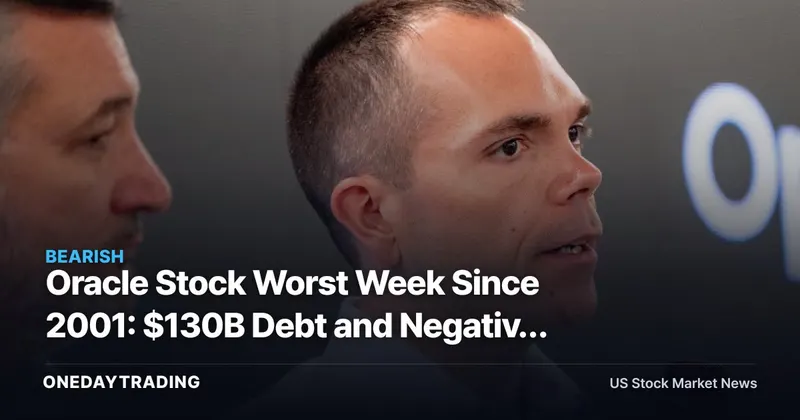
Oracle just posted its worst weekly equity performance since the 2001 dot-com collapse — and unlike that episode, the culprit is not vanishing demand but a self-inflicted financing structure: surging AI infrastructure spending has pushed free cash flow into negative territory while total debt sits at $130 billion. The market is no longer willing to value booked AI contracts without first discounting the capital cost of fulfilling them.
Why It Matters Now
The core tension is timing asymmetry. Oracle Cloud Infrastructure has attracted genuine enterprise AI commitments, but data-center capex is cash-out-the-door now while revenue recognition trails by quarters. In a rising-rate world, a $130 billion debt load is not a passive balance-sheet footnote — it is an active drag on financial flexibility, compressing the window Oracle has to prove its AI workloads generate enough operating cash to service obligations without returning to debt markets on punishing terms. Negative free cash flow means the growth is being rented, not owned.
The distinction the tape is drawing — and this is the critical read-through for software investors broadly — is between self-funded AI infrastructure scale and debt-funded attempts to match it. Microsoft, Amazon, and Alphabet generate operating cash at a volume that absorbs hyperscale capex internally. Oracle, arriving later to the infrastructure race, is borrowing to compete. That structural gap tends to widen, not close, when capital markets tighten their appetite for leveraged tech buildouts. Enterprise AI procurement teams notice balance-sheet stability; a credit-stressed vendor is a concentration risk.
The 2001 parallel is emotionally resonant but mechanically misleading. Then, Oracle fell because corporate IT budgets evaporated. Today, demand for AI compute is intact — the problem is that Oracle chose a financing model that front-loads risk onto shareholders at exactly the moment rates make that model most expensive. Investors who bought ORCL as a backdoor AI infrastructure trade are now re-examining whether the entry price adequately reflected the leverage embedded in the thesis.
FAQ
- Why does negative free cash flow matter more for Oracle than for a startup? Oracle is a mature, profitable software business whose valuation has historically been anchored to FCF yield. Flipping negative signals that capex has structurally exceeded operating cash generation — a regime change, not a one-quarter anomaly — and erodes the basis for a premium multiple.
- What is the AI bet Oracle is making? Oracle has been positioning OCI as a preferred venue for large-model training, citing GPU cluster density and sovereign cloud contracts. The thesis is sound on demand; the problem is that fulfilling those contracts requires capital expenditure that currently outstrips cash inflow.
- Could the RPO backlog rescue the thesis? Remaining Performance Obligations — forward contracts not yet recognized as revenue — are the key leading indicator. If RPO converts to cash-generating cloud revenue faster than debt service accumulates, FCF recovers. The rate of that conversion is the number to track, not the headline backlog figure.
- Is there contagion risk to other enterprise software names? Direct contagion is limited to companies with similar leverage profiles and capex commitments. The broader risk is multiple compression across the cohort as the market reassesses how much AI infrastructure spending is actually discretionary versus obligatory for competitive survival.
Related Stocks & Sectors
- ORCL — Direct subject; debt load and negative FCF are company-specific but the AI cloud thesis is now on trial.
- MSFT — Favorable contrast: Azure AI infrastructure is self-funded from operating cash, potentially redirecting enterprise AI budgets away from capital-constrained alternatives.
- AMZN — AWS in the same beneficiary position; Oracle cloud hesitancy could accelerate multi-cloud deals that default to AWS as the stability anchor.
- GOOGL — Google Cloud gains credibility as enterprises scrutinize vendor financial resilience alongside technical capability.
- CRM — Sympathy exposure: any re-rating of leveraged software capex cycles raises questions about other enterprise software names investing ahead of monetization.
What to Watch
- Oracle quarterly earnings — specifically FCF trajectory and whether management signals any moderation in capex commitments or a revised path to positive free cash flow.
- RPO growth rate versus interest expense growth — if debt service is rising faster than backlog conversion, the math does not close without dilution or asset sales.
- Debt refinancing activity — any new bond issuance will reveal the credit market's current risk premium on Oracle paper and quantify the cost of the financing model.
- Hyperscaler capacity announcements — accelerated buildout by AWS, Azure, or Google Cloud narrows the window for Oracle to lock in long-term AI workload contracts before enterprise procurement consolidates.
Overall Outlook
The bull case is RPO conversion: if Oracle's AI contracts accelerate into recognized cloud revenue over the next two to four quarters, FCF recovers, the debt load becomes manageable relative to earnings, and the selloff proves to be a sentiment overshoot. The company has differentiated sovereign cloud capability and real GPU availability — those are not invented advantages. The bear case is a debt-trap dynamic where persistent capex needs and rising interest burden intersect with a slower-than-expected AI adoption curve, forcing Oracle to choose between dilutive equity issuance, asset disposals, or ceding ground in the infrastructure race. The 2001 comp belongs less in the fundamental analysis than in the investor psychology column — but that psychology is now in the price, and reversing it requires quarterly cash flow data, not a renewed booking announcement.
Market data check: ORCL
ORCL last traded near $148.53 (-2.58%). Our composite signal — blending price momentum and news flow — reads 🟡 neutral. Price momentum scores 29/100 (soft).
Data as of publication. Price via market feeds; for reference only, not investment advice.
📊 Analysis
Signal Bearish
Why Negative free cash flow combined with $130 billion in debt makes Oracle's AI infrastructure bet dependent on borrowed capital at the worst possible time, eroding the FCF-yield basis for its software valuation premium.
Tickers$ORCL$MSFT$AMZN$GOOGL$CRM
This article was independently written by OneDayTrading from public reporting. Read the original (CNBC)