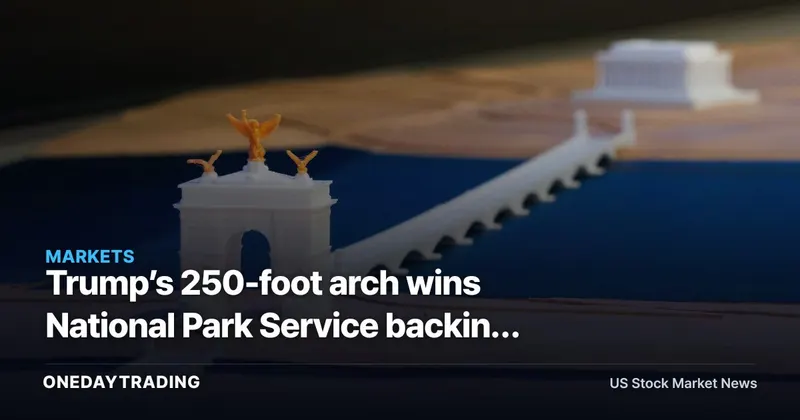
What does National Park Service backing mean for the Trump arch?
National Park Service backing for the Trump arch means the project has cleared an important symbolic hurdle even after officials said it would adversely affect historic sightlines and other visual relationships among nearby landmarks, per CNBC. For investors, that matters because approval risk can be more binding than design debate in any large civic project.
The National Park Service finding also changes the conversation from aesthetics to execution. Once a project is treated as politically viable, the next gate is less about concept and more about permits, contractors, materials, and whether the schedule survives public pushback. That is where a physical project starts to become a capital-cycle story.
Why the 250-foot scale matters for contractors and materials
The arch’s 250-foot height is the only hard number in the report, and it is enough to show why preservation groups are focused on sightlines. A structure that size creates visual impact by design, which raises the odds of continued scrutiny even if the federal side is open to it.
For builders and suppliers, size only translates into orders if the project moves from endorsement to procurement. Without a contract award, the arch is still an option value event. With one, steel, engineering, transport, and site work become the real economic story.
Winners & Losers
- Engineering and construction firms: potential upside only if the project advances into bids and awarded work.
- Steel and materials suppliers: more volume if the arch becomes a funded build, not just a proposal.
- Local real estate and hospitality: attention can help sentiment, but controversy can also slow decision-making.
- Historic preservation and neighborhood groups: influence remains high, but that is a policy lever, not a market catalyst.
Risk Check
- NPS backing is not the same as final approval.
- No budget, no contractor list, and no timetable were included in the report.
- Historic-site objections can still delay the process.
- If the project stalls, suppliers see little or no near-term spillover.
Bottom Line
The Trump arch story is less about a monument than about how far a politically backed project can travel after preservation officials identify real visual harm. That keeps the upside tied to eventual procurement, while the downside is straightforward: public resistance or procedural delay can leave the project as a headline, not a build.
FAQ
What does National Park Service backing mean for the Trump arch?
It means the project has institutional support even after officials identified adverse effects on historic sightlines and nearby landmarks. It does not, by itself, mean construction is guaranteed.
Is the Trump arch approved now?
Not from the information in CNBC’s report. The key takeaway is that backing from the National Park Service lowers one barrier, but the project still depends on the rest of the approval and execution chain.
Which industries could benefit if the arch moves ahead?
Construction, engineering, steel, and other materials suppliers would be the most direct beneficiaries if the project reaches procurement. Real estate and hospitality could also get a sentiment lift, but only if the project becomes a real build rather than a political gesture.
📊 Analysis
Signal Neutral
Why The report is a policy and permitting signal with no named listed beneficiary or disclosed budget, so the market impact is indirect and unproven.
This article was independently written by OneDayTrading from public reporting. Read the original (CNBC)