Summary
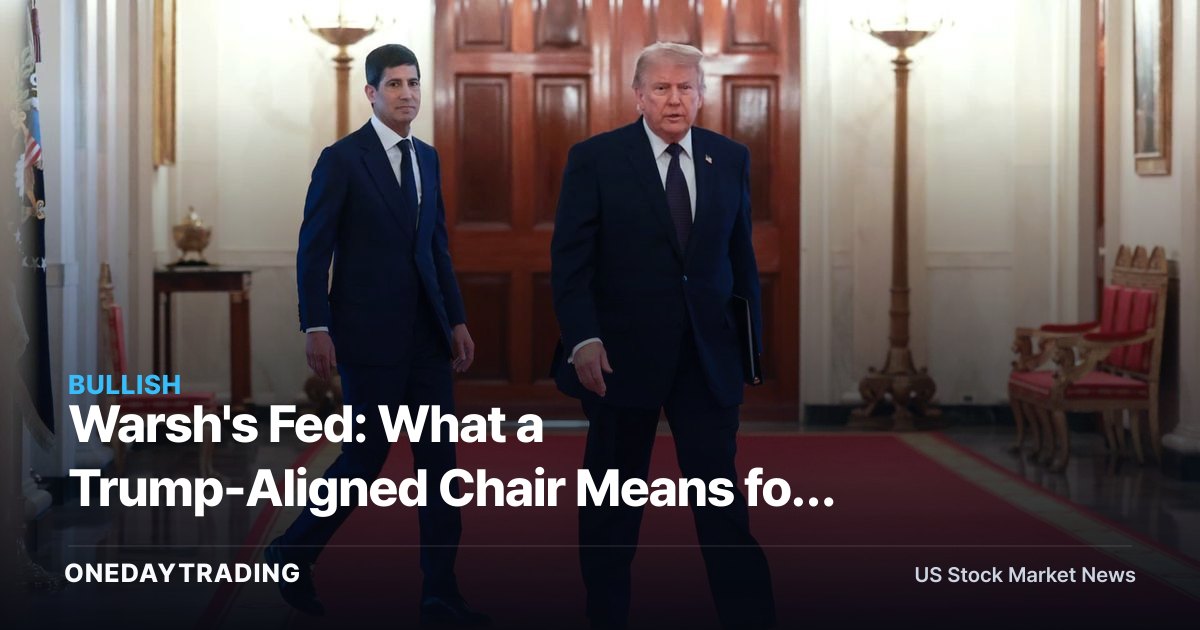
Kevin Warsh takes the Fed chair with rare political cover: a president who spent years attacking the central bank now appears willing to give him room to remake it. For investors, the signal that matters is policy direction. A chair aligned with a White House that openly wants lower borrowing costs tilts the rate path lower, which is a tailwind for long-duration growth and credit-sensitive sectors but a fresh question mark over Fed independence.
The Full Story
The handover is unusual because the relationship is unusually friendly. Trump has been the Fed's single most vocal opponent, repeatedly pressing for cheaper money, and the early dynamic with Warsh reads less like the traditional arm's-length tension between the Oval Office and the central bank and more like a working alliance. That honeymoon gives a new chair latitude to reshape personnel, communication and the policy framework with limited public friction.
Markets care about this less as personality and more as a reaction function. If the incoming leadership leans toward a faster or deeper easing cycle, the front end of the curve resets lower and risk appetite broadens. The catch is the long end: a Fed perceived as politically accommodative can push longer-dated yields higher as investors demand more compensation for inflation and credibility risk, even while short rates fall.
Structural Background
The Fed chair sets the tone but votes alongside a committee, and a reshaped board takes time to assemble. The framework debate matters too. A leadership that prioritizes growth and labor over a strict inflation target changes how every data print is interpreted, which is why the same jobs or CPI number can move rates differently under a different chair.
Stock & Sector Ripple
- Banks (JPM, BAC, GS): Lower policy rates cut deposit and funding costs and can revive lending and capital-markets activity, though a flatter-to-inverted curve compresses net interest margins, so the benefit depends on whether the long end falls with the short end.
- Homebuilders (LEN, DHI): Mortgage demand is the most rate-elastic part of the economy. A credible path to lower financing costs directly improves affordability and order volumes.
- Growth and tech (NVDA): Long-duration earnings are discounted at lower rates, so an easing tilt mechanically supports high-multiple growth names.
- Regional and rate-sensitive credit: Cheaper funding eases pressure on balance sheets stressed during the high-rate cycle, supporting commercial real estate exposure.
Bull vs Bear Scenarios
Bull case: a cooperative Fed delivers a smoother easing cycle, funding costs fall, and equities re-rate as recession risk recedes. Bear case: markets read political alignment as a loss of independence, long-term yields rise on inflation fears, and the dollar and bond market punish the very stimulus the White House wants, offsetting the equity tailwind.
Investor Action Points
- Watch the 10-year Treasury yield against the policy rate. A falling short rate with a rising long end is the warning sign that the independence premium is widening.
- Track the next FOMC statement and dot plot for any framework shift toward growth and employment over inflation.
- Monitor bank net interest margin commentary at the next earnings round to confirm whether lower rates help or hurt lenders.
- Follow board and committee appointments, since a reshaped Fed only changes the vote count as new members are seated.
📊 Analysis
Signal Bullish
Why A Fed chair aligned with a president pushing for lower rates tilts the policy path toward easing, a tailwind for rate-sensitive equities, though independence risk is a real offset.
Tickers$JPM$BAC$LEN$DHI$NVDA$GS
This article was independently written by OneDayTrading from public reporting. Read the original (CNBC)