Key Takeaways
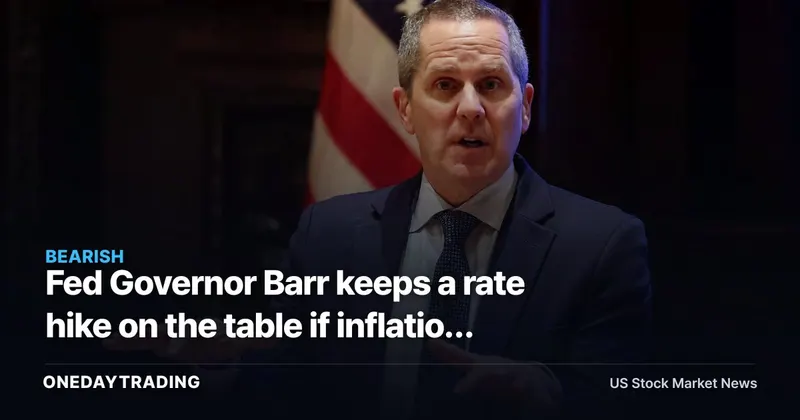
Fed Governor Barr's willingness to support a rate hike if inflation does not ease keeps a hawkish policy path alive while inflation sits above the Fed's 2% target. For investors, that means the first trade is not about one speech; it is about whether Treasury yields, discount rates, and mortgage costs keep enough pressure on valuations to matter for banks, homebuilders, and long-duration growth stocks.
A rate hike is an increase in the Fed's benchmark policy rate, the reference point for borrowing costs across the U.S. economy. Barr's comment matters because it tells the market the Fed is still focused on broader price pressures taking hold, not just on proving that inflation is drifting lower.
What Happened
Fed Governor Barr said he would support a rate hike if inflation does not ease, and he said he is worried broader price pressures are taking hold. The Federal Reserve's 2% inflation target is the benchmark he used to frame the risk.
The message is conditional, not a forecast. Still, a conditional hike is enough to keep policy from being priced as one-way easing and to remind investors that the Fed can still lean harder if inflation stops cooperating.
Background & Context
The market channel runs through rates first and equity multiples second. When yields rise, future cash flows are discounted more heavily, which usually hurts sectors whose value sits far out in time and whose financing costs are sensitive to policy.
That is why the same comment can look mixed across financials. Banks such as JPMorgan, Bank of America, and Wells Fargo can benefit from wider lending spreads, but they also face slower loan demand and a greater chance that credit conditions tighten before volume improves.
Market & Stock Impact
- DHI and LEN: higher mortgage costs hit affordability, which can slow orders, push out closings, and pressure pricing power in housing.
- JPM, BAC, and WFC: higher rates can support asset yields, but the upside is capped if funding costs rise and borrowers pull back.
- Long-duration growth stocks: a higher discount rate trims the valuation support that depends on cash flows arriving years from now.
- Real estate and dividend-sensitive sectors: Treasuries compete more directly with yield, which can compress multiples even when fundamentals hold.
Investor Checkpoints
- Watch the next inflation data for evidence that prices are still above the Fed's 2% target.
- Track Treasury yields, because they translate the Fed's language into financing conditions for stocks and housing.
- Watch mortgage rates and new-home demand, where a hawkish message shows up fastest in real activity.
- Listen for whether other Fed officials echo Barr or pull the discussion back toward patience.
Outlook
The bull case for risk assets is straightforward: if inflation cools, Barr's warning stays conditional and the market can move back toward easier policy. The bear case is equally clear: if broader price pressures stick, higher-for-longer rates can keep pressure on valuations, with housing and rate-sensitive equities feeling it before banks fully benefit.
The next trigger is the next inflation read and the next Fed signal. If both stay firm, the market has to price a tighter path than it wants; if they soften, Barr's comment fades into background noise.
FAQ
Did Fed Governor Barr say the Fed will raise rates?
No. Fed Governor Barr said he would support a rate hike if inflation does not ease. That is a conditional warning, and the market often reacts to the condition before the Fed ever acts.
Why does inflation above the Fed's 2% target matter for stocks?
Inflation above the Fed's 2% target keeps yields and borrowing costs elevated relative to a softer-price scenario. Fed Governor Barr's comment matters because higher yields usually hit valuations first and then spread into housing, credit, and other rate-sensitive sectors.
What stocks are most exposed if the Fed stays hawkish?
JPM, BAC, and WFC are exposed through loan growth and funding costs, while DHI and LEN are exposed through mortgage affordability. Those are the cleanest channels from a hawkish Fed into earnings and multiples.
📊 Analysis
Signal Bearish
Why Barr's conditional support for another hike keeps rates higher for longer in the market's frame, which pressures housing and long-duration equity valuations.
Tickers$DHI$LEN$JPM$BAC$WFC
This article was independently written by OneDayTrading from public reporting. Read the original (CNBC)