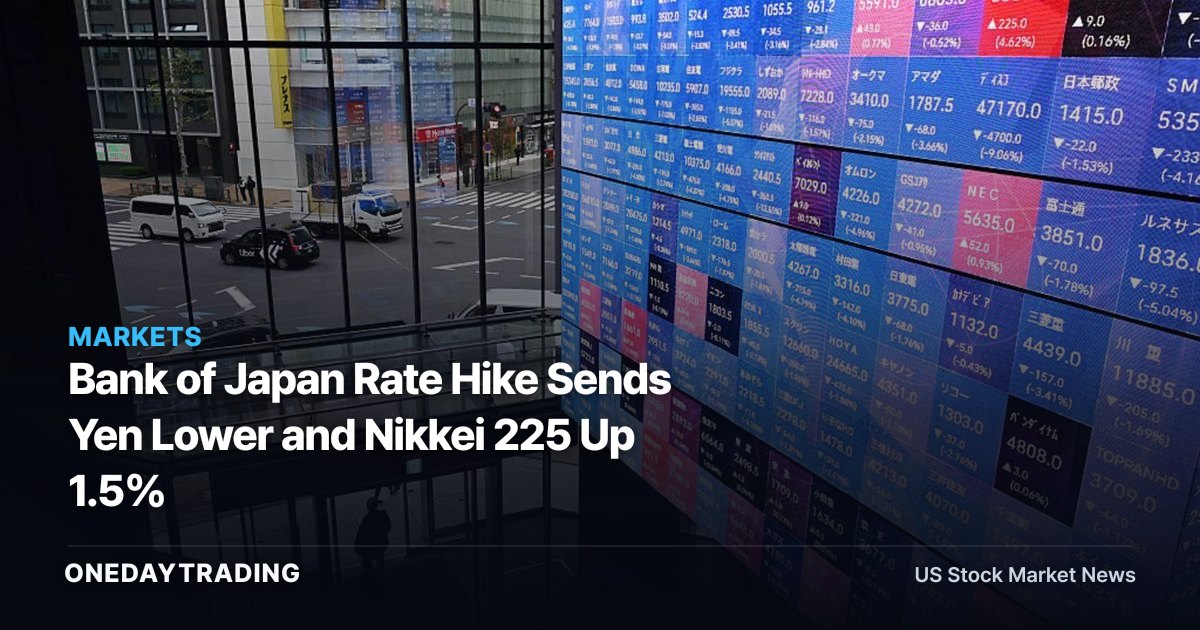
Japan’s Rate Hike Broke the Usual Market Script
Japan’s policy move delivered a split signal for investors: the Bank of Japan raised its policy rate to 1.25%, yet the yen weakened past 157 against the dollar, the 10-year Japanese Government Bond yield slipped and the Nikkei 225 gained 1.5% on Friday. The market read the decision as tightening today without a clear commitment to an aggressively higher path tomorrow.
That distinction matters across currencies, bonds and equities. A rate increase can support a currency and lift bond yields, but those effects depend on how much future tightening investors already expect. Here, the BOJ’s 7-2 vote, the absence of an updated outlook report and a decline in core inflation reduced the force of the headline hike.
The 7-2 Vote Changed the Interpretation
The BOJ decision passed with seven votes in favor and two against. Board members Toichiro Asada and Ayano Sato favored keeping rates unchanged, making the internal split central to the market reaction.
Hirofumi Suzuki, chief FX strategist at Sumitomo Mitsui Banking Corporation, said, “The two dissenting votes in favor of keeping rates unchanged came as a surprise.” For currency traders, dissent at a meeting that still produced a hike can imply a higher bar for subsequent increases, even when the current policy rate moves upward.
Masahiko Loo, senior fixed income strategist at State Street Investment Management, said the meeting lacked an updated outlook report. Without revised forecasts, the BOJ had less opportunity to reinforce a hawkish interpretation through new projections. Shigeto Nagai, head of Japan economics at Oxford Economics, also pointed to the less forceful tone of the communication.
Inflation Is Below the BOJ’s Threshold
Japan’s core inflation was 1.7% in August, down from 1.8% in July and below the 2% threshold referenced in the debate over policy. Asada argued that inflation below 2% indicated the economic situation might not be strong enough to justify an immediate increase. Sato said current economic and price developments had not substantially accelerated compared with the prior period.
The BOJ’s stated framework is conditional. It said it would continue raising rates as economic and price conditions develop, while maintaining that monetary policy would be conducted as appropriate to stabilize underlying inflation around its 2% target. That language leaves the next decision dependent on incoming conditions rather than establishing a fixed sequence of hikes.
The rate is now at its highest level since 1995, a 31-year comparison, and the increase came three months after the previous increase. Those facts establish a meaningful tightening cycle, but they do not by themselves determine the pace of the next move.
Why Stocks Rose While the Yen Fell
The Nikkei 225’s 1.5% Friday gain is consistent with a market that sees the BOJ’s tightening path as less forceful than a simple rate headline implies. If investors expect gradual rather than rapid increases, the pressure on equity valuations and financing conditions may be less immediate than the policy rate alone suggests.
The yen’s move past 157 against the dollar points to the same expectation in the foreign-exchange market. The exact exchange rate beyond that level is not established here, but the direction shows that the hike did not create a stronger yen on Friday. A less hawkish interpretation can reduce the expected interest-rate advantage of holding yen assets relative to dollar assets.
The 10-year Japanese Government Bond yield also slipped, although the exact yield and size of the change are not provided. That decline indicates bond investors focused on the BOJ’s future path and communication, not only on the 1.25% policy rate delivered at the meeting.
Growth Risks Complicate the Next Move
The BOJ said growth was likely to decelerate because of high oil prices stemming from the Middle East conflict. That warning creates a counterweight to the case for rapid further tightening: weaker growth can restrain demand-driven inflation even when energy costs remain elevated.
Stefan Angrick, head of Asia-Pacific economics at Moody’s Analytics, said weak demand-driven inflation and disappointing real-wage growth would limit subsequent moves. This is a mechanism investors can test in future data: if underlying price pressure approaches the BOJ’s 2% target without a deeper growth slowdown, the case for additional increases strengthens; if demand and wages remain weak, the pace may be constrained.
Japan’s political and international policy context is also part of the debate. Nagai said the dissenting votes signaled that Prime Minister Sanae Takaichi was not convinced to accept faster rate increases. The fact sheet records that U.S. Treasury Secretary Scott Bessent stressed the need for higher BOJ rates in a May meeting with Japanese Finance Minister Satsuki Katayama. Those remarks describe pressure around policy, not a confirmed future decision.
What Investors Should Track Next
- Inflation: The next core-inflation readings should be compared with 1.7% in August, 1.8% in July and the BOJ’s 2% underlying-inflation target.
- BOJ communication: Governor Kazuo Ueda’s description of whether forthcoming meetings remain active will help investors judge how much weight to place on the 7-2 split.
- Bond-market confirmation: The 10-year Japanese Government Bond yield’s next move will show whether fixed-income investors are pricing faster tightening or a slower path. The current exact yield and change are not specified.
- Growth pressure: Evidence of deceleration linked to high oil prices, weak demand-driven inflation or disappointing real-wage growth would argue against assuming a rapid sequence of hikes.
Sam Jochim, an economist at EFG International, said rates could rise roughly once every three months as underlying inflation approaches 2% and expected a terminal rate between 1.75% and 2% in 2027. That is an external expectation, not a BOJ forecast. The central bank has not supplied a terminal-rate projection, and whether another hike occurs remains unknown.
Bottom Line: Tightening, but Not a Straight-Line Trade
The BOJ has moved policy to 1.25%, its highest level since 1995, confirming that normalization is active. Friday’s market reaction shows why the path matters more than the headline: a 7-2 decision, core inflation below 2%, cautious communication and growth risks produced a weaker yen, lower 10-year JGB yields and a 1.5% Nikkei 225 gain. Investors should treat the next inflation and BOJ communication checkpoints as tests of whether the market’s restrained interpretation holds, while recognizing that no next hike has been confirmed.
📊 Analysis
Signal Neutral
Why The hike is a tightening signal, but dissenting votes, softer inflation and limited forward guidance produced an offsetting market reaction.
This article was independently written by OneDayTrading from public reporting. Read the original (CNBC Markets)