At a Glance
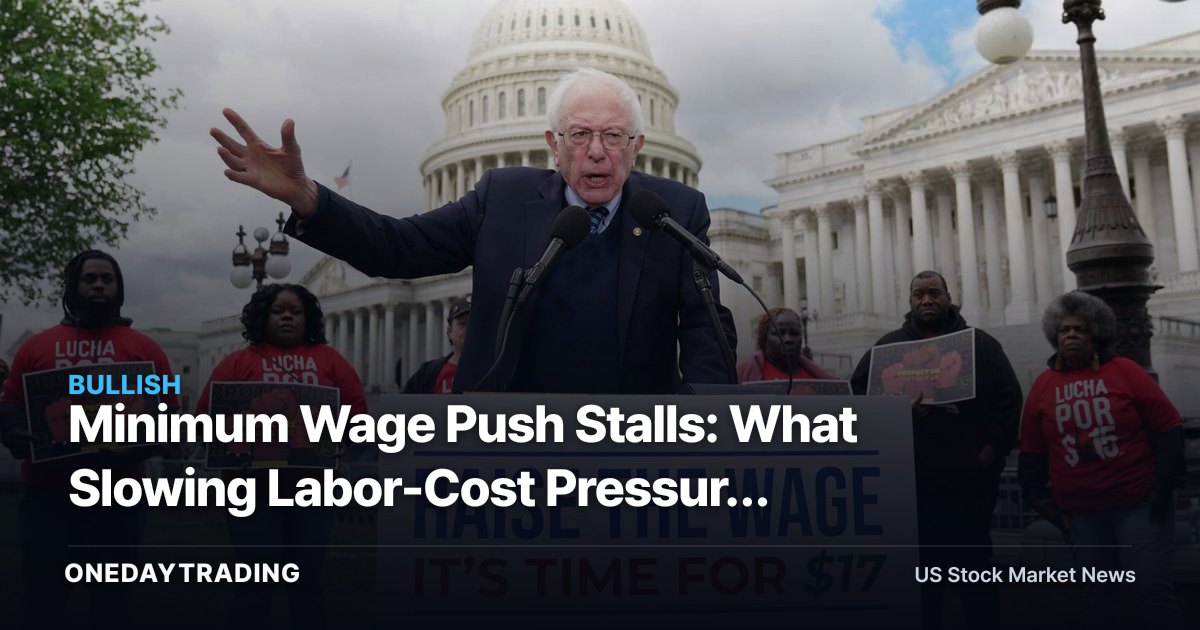
Raising the minimum wage has been a reliable ballot-box winner for progressives, but recent losses point to a cooling appetite for further hikes as the broader economic mood softens. For investors, the read-through runs straight through labor-cost lines at companies that employ large hourly workforces.
The story is political, but the channel to markets is operational: wage floors set the baseline for what restaurants, retailers and other service employers pay their lowest-tier staff.
Why It Matters Now
Minimum wage is one of the few policy levers that hits the income statement directly and predictably. When statutory floors rise, labor-intensive operators face higher hourly costs that they must either absorb through thinner margins, offset with price increases, or counter with automation and reduced headcount. A stall in the upward push removes a source of forward cost inflation that companies have been guiding investors to expect.
The political resistance matters because it changes the trajectory, not just the level. Ballot measures and state-level increases have been the main engine of wage gains while the federal floor has stayed static. If voter enthusiasm is fading alongside a more cautious economic mood, the pace of future state and local increases could slow, easing the multi-year cost ramp that quick-service restaurants and discount retailers have been planning around.
The flip side is demand. The same softening mood that cools wage activism can also signal a consumer pulling back, and lower-wage workers are core customers for value-focused chains and dollar stores. A cost tailwind that arrives alongside a spending headwind is not a clean win.
FAQ
- Who benefits if wage hikes stall? Employers with heavy hourly workforces — fast food, casual dining and big-box retail — see relief on a key cost input.
- Why is this political shift relevant to stocks? Minimum wage flows directly into labor expense, the largest controllable cost for service businesses.
- Is this clearly bullish? No. A cautious economic mood that slows wage activism can also dent spending by lower-income consumers.
- What is the main uncertainty? Whether resistance is a durable trend or a single-cycle pause tied to current sentiment.
Related Stocks & Sectors
- McDonald's (MCD) — large hourly workforce and franchise model make store-level labor costs a central margin driver.
- Starbucks (SBUX) — company-operated stores carry direct wage exposure plus unionization pressure.
- Chipotle (CMG) and Darden (DRI) — restaurant labor intensity ties margins to wage floors.
- Walmart (WMT) — the largest private employer; baseline pay decisions ripple across retail.
- Restaurant and discount retail sectors broadly, where minimum wage sets the entry pay grid.
What to Watch
- Upcoming earnings calls for explicit labor-cost and wage-inflation commentary in guidance.
- State and municipal ballot outcomes and legislative calendars for new minimum wage measures.
- Same-store sales and traffic trends at value chains as a tell on lower-income spending.
- Commentary on automation and labor-hour management as an offset to wage pressure.
Overall Outlook
The bull case is straightforward: a slowdown in minimum wage increases trims a forward cost line for labor-heavy operators, supporting margins if pricing power holds. The risk is that the same mood driving the political resistance reflects a weakening consumer, which would pressure traffic at the very chains that gain on the cost side. Investors get the clearest signal not from headlines but from how management quantifies labor inflation and consumer behavior in the next round of results.
Market data check: MCD
MCD last traded near $278.61 (-1.84%). Our composite signal — blending price momentum and news flow — reads 🟡 neutral. Price momentum scores 35/100 (soft).
Data as of publication. Price via market feeds; for reference only, not investment advice.
📊 Analysis
Signal Bullish
Why Stalling minimum wage increases ease a key labor-cost input for restaurant and retail employers, a modest margin tailwind despite consumer-demand risks.
Tickers$MCD$SBUX$CMG$WMT$DRI
This article was independently written by OneDayTrading from public reporting. Read the original (CNBC)