What Changes
China's August PMI is better for sentiment than for earnings models. The factory downturn is easing, but the economy is still not expanding, and that difference matters for machinery, miners and commodity proxies that trade on whether China is stabilizing or truly reaccelerating.
China's official manufacturing PMI at 49.8 says the tape can price a softer landing, not a full recovery. Production at 50.4, new orders at 50.6 and new export orders at 50.1 tell investors where the improvement came from: external demand and near-term output, not a broad domestic snapback.
That split matters for multiples. Export-heavy industrials can rally on the idea that volumes are bottoming, but those gains get fragile fast if domestic demand stays weak and Beijing does not add support. The market is pricing a floor; it is not yet pricing a growth cycle.
By the Numbers
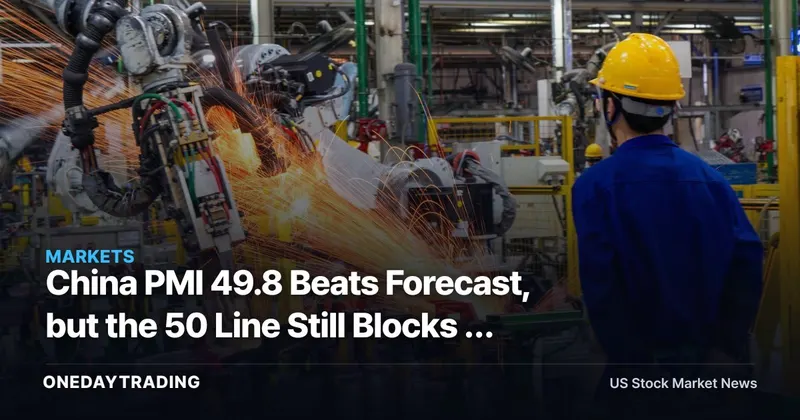
China's official manufacturing PMI rose to 49.8 in August 2026 from 49.2 in July 2026, above the 49.6 Reuters consensus. The 50 threshold still separates expansion from contraction, so August remained the second straight month below growth.
The sub-indexes did the real work. Production reached 50.4, new orders hit 50.6 and new export orders reached 50.1. That mix points to a modest industrial turn, but not one strong enough on its own to pull the broader economy out of pressure.
Winners & Losers
- CAT: Caterpillar gets a better China demand backdrop for equipment and mining sentiment, but only if the improvement in orders translates into real capex.
- FCX: Freeport-McMoRan benefits if Chinese factory output and export orders keep copper demand firmer, though a sub-50 headline still caps conviction.
- NUE: Nucor can catch a sympathy bid on better industrial tone, but steel demand needs follow-through beyond one improved survey.
- BHP: BHP's China exposure makes it a direct read-through on industrial metals, especially if Beijing adds support.
- RIO: Rio Tinto moves with the same China growth beta; export-led stabilization helps, but domestic weakness still limits the upside case.
Risk Check
- China's 49.8 PMI is still contraction, not expansion.
- The improvement came from production and exports, not a full domestic-demand recovery.
- Weak domestic demand means the next print can easily reverse this one.
- Without fresh Beijing support, cyclicals can run ahead of the data and give it back.
Bottom Line
China's August PMI argues for caution, not despair. The factory slump is less severe, and that helps China-sensitive industrials and miners, but the 50 line still separates a tradable stabilization from a durable growth turn. Investors now need the next PMI, not the headline beat, to confirm whether this was a base or just a pause.
FAQ
What does a 49.8 PMI mean?
China's 49.8 PMI means manufacturing is still contracting because the reading remains below 50. The August 2026 number is better than July's 49.2 and beat the 49.6 forecast, but it still does not signal expansion.
Why do U.S. industrial stocks care about China PMI?
China's factory data feeds demand expectations for machinery, metals and mining. Stocks like Caterpillar, Freeport-McMoRan, Nucor, BHP and Rio Tinto trade on whether China is stabilizing enough to support orders and pricing.
What is the next catalyst for China-sensitive stocks?
The next catalyst is whether China can push the PMI back above 50 and keep the sub-index gains in production, new orders and export orders. If Beijing follows with support, cyclicals can hold the move; if not, the bounce can fade fast.
Market data check: CAT
CAT last traded near $799.99 (-0.03%). Our composite signal — blending price momentum and news flow — reads 🟡 neutral. Price momentum scores 50/100.
Data as of publication. Price via market feeds; for reference only, not investment advice.
📊 Analysis
Signal Neutral
Why The PMI beat expectations and improved, but 49.8 is still contraction, so the read-through is supportive for sentiment yet not strong enough for a clear bullish call.
Tickers$CAT$FCX$NUE$BHP$RIO
This article was independently written by OneDayTrading from public reporting. Read the original (CNBC Markets)