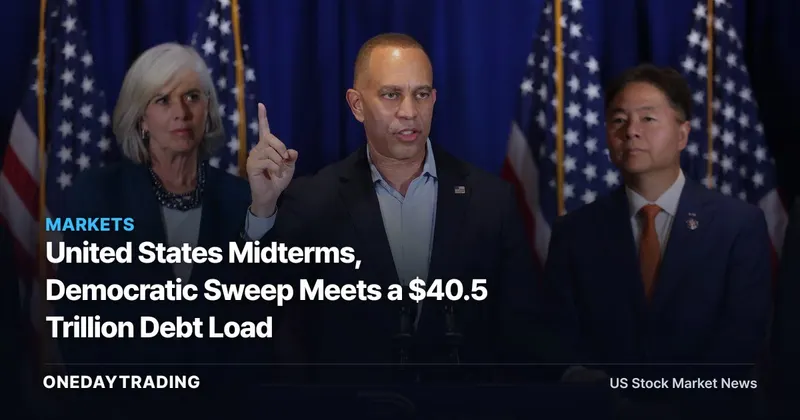
United States Midterms Leave Investors With a Policy Question, Not a New Cycle
The United States election result changes the political negotiating table, not the economic starting point. In reporting dated 2026-11-05, CNBC Markets said Democrats had swept House, Senate, governor and other state races, while economists argued that the main pressures on growth were likely to persist.
For investors, the sharpest distinction is between policy that legislators could contest and forces the election did not settle. Trade, spending priorities and artificial intelligence may enter negotiations, although inflation, weak real-wage growth, heavy federal borrowing and an expansion tied closely to AI still define the macro risk.
What the Democratic Sweep Did—and Did Not—Change
A Democratic sweep means the party won the cited federal and state races; it does not establish which economic measures Democrats will enact or secure. Mark Zandi, chief economist at Moody's Analytics, said economic and foreign policy is largely set in the executive branch and stated, “I don't expect any change in economic policy.”
That assessment places Donald Trump’s executive authority at the center of the market debate. The election may affect bargaining over tariffs, spending and the debt ceiling, while the supplied evidence does not establish the concessions Democrats will pursue, whether tariffs will become legislation, or whether spending cuts will be reversed.
Morgan Stanley analysts discussed possible Democratic efforts to reverse spending cuts. Jan Hatzius, chief economist at Goldman Sachs, also identified a debt-ceiling impasse as a possible route to policy concessions, though the specific terms remain unknown.
Growth Is Firm, While Household Purchasing Power Is Under Strain
CNBC Markets reported that United States GDP accelerated at a 3.4% annualized pace in the third quarter and United States consumer spending increased 3.8% in the same period. Those figures describe an economy still expanding through the election, not one already registering a policy-driven reversal.
The labor data carry the same tension. CNBC Markets put the current United States unemployment rate at 4.2% and said layoffs were around their lowest level since 1969, evidence that employment conditions had not collapsed.
Price and wage figures complicate that resilience. CNBC Markets reported a 3.7% United States consumer price index inflation rate in September, compared with 2.3% in April 2025 and 2.4% in late February. The Bureau of Labor Statistics said United States inflation-adjusted wage growth declined 0.7% from a year earlier in September.
For consumer-facing businesses, the relevant mechanism is purchasing power: spending grew in the third quarter, while real wages were lower than a year earlier in September. The evidence does not identify which companies gained or lost, so a company-level revenue or margin conclusion would outrun the available facts.
AI Dependence Makes Equity Valuations Part of the Macro Risk
AI dependence is the link between economic growth and equity-market fragility in Zandi’s analysis. He said, “The risks are decidedly to the downside because the growth is so dependent on AI,” connecting the expansion to AI activity, the equity market and valuations.
The transmission matters even without a supplied index move or company-specific figure. If AI remains an important support for growth, the expansion retains that support; if equity valuations cease to sustain the AI growth effects described by Zandi, a concentrated source of momentum could weaken. The fact sheet provides no sector earnings, capital-spending totals or share prices with which to quantify either path.
That leaves investors with a macro exposure rather than a defensible single-stock call. The election result alone does not show whether AI investment, data-center activity or equity valuations will rise or fall, and local opposition to data centers cannot be quantified from the allowed evidence.
Trade Policy Offers Negotiating Space, Not a Confirmed Outcome
Gary Cohn, who served as director of the National Economic Council during Donald Trump’s first term, said, “There's become a much more universal view on tariffs and what they're good for.” The supported policy distinction is between tariffs directed toward China and the effects of trade barriers involving the United States, Canada and Mexico.
That creates a possible area for agreement without proving that an agreement will occur. The record does not confirm whether tariffs will pass through legislation, what their scope would be, or whether United States-Mexico-Canada trade relations will reset after 1.5 years of tension.
For the equity market, the checkpoint is the legal form and geographic reach of any tariff action. Legislation, executive action and a negotiated trade reset represent different policy channels, and the facts supplied do not resolve which channel will prevail.
The $40.5 Trillion Debt Constraint Survives the Election
CNBC Markets placed current United States national debt at $40.5 trillion, an increase of more than $4 trillion since Donald Trump took office in January 2025. Net interest on the debt totaled $1.05 trillion in fiscal 2026, keeping federal financing costs central to any spending debate.
The United States finished the year with a budget deficit just shy of $2 trillion, or about 6.1% of GDP, according to the same reporting. A change in legislative power can alter bargaining priorities, but it does not erase that balance-sheet constraint or identify how a future agreement would divide spending restraint, benefit restoration and other concessions.
This is where political headlines can diverge from the investable signal. A debt-ceiling dispute could become leverage for policy negotiations; the evidence does not specify what Democrats would demand or what could pass. Markets therefore lack a confirmed fiscal path to price from the election result alone.
Investor Checkpoints After the Democratic Election Sweep
- Inflation and real wages: Compare the next consumer price index reading with the 3.7% September rate and check whether inflation-adjusted wage growth improves from its 0.7% year-over-year decline.
- Growth composition: Test whether the next GDP and consumer-spending data preserve the third quarter’s 3.4% annualized GDP pace and 3.8% spending growth, with particular attention to whether growth remains dependent on AI.
- Labor resilience: Watch whether the current 4.2% unemployment rate and layoffs near their lowest level since 1969 continue to coexist with weak real wages.
- Policy form: Look for concrete legislative or executive action on tariffs, spending cuts and the debt ceiling rather than treating negotiating positions as completed policy.
RSM’s Expansion Case Versus the Downside Risks
Joseph Brusuelas, chief economist at RSM, projected United States economic growth near 2½% and assigned a 15% probability of recession over the next 12 months. He added, “The outcome of the election was immaterial to that estimate.”
The constructive case is straightforward: third-quarter GDP and consumer spending were expanding, unemployment stood at 4.2%, and layoffs remained near a comparison last seen in 1969. Continued expansion would be consistent with those figures and Brusuelas’s outlook.
The risk case is equally concrete: September inflation stood at 3.7%, real wage growth was down 0.7% from a year earlier, national debt reached $40.5 trillion, and Zandi described growth as unusually dependent on AI. Neither continuation nor recession is confirmed; the next decisive evidence will come from inflation, real wages, labor conditions, growth composition and the first concrete policy terms emerging from the new political balance.
📊 Analysis
Signal Neutral
Why The election may reopen debate over trade and spending, although executive control, inflation, debt and AI dependence limit a clear directional market catalyst.
This article was independently written by OneDayTrading from public reporting. Read the original (CNBC Markets)