Key Takeaways
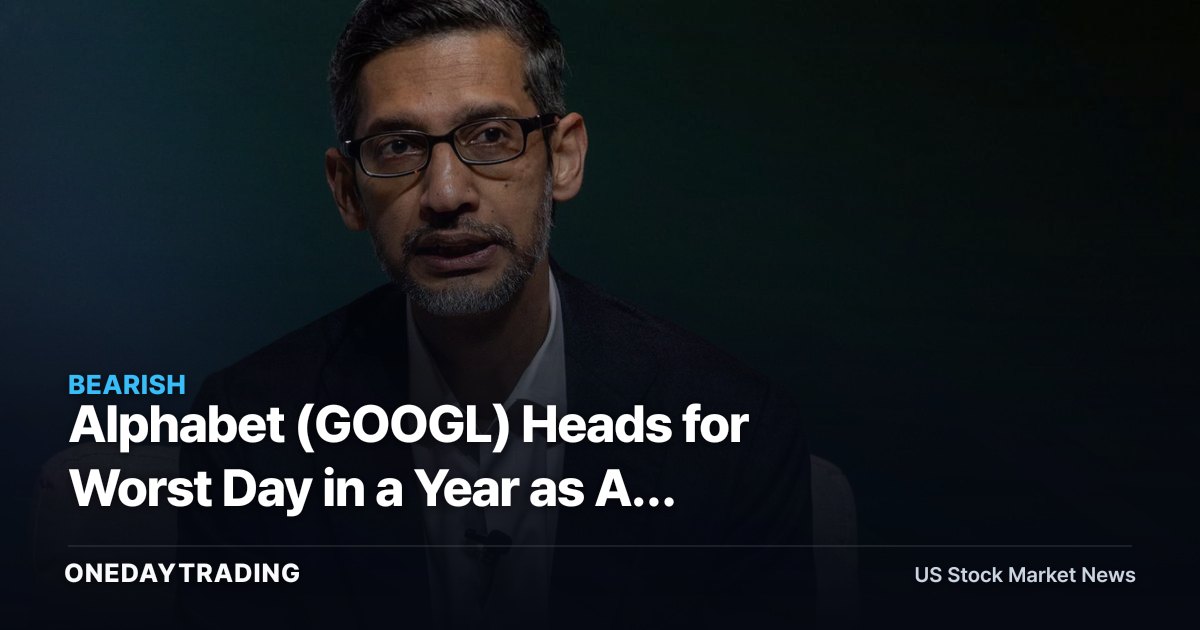
Alphabet is tracking toward its steepest single-day decline in a year as a string of high-profile artificial intelligence researcher departures stokes doubts about whether Google can defend its position in the most contested technology race of the decade. The sell-off is less about quarterly numbers and more about a market reassessing the durability of Google's AI talent moat.
What Happened
Shares of Google parent Alphabet are pacing for their worst day in roughly twelve months after consecutive exits of senior AI researchers. Talent is the scarcest input in frontier AI, and when departures cluster rather than occur in isolation, investors read them as a signal about internal direction, compensation dynamics, or confidence in the research roadmap rather than ordinary churn.
The reaction is notable because it is sentiment-driven. There is no earnings miss or guidance cut attached to the move; instead, the market is repricing an intangible — the perception that Google's DeepMind and broader research organization can keep pace with rivals poaching the same narrow pool of specialists who build and tune large models.
Background and Context
Alphabet has been a primary beneficiary of the AI narrative through its Gemini models, cloud demand, and search integration. That same exposure cuts both ways: when the bull thesis rests heavily on AI leadership, headlines that challenge the talent story carry outsized weight. Frontier labs across the industry have been competing aggressively for a small number of researchers, and visible exits can compound into a narrative of momentum shifting elsewhere.
Market and Stock Impact
- Alphabet (GOOGL, GOOG): Most directly hit. Roughly 80 percent of revenue still ties to advertising, but the valuation premium increasingly leans on AI leadership in cloud and search — so a talent-confidence shock pressures the multiple, not the current cash flows.
- Microsoft (MSFT): A relative-positioning beneficiary. Every doubt about Google's AI bench reinforces the rival camp anchored to OpenAI, where Microsoft has deep commercial and infrastructure ties.
- Meta (META): An active competitor for the same scarce researchers; talent reshuffling across labs can flow toward firms paying up most aggressively for frontier expertise.
- Nvidia (NVDA): Largely insulated near term — AI training demand persists regardless of which lab employs which researcher, but it watches lab momentum as a proxy for sustained capex.
Investor Checkpoints
- Whether the departures stay isolated or accelerate into a broader pattern in coming weeks.
- Alphabet's next earnings report, specifically Google Cloud growth and any commentary on AI product cadence and Gemini adoption.
- Cloud capital expenditure guidance, the clearest signal of internal AI conviction.
- Competitor hiring announcements that confirm or deny a talent shift away from Google.
Outlook
The bull case is that the reaction is an overreaction: Alphabet retains enormous research depth, distribution scale, and an advertising engine that funds AI investment far beyond what most rivals can sustain, and one volatile session does not break that. The risk is that talent attrition is an early, hard-to-quantify indicator — by the time it shows up in product or cloud growth, the competitive gap may already be wider. The honest read is that this is a confidence event, and the data that resolves it will come from the next earnings cycle and the pace of further exits, not from the tape today.
Market data check: GOOGL
GOOGL last traded near $346.25 (-5.92%). Our composite signal — blending price momentum and news flow — reads 🟡 neutral. Price momentum scores 5/100 (soft).
Data as of publication. Price via market feeds; for reference only, not investment advice.
📊 Analysis
Signal Bearish
Why Consecutive senior AI researcher exits pushed Alphabet toward its worst session in a year, signaling market doubt about its AI talent moat and pressuring the valuation premium.
Tickers$GOOGL$GOOG$MSFT$META$NVDA
This article was independently written by OneDayTrading from public reporting. Read the original (CNBC)