Summary
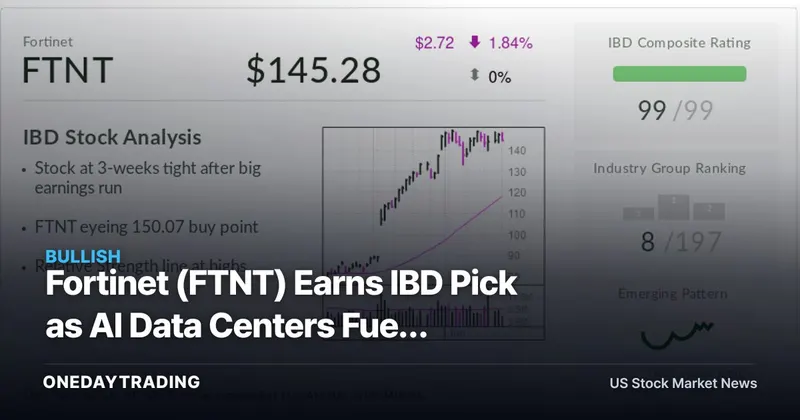
Fortinet's IBD Stock of the Day recognition lands at the intersection of two durable trends: the hyperscale AI data center buildout and the corresponding surge in demand for high-throughput network firewalls. The read-through is direct — more GPU clusters mean more east-west traffic, and more east-west traffic means more inspection capacity, which is precisely where Fortinet's custom-ASIC FortiGate architecture has a defensible structural edge over software-defined rivals.
The Full Story
Traditional enterprise firewalls were engineered for perimeter defense — north-south traffic at the corporate edge. AI data centers invert this architecture entirely: the dominant flows run east-west, between GPU nodes exchanging activations and gradients at extraordinary bandwidth. Securing that fabric requires firewalls capable of multi-hundred-gigabit throughput with deterministic, microsecond-class latency. Fortinet built its FortiGate line on proprietary security processing units rather than commodity CPUs, yielding a throughput-per-watt advantage that grows more valuable as data center power density compounds with each GPU generation.
The competitive read is instructive. Palo Alto Networks has strategically pivoted toward a software-defined, platform-led model that deliberately de-emphasizes discrete firewall appliances — the right call for distributed enterprise environments, but one that surrenders ground wherever raw throughput and low latency are the governing constraints. Fortinet's willingness to own the hardware layer, historically a margin headwind in a commoditizing-server world, becomes a moat when the workload demands purpose-built silicon. That is the architectural bet now paying off.
Structural Background
The AI infrastructure capex cycle — hyperscalers and co-location operators deploying tens of billions in GPU capacity — creates derived security demand that the headline GPU narrative consistently underweights. Every dollar of compute capex requires commensurate investment in networking and security infrastructure. Fortinet's data center firewall positioning makes it a picks-and-shovels beneficiary of AI buildout without the cyclical semiconductor exposure embedded in direct GPU bets. The subscription attach on FortiGuard services means each new appliance socket also seeds a recurring revenue stream, improving revenue quality over time.
Stock & Sector Ripple
- FTNT — Primary beneficiary; AI data center firewall demand extends its growth vector materially beyond the traditional enterprise refresh cycle.
- PANW — Indirect read-through; rising AI-driven security budgets lift the category, though Palo Alto's platform model is less directly exposed to appliance throughput demand inside GPU clusters.
- CSCO — Cisco's data center networking footprint creates adjacent conversations, but its security portfolio lacks Fortinet's ASIC specialization at the inspection layer.
- ANET — Arista benefits from the same AI fabric buildout as a networking infrastructure layer; security uplift is a complementary tailwind without direct firewall exposure.
Bull vs Bear Scenarios
Bull: Hyperscaler AI capex sustains into 2027 and beyond, extending the data center firewall refresh cycle well past consensus estimates. Fortinet's ASIC architecture is not easily replicated — custom silicon programs take years to develop and qualify — creating a durable window to capture incremental socket wins. FortiGuard subscription compounding on top of appliance revenue improves mix and visibility.
Bear: AI infrastructure buildout eventually plateaus, and Fortinet's valuation already prices in meaningful growth acceleration. Cloud-native inspection engines are maturing, and over time could reduce the throughput premium that makes custom silicon compelling. More acutely, if hyperscalers build proprietary internal security tooling — as they have done with switching and routing — the commercial firewall addressable market inside the largest data centers narrows structurally.
Investor Action Points
- Next earnings call: listen for explicit AI data center segment color — any quantification of GPU-cluster-adjacent firewall bookings would materially shift consensus on Fortinet's growth duration.
- Track hyperscaler capex guidance from MSFT, AMZN, GOOGL and META as a leading indicator; equipment orders typically lag capex announcements by two to four quarters, making those calls a forward pipeline signal.
- Watch for FortiGate SKU introductions targeting 400GbE and 800GbE data center fabrics — new high-throughput product launches signal management confidence in the AI infrastructure pipeline.
- Monitor billings growth relative to valuation at each report; FTNT's multiple versus the cybersecurity peer group is only defensible if the data center demand vector proves durable rather than a one-cycle event.
Market data check: FTNT
FTNT last traded near $150 (+0.05%). Our composite signal — blending price momentum and news flow — reads 🟡 neutral. Price momentum scores 50/100.
Data as of publication. Price via market feeds; for reference only, not investment advice.
📊 Analysis
Signal Bullish
Why AI data center buildout creates structural incremental demand for Fortinet's high-throughput ASIC-based firewall appliances, extending its growth runway beyond the enterprise refresh cycle.
Tickers$FTNT$PANW$CSCO$ANET
This article was independently written by OneDayTrading from public reporting. Read the original (Yahoo Finance)