CoreWeave’s Earnings Signal Meets an Insider-Selling Reset
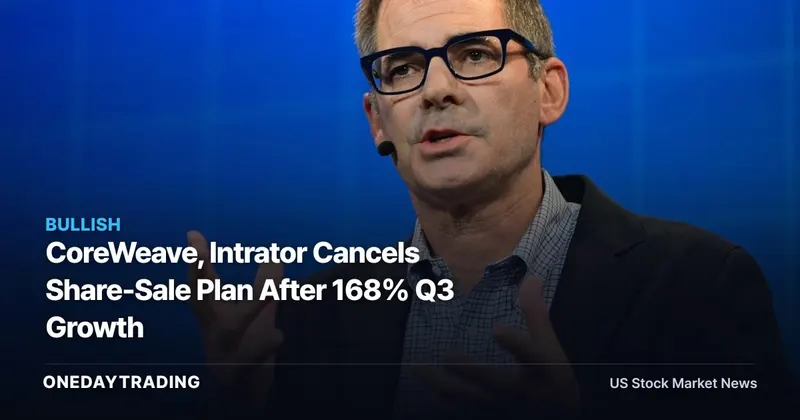
CoreWeave investors received two supportive signals on 2026-11-11: CNBC reported that CEO Michael Intrator had canceled his planned 10b5 stock-sale program after the AI infrastructure company beat Q3 expectations and raised its 2026 forecast. The decision matters because it removes a planned source of CEO selling just as the operating outlook improves, although it does not erase the capital, power and permitting risks surrounding the company’s expansion.
CoreWeave reported 168% year-over-year revenue growth in Q3, according to CNBC, while its shares posted a 20% post-earnings rally on Wednesday. The combination reframes the near-term investment debate. The earnings report supplies evidence of rapid growth; the canceled plan addresses concern about continued scheduled selling by the company’s chief executive.
A 10b5-1 plan is a prearranged stock-trading program that can govern future insider sales. Michael Intrator said the program had been sidelined until there is a material change in CoreWeave’s equity pricing, and described any further selling as normal tax activity. The exact cancellation date and the amount of any future sales were not disclosed.
What Michael Intrator’s Decision Changes
The plan announced in November 2025 had already enabled substantial sales. CNBC reported that Michael Intrator sold 8.26 million shares at an average price of $96.14 per share, totaling $794.2 million, since the program was announced. Canceling the remaining program cannot reverse those transactions, though it changes the expected path of planned sales from this point.
For shareholders, that distinction is important. The move is a change in the supply of shares scheduled for sale under the CEO’s plan, not a new operating contract, additional power capacity or lower funding requirement. Its direct effect is therefore on the equity narrative and insider-alignment debate; the earnings beat and raised forecast carry the operational evidence.
The market response shows both relief and residual skepticism. CoreWeave rallied 20% after earnings on Wednesday, according to CNBC, yet the stock remained down 18% so far in 2026 and had fallen about 27% over the past month. Those figures suggest the rally repaired only part of the earlier decline and that investors are still weighing execution against the scale of the buildout.
CoreWeave’s Capacity Plan in Physical Units
The central operating checkpoint is power, because data-center ambitions become usable infrastructure only when active capacity is available. CoreWeave said it still anticipates 1.85 gigawatts in active power by the end of 2026. That target gives investors a concrete unit against which to test whether spending converts into operating capacity.
The financial commitment is equally large. CoreWeave is targeting $37 billion to $39 billion in full-year capital expenditures for 2026, implying 155% growth at the middle of the range. Visible Alpha’s analyst estimate was $37.69 billion, placing the poll within the company’s stated range.
This is the key tension in the story: fast revenue growth and a higher forecast coexist with an expansion program that requires heavy capital deployment. A 168% year-over-year Q3 growth rate supports the demand side of the thesis, while the $37 billion to $39 billion spending target makes conversion into powered capacity the execution test. Investors should judge the next update by progress toward active power, the capital-expenditure range and the revised forecast, whose precise value was not provided.
Election Results Add a Data-Center Policy Constraint
The external risk is no longer abstract. According to Ballotpedia, voters favored greater restrictions on data centers in 40 out of 41 ballot measures across 10 states during the Nov. 3 midterm elections. Democrats also won control of both houses of Congress and governors’ races in Texas, Ohio and Georgia.
Michael Intrator said CoreWeave did not anticipate an impact from the regulatory shift and argued that the election message concerned how facilities are built. He emphasized responsible construction and being good neighbors, while saying the company remained comfortable with its pipeline. Those statements express management’s assessment; they do not specify the restrictions or demonstrate that every project will avoid changes.
J.P. Morgan Asset Management identified data-center projects from 2028 onward as the period “most exposed,” citing greater uncertainty around permitting, power availability and financing. That timing separates CoreWeave’s immediate end-of-2026 active-power target from the longer-duration policy question. Near-term execution can remain on plan while later projects encounter a less predictable approval and funding environment.
Who Gains and Where the Pressure Sits
- CoreWeave’s equity narrative: The canceled 10b5-1 program removes planned CEO selling under that arrangement, while the Q3 beat, 168% year-over-year revenue growth and raised 2026 forecast strengthen the operating side of the case.
- AI data-center expansion: CoreWeave’s continued target of 1.85 gigawatts in active power by the end of 2026 and its $37 billion to $39 billion capital-expenditure plan indicate that the company has not reduced its stated buildout.
- Projects from 2028 onward: J.P. Morgan Asset Management sees this period as most exposed to uncertainty involving permits, power and financing, making longer-dated expansion more sensitive to policy implementation.
- Existing shareholders: They gain relief from the sidelined sale program, although Michael Intrator and his co-founders have already sold stock and future tax-related selling remains possible.
CoreWeave Risk Check and Next Evidence
- Capacity conversion: Track whether CoreWeave reaches 1.85 gigawatts in active power by the end of 2026. Spending alone does not establish that capacity is active.
- Capital intensity: Compare subsequent disclosures with the $37 billion to $39 billion full-year capital-expenditure target and the 155% growth implied at the range midpoint.
- Forecast detail: CoreWeave raised its 2026 forecast, though the precise revised value was not supplied. The next company update must provide the measurable baseline for judging delivery.
- Policy implementation: Examine the actual restrictions that follow the Nov. 3 ballot results, particularly their effects on permitting and power availability. The measures’ specific terms were not included in the available facts.
- Insider activity: Distinguish canceled program sales from any later tax-related transactions. Michael Intrator did not quantify possible future sales.
The Investment Line After CoreWeave’s Q3 Beat
The bullish case now has three documented supports: Q3 revenue grew 168% year over year, CoreWeave beat expectations and lifted its 2026 forecast, and Michael Intrator canceled his planned 10b5 stock-sale program. The counterweight is physical and financial execution. The company must translate $37 billion to $39 billion of planned 2026 capital expenditures into its 1.85-gigawatt active-power target while navigating a tougher policy setting for data centers.
The next decisive evidence will not come from another statement about insider alignment. It will come from measurable progress on active power, spending and the raised forecast, followed by clarity on how permitting, power availability and financing affect projects from 2028 onward. Nick Wells contributed to CNBC’s reporting on the event.
📊 Analysis
Signal Bullish
Why The earnings beat, higher forecast and canceled share-sale program support sentiment, while permitting, power and financing risks temper the signal.
This article was independently written by OneDayTrading from public reporting. Read the original (CNBC)