Summary
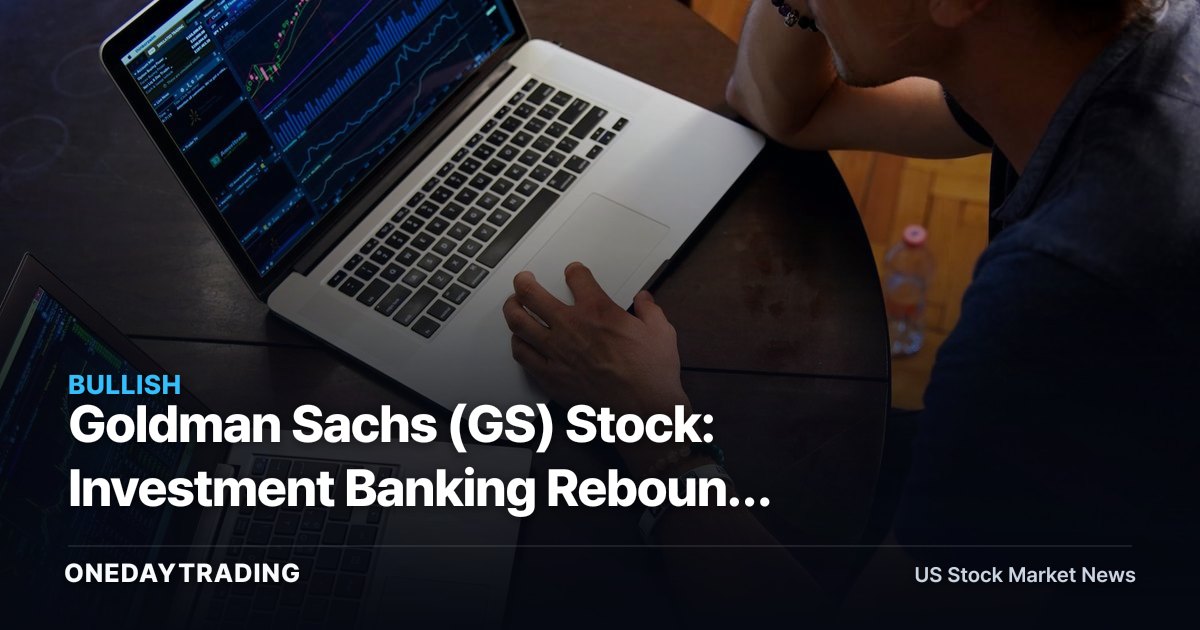
Jim Cramer has singled out Goldman Sachs as a beneficiary of a sharp pickup in investment banking activity, putting the spotlight back on the advisory and capital-markets cycle. For investors, the read-through is less about one analyst call and more about whether a multi-year drought in mergers, IPOs and debt issuance is finally turning. That distinction matters because banks levered to fee income, not just lending spreads, are the ones with the most operating leverage to a deal recovery.
The Full Story
Investment banking is a feast-or-famine business. Revenue is tied to transaction volumes — advisory fees on mergers and acquisitions, underwriting fees on equity offerings, and debt capital markets issuance. When activity reaccelerates after a slow stretch, the incremental fees fall through to the bottom line with little added cost, because the bankers, technology and risk infrastructure are already in place. That is the mechanism behind the optimism around Goldman: a rebound lifts the highest-margin, most cyclical part of its revenue mix.
Goldman sits at the center of this because its franchise skews more toward institutional advisory and capital markets than the diversified consumer-and-commercial models of the largest universal banks. After a prolonged slowdown in dealmaking, a normalization in issuance and M&A would disproportionately benefit firms where those lines are the core engine rather than a sideshow to a retail deposit base.
Structural Background
The deal cycle is driven by financing conditions and corporate confidence. Lower volatility, tighter credit spreads and clarity on the path of interest rates tend to reopen the IPO window and embolden boards to pursue acquisitions. A backlog of private-equity portfolio companies waiting to exit, plus sponsors sitting on uncommitted capital, creates pent-up supply that releases quickly once conditions stabilize — which is why IB revenue can inflect faster than the broader economy.
Stock & Sector Ripple
- Goldman Sachs (GS) — Highest leverage to advisory and underwriting fees; a deal rebound flows straight into its most profitable segment.
- Morgan Stanley (MS) — Similar capital-markets exposure plus a wealth-management cushion that smooths the cyclicality.
- JPMorgan (JPM) and Bank of America (BAC) — Large IB arms benefit too, but fee gains are diluted by their bigger lending and consumer books.
- Evercore (EVR) and other boutiques — Pure-play M&A advisers offer the most concentrated bet on the advisory upcycle, with corresponding downside if deals stall.
- Exchanges and asset managers — More issuance and trading activity lifts volumes across the capital-markets ecosystem.
Bull vs Bear Scenarios
The bull case: operating leverage means each incremental deal adds outsized profit, and a sustained reopening of IPO and M&A pipelines could drive a multi-quarter earnings tailwind for GS. The bear case: IB revenue is notoriously lumpy and sentiment-driven. A renewed spike in rate volatility, wider credit spreads, or a risk-off shock can freeze pipelines just as fast as they thawed. A single influential endorsement is not a fundamental confirmation, and GS shares already price in some recovery, so the valuation question is whether the rebound is durable or a head-fake.
Investor Action Points
- Watch Goldman's next quarterly results for the actual trend in investment banking fees, advisory backlog and underwriting revenue — the hard confirmation behind the narrative.
- Track the IPO calendar and announced M&A volume as leading indicators of whether the pipeline is genuinely reopening.
- Monitor credit spreads, equity volatility and the rate outlook; deteriorating financing conditions are the fastest way to stall the cycle.
- Compare fee-driven names like GS and MS against lending-heavy peers to gauge where the deal recovery delivers the cleanest earnings leverage.
Market data check: GS
GS last traded near $1,106.37 (+0.89%). Our composite signal — blending price momentum and news flow — reads 🟢 constructive. Price momentum scores 57/100. Recent coverage skews bullish (4 vs 1).
Data as of publication. Price via market feeds; for reference only, not investment advice.
📊 Analysis
Signal Bullish
Why A reacceleration in investment banking activity directly lifts Goldman Sachs's highest-margin advisory and underwriting revenue, which Cramer flagged as a positive catalyst.
Tickers$GS$MS$JPM$BAC$EVR
This article was independently written by OneDayTrading from public reporting. Read the original (Yahoo Finance)