Summary
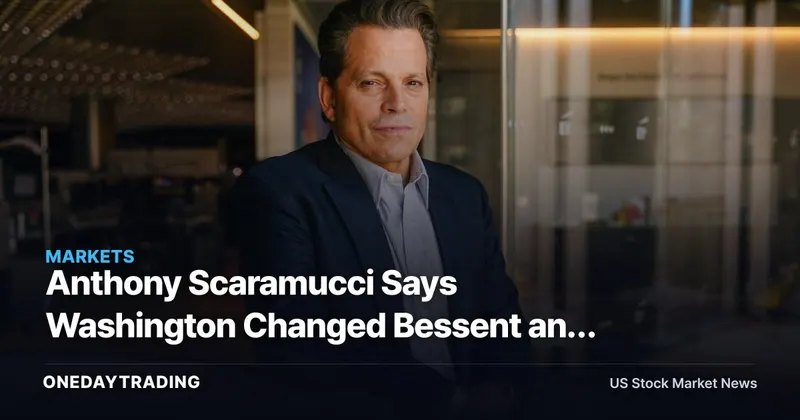
Anthony Scaramucci told CNBC that Washington can reshape officials who enter its orbit, describing Treasury Secretary Scott Bessent and Commerce Secretary Howard Lutnick as affected by what he calls Potomac fever. The comment is a political judgment, not an economic data point, so investors should treat it as a signal about policymaking behavior rather than a forecast for markets.
Scaramucci’s core claim is that people who arrive in Washington believing they can change the system are often changed by the system instead. That framing puts the focus on institutional incentives surrounding economic policy, not on a specific rate, tax or trade decision.
The Full Story
Scaramucci, a former White House communications director, said in CNBC reporting that he had experienced “Potomac fever” while working in the White House. He summarized the effect this way: people may think they are smarter than Washington’s residents, but the capital changes them.
Scaramucci applied that interpretation to Bessent and Lutnick, saying both officials have it. The statement offers no numerical evidence, policy detail or dated decision establishing a measurable change in either secretary’s conduct; its value lies in identifying a perceived shift in how senior officials operate inside government.
What does Potomac fever mean for economic policy?
In Scaramucci’s usage, Potomac fever means that Washington’s political culture changes newcomers’ assumptions and behavior. For investors, the practical question is whether officials’ rhetoric and priorities evolve as they absorb institutional pressures, a process that can affect expectations even before formal policy changes.
Structural Background
Bessent and Lutnick occupy economic-policy posts with direct relevance to markets: the Treasury secretary is associated with fiscal and financial policy, while the Commerce secretary oversees a department tied to business and trade matters. The source does not specify which decisions Scaramucci believes demonstrate the alleged influence.
That missing detail matters. A political label can shape headlines and investor narratives, but it does not establish the direction of bond yields, the dollar, equities or commodities without a concrete policy mechanism.
Stock & Sector Ripple
- U.S. markets: The remarks may influence sentiment around policy credibility, but no company, index move or earnings impact is identified in the source.
- Treasury-linked assets: Bessent’s inclusion makes fiscal and financial-policy expectations relevant, yet the report supplies no new issuance, deficit or interest-rate information.
- Trade-sensitive industries: Lutnick’s role makes Commerce Department decisions important to manufacturers and importers, but Scaramucci gives no tariff or export-control announcement to price.
- Financials and industrials: These sectors could react to later policy decisions, not to the diagnosis alone; the source contains no company-specific catalyst.
Bull vs Bear Scenarios
The constructive interpretation is that experienced officials who understand Washington’s constraints could produce more workable policy and reduce surprise. The adverse interpretation is that institutional adaptation could dilute campaign promises or create uncertainty if public rhetoric and administrative action diverge.
Neither scenario is confirmed by the CNBC account. The immediate risk is narrative overreach: investors may attach market conclusions to a colorful phrase without a dated policy action, legislative development or official statement.
Investor Action Points
- Track Treasury announcements and fiscal guidance for evidence of changed priorities attributed to Bessent.
- Monitor Commerce Department releases for concrete trade, export or industrial-policy actions linked to Lutnick.
- Compare officials’ public commitments with enacted measures rather than relying on political characterizations.
- Use the next market reaction to a specific policy event—not this comment alone—as the test of pricing impact.
FAQ
What did Anthony Scaramucci say about Scott Bessent and Howard Lutnick?
Anthony Scaramucci told CNBC that he had “Potomac fever” during his White House tenure and said Treasury Secretary Scott Bessent and Commerce Secretary Howard Lutnick have it too. He meant that Washington changes people who enter its political system.
Is Potomac fever an economic indicator?
Potomac fever is Scaramucci’s political description, not a published economic statistic or market gauge. The CNBC report provides no data linking the phrase to rates, stocks, trade volumes or growth.
Why might investors search for Scaramucci’s Potomac fever comments?
Investors may view the remarks as commentary on whether senior economic officials adapt to Washington’s institutional pressures. Any tradeable conclusion requires a subsequent policy announcement, Treasury action or Commerce decision with a defined market channel.
📊 Analysis
Signal Neutral
Why The source contains a political assessment without a specific policy action, market move or company impact to establish a directional trade signal.
This article was independently written by OneDayTrading from public reporting. Read the original (CNBC)