Summary
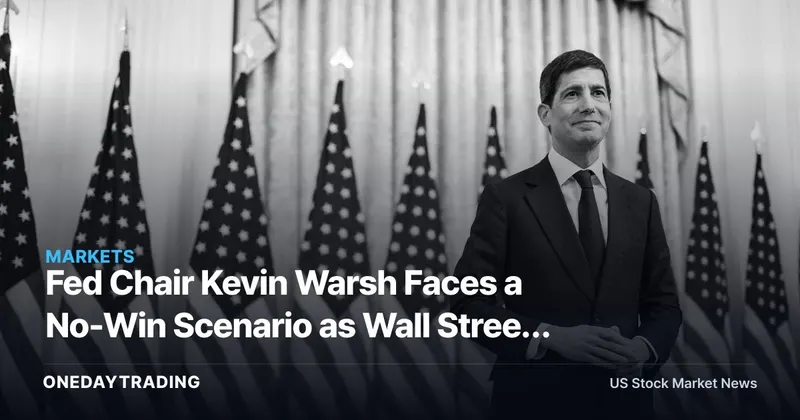
Speculation around Kevin Warsh leading the Federal Reserve frames a difficult bind: any policy path risks disappointing either inflation hawks or growth-focused investors. The framing is that both the prospective Fed Chair and Wall Street are caught in a no-win scenario, with no clean policy outcome available. For markets, the key takeaway is heightened uncertainty around the future rate path rather than a single clear catalyst.
The Full Story
The central idea is that a Fed leader stepping in under current conditions inherits a problem with no easy answer. Cut rates too aggressively and the credibility of the inflation fight is questioned; hold or stay restrictive for too long and the risk of slowing growth and pressuring asset prices rises. That tension is what defines the so-called no-win scenario.
For Wall Street, the difficulty is that markets have grown accustomed to anticipating a predictable policy reaction. A Fed perceived as more hawkish or less predictable removes some of that comfort. Equity valuations, particularly for long-duration growth names, are sensitive to assumptions about where policy rates settle and how quickly any easing arrives.
Because the story centers on leadership and policy posture rather than a specific data release, the immediate impact is on sentiment and positioning. Investors must weigh the possibility of a less accommodative stance against the broad market's heavy reliance on a friendly rate backdrop.
Structural Background
The Federal Reserve's dual mandate — price stability and maximum employment — frequently pulls in opposite directions. When inflation risk and growth risk are both elevated, any rate decision satisfies one objective at the expense of the other. A new Fed Chair signals the market's intense focus on who sets the tone for that trade-off.
Rate expectations flow directly into discount rates used to value equities. Higher-for-longer policy pressures rate-sensitive sectors, while a dovish pivot tends to lift them. That mechanical link is why Fed leadership speculation moves broad indices, not just bank stocks.
Stock & Sector Ripple
- Banks (JPM, BAC): A steeper or higher rate path can support net interest margins, though credit and growth risks cut the other way.
- Mega-cap tech (AAPL, MSFT, NVDA): Long-duration growth valuations are highly sensitive to any shift toward a more restrictive policy stance.
- Broad market index funds (SPY): Index-level direction hinges on how the prospective Fed posture reshapes the expected rate path.
- Rate-sensitive sectors (real estate, utilities): These groups tend to underperform when policy is seen as staying tighter for longer.
Bull vs Bear Scenarios
Bull case: A credible, steady Fed leader could anchor expectations, reduce volatility, and set the stage for a measured easing cycle that supports equities and risk appetite.
Bear case: A more hawkish or less predictable posture keeps rates elevated, compresses valuations, and removes the policy cushion markets have leaned on, raising downside risk for growth-heavy indices.
Investor Action Points
- Watch official Fed communications and rate guidance rather than reacting to leadership speculation alone.
- Stress-test portfolios against a higher-for-longer scenario, especially long-duration growth exposure.
- Consider balancing rate-sensitive names with sectors that benefit from elevated rates, such as banks.
- Maintain flexibility and avoid over-positioning ahead of clarity on the actual policy path.
📊 Analysis
Signal Neutral
Why The story centers on policy uncertainty and a no-win bind for the Fed and markets rather than a clear directional catalyst.
Tickers$SPY$JPM$NVDA$AAPL$BAC
This article was independently written by OneDayTrading from public reporting. Read the original (Yahoo Finance)