At a Glance
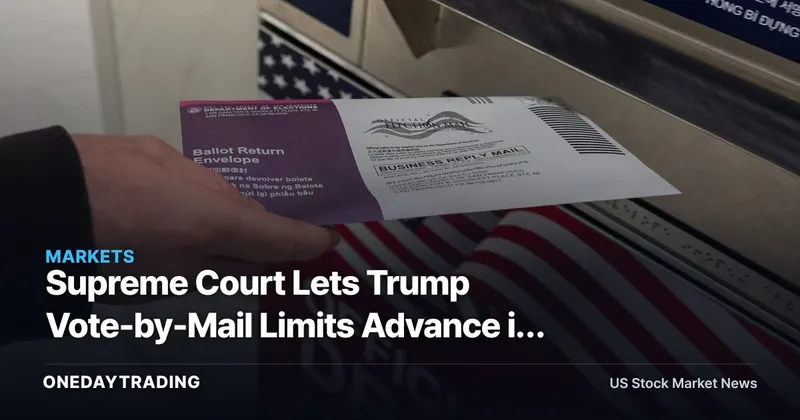
Supreme Court vote-by-mail limits matter for investors because the order raises election-process uncertainty ahead of the midterm election, not because it changes earnings for a single company; per CNBC, the unsigned order lifted an injunction covering 23 states and Washington, D.C.
The immediate market read-through is macro, not sector-specific: investors should separate political noise already embedded in risk assets from policy uncertainty that can affect rates, the dollar, index volatility and regulated industries after the vote.
Why It Matters Now
The Supreme Court order allowed some Trump vote-by-mail limits to proceed ahead of the midterm election, per CNBC, and the three liberal justices dissented. Vote-by-mail limits are election rules that restrict how voters can cast or return ballots outside in-person polling, a process issue that can shape timing, turnout disputes and litigation risk.
For U.S. equities, the channel is not revenue today. The channel is uncertainty: if investors expect a slower or more contested election count across 23 states and Washington, D.C., the equity risk premium can widen, especially in index futures and sectors tied to federal policy.
The tape usually prices known political conflict faster than it prices implementation friction. CNBC’s reported 23-state scope gives the order breadth, but the source does not provide company-level exposure, expected turnout effects or a timetable for additional court action, so the investable conclusion should stay disciplined.
Key Debates
- Election timing risk: The Supreme Court order affects vote-by-mail rules ahead of the midterm election, per CNBC, which can matter if investors expect delayed clarity in close races.
- Policy risk versus earnings risk: The order does not change reported revenue, margins or guidance for S&P 500 companies, so direct stock-specific conclusions would overreach the reported facts.
- Judicial signal: The unsigned Supreme Court order lifted an injunction, and the three liberal justices dissented, per CNBC, showing a divided court posture without a signed majority rationale in the source summary.
- Market pricing: Large-cap indices can absorb political headlines when earnings and rates dominate, but a contested midterm path would shift attention back to volatility hedges and policy-sensitive sectors.
Related Stocks & Sectors
- Macro: The primary impact is on U.S. election uncertainty, which investors express through index exposure rather than a single listed company.
- Banks: Financials are policy-sensitive because control of Congress can affect regulation, capital rules and oversight, but the CNBC report gives no bank-specific data.
- Healthcare: Managed care, pharmaceuticals and providers can react to federal-policy expectations after elections, but the Supreme Court order itself is procedural rather than earnings-based.
- Clean energy and traditional energy: Energy policy can move after election outcomes, though CNBC’s reported order does not specify any policy platform or sector proposal.
What to Watch
- Further court action: Investors should track whether additional injunctions or emergency orders change the scope beyond the 23 states and Washington, D.C. cited by CNBC.
- Midterm vote-count timing: The key market variable is whether vote-by-mail restrictions create uncertainty in close races after Election Day.
- Index volatility: Watch whether the VIX and S&P 500 futures react to election-process risk rather than treating the order as a contained legal headline.
- Policy-sensitive sectors: Banks, healthcare and energy become more exposed if the order changes perceived odds for congressional control.
Overall Outlook
The base case for investors is neutral-to-cautious: the Supreme Court order is market-relevant because it can affect election uncertainty, but CNBC’s reported facts do not justify a direct bullish or bearish call on any single U.S.-listed stock. If the midterm election produces a clean result, rates, earnings and inflation should reclaim leadership quickly; if the count becomes disputed across key states, political risk moves from background noise to a tradable volatility input.
FAQ
What did the Supreme Court decide on Trump vote-by-mail limits?
The Supreme Court allowed some Trump vote-by-mail limits to move forward ahead of the midterm election, per CNBC. CNBC reported that the unsigned order lifted an injunction covering 23 states and Washington, D.C., and that the court’s three liberal justices dissented.
Why does the Supreme Court vote-by-mail order matter for the stock market?
The Supreme Court vote-by-mail order matters for the stock market because election-process uncertainty can influence index volatility, policy expectations and risk premiums. The CNBC report does not identify a direct revenue or earnings effect for any listed company.
Which sectors are most exposed to midterm election uncertainty?
Midterm election uncertainty can affect banks, healthcare and energy because those sectors depend heavily on federal policy, regulation and congressional oversight. The Supreme Court order reported by CNBC is procedural, so sector moves would depend on whether the midterm outcome becomes less certain or more contested.
📊 Analysis
Signal Neutral
Why The order raises election-process uncertainty but the reported facts do not create a direct earnings catalyst for a specific stock or sector.
This article was independently written by OneDayTrading from public reporting. Read the original (CNBC)