Summary
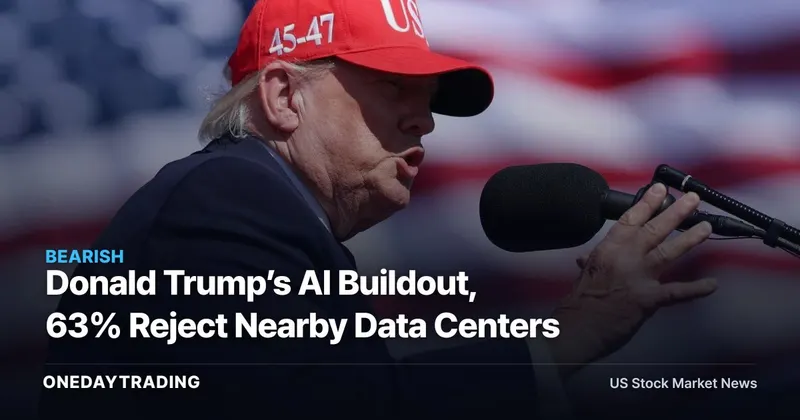
CNBC’s Oct. 14-18 survey found that 63% of the electorate opposed an AI data center near home, while 13% supported one as Donald Trump and Republicans approached the midterm election. For investors, the message is bearish for the pace and economics of AI infrastructure: enthusiasm for advanced AI does not automatically translate into local consent for the power, water and land required to operate it.
Data-center backlash is a political constraint on physical capacity, not evidence that demand for artificial intelligence has disappeared. The distinction matters for Amazon Web Services and the wider infrastructure chain because measures involving self-funded generation, community payments, impact reviews and reduced tax incentives could alter project costs or timing even when technology development continues.
CNBC Finds a Split Inside Donald Trump’s AI Coalition
An AI data center is the physical infrastructure that houses computing systems and depends on substantial supporting power and cooling capacity. Donald Trump has promoted faster artificial-intelligence development alongside expansion of data centers and power infrastructure, framing rapid deployment as important to the country’s competitive position.
The political tension appears inside his own coalition. CNBC found that 55% of MAGA supporters wanted companies to continue developing advanced AI while Congress considered regulation, compared with 27% who favored a pause. On the local question, only 29% of MAGA supporters backed a data center within 10 miles of home, while 40% opposed one.
Support weakened further across the broader Republican electorate. Among Republicans and Republican-leaning voters, 24% supported a nearby facility. The result suggests that an abstract preference for AI development and a concrete willingness to host its infrastructure are separate political propositions.
The Local Cost Debate Reaches National Politics
Communities are contesting data centers over electric bills, electricity and water demand, noise, land use and taxpayer subsidies. Those objections identify the transmission mechanism for investors: political pressure can move from public meetings into permitting reviews, grid-cost rules, community compensation and tax policy.
Dan Diorio of the Data Center Coalition argued that the industry delivers jobs, investment and tax revenue, while saying operators are committed to covering the energy they consume. That is the constructive case for continued development. Its investment significance depends on whether elected officials and host communities consider those benefits sufficient compensation for local demands.
The issue also ranked among voters’ concerns about continued Republican control. In CNBC’s Oct. 14-18 survey, 18% of voters cited failure to regulate AI and data centers, compared with 15% citing continued Immigration and Customs Enforcement deportations, 10% citing cuts to health-insurance subsidies and 5% citing an extension of Trump’s tariffs. Among voters who wanted Republicans to retain control, 17% identified weak AI and data-center oversight.
Amazon Web Services Becomes the Clearest Listed Read-Through
Amazon Web Services is the only named operating company directly tied to a specific expansion in the evidence. Jon Husted helped announce a $10 billion Amazon Web Services expansion in 2024 while serving as Ohio lieutenant governor, describing AI facilities as important to national economic strength.
The political setting has since become more complicated. According to Axios as cited by CNBC, the National Republican Senatorial Committee warned AI companies in August that data-center opposition threatened Husted’s reelection. Sherrod Brown has made opposition to data centers part of the Ohio campaign, while Husted is promoting stalled legislation under which large facilities would cover their own grid and generation costs.
For AMZN, this is a policy-exposure signal rather than a quantified earnings forecast. If host jurisdictions require developers to finance more generation or grid support, the cost assigned to a project could rise. If local payments or clearer cost allocation improve acceptance, those same measures could preserve a path to construction. The fact sheet does not establish the financial, grid or water effect of any specific facility, so the magnitude cannot be modeled from this survey alone.
Greg Abbott and Donald Trump Reframe the Terms of Expansion
Texas illustrates how political sponsorship can shift when infrastructure pressure becomes salient. Greg Abbott halted data-center permits pending grid- and water-impact reviews and called for ending state tax incentives after previously presenting the state as a center of AI development.
Donald Trump also adjusted the policy frame in a Wednesday Truth Social post. He said developers should generate their own power and provide host communities with a financial dividend. For the sector, those proposals redirect the question from whether AI capacity should be built to who pays for the supporting infrastructure and what local residents receive.
This distinction sets up two possible pathways. Operator-funded power and community compensation could improve local acceptance and make project obligations more predictable. They could also place more infrastructure spending and execution responsibility on developers, weakening project economics where the added burden is not offset by the value of new capacity.
Survey Strength, Political Limits and the Regulatory Divide
The CNBC All-America Economic Survey covered 1,000 registered voters nationwide from Oct. 14-18 and was conducted by Hart Research Associates and Public Opinion Strategies. Its overall margin of error was 3.1 percentage points. The proximity question went to a half-sample of roughly 500 voters and carried a 4.38-percentage-point margin of error.
Opposition was strongest among Democrats: CNBC measured 80% against a nearby facility and 4% in support. On management of data-center expansion, 32% of voters trusted Democrats, 24% trusted Republicans and 27% trusted neither party.
Skepticism extended beyond zoning. CNBC found that 52% of registered voters wanted advanced-AI development paused until Congress adopted safety regulations, while 32% favored continued development to keep pace with China. Among Democrats, 70% favored a pause and 18% supported moving ahead.
Brad Carson, co-founder of the AI-industry-backed Public First Action PAC, described public sentiment as having worsened over the preceding 6 months and said the debate had changed from the preceding 1 year. The survey does not provide respondents’ geographic or demographic breakdowns, and it cannot establish whether opposition will change election results.
Bull and Bear Cases for AI Data-Center Investment
Bull case: Support for advanced AI remains materially stronger than support for pausing it among MAGA voters. Policy responses focused on self-generation, explicit grid-cost allocation and community dividends could create terms under which projects retain political support. Industry claims concerning jobs, investment and tax revenue provide advocates with a local-benefit argument.
Bear case: Nearby-facility opposition spans the electorate and includes Republican voters who otherwise favor AI development. Permit reviews, reduced tax incentives, additional generation responsibilities and host-community payments could delay projects or increase their obligations. The gap between national AI ambition and local infrastructure acceptance is therefore the central risk to the buildout.
Investor Checkpoints for Amazon Web Services and AI Infrastructure
- Ohio policy: Track whether Jon Husted’s stalled grid-cost legislation advances and whether the data-center issue remains prominent in his contest with Sherrod Brown.
- Texas permits: Monitor the outcome of Greg Abbott’s grid- and water-impact reviews and any action on state tax incentives.
- Developer obligations: Look for concrete implementation of Donald Trump’s proposals for self-generated power and financial dividends to host communities.
- Amazon Web Services execution: Watch for disclosed changes to the announced $10 billion expansion’s cost responsibility, approvals or development terms. The supplied evidence gives no current project outcome, making those disclosures the next company-specific test.
Market data check: Amazon.com, Inc.
Amazon.com, Inc. last traded near $248 (-0.95%). Our composite signal — blending price momentum and news flow — reads 🟡 neutral. Price momentum scores 42/100.
Data as of publication. Price via market feeds; for reference only, not investment advice.
📊 Analysis
Signal Bearish
Why Broad voter resistance could increase permitting friction, infrastructure obligations and subsidy risk for AI data-center development.
This article was independently written by OneDayTrading from public reporting. Read the original (CNBC)