At a Glance
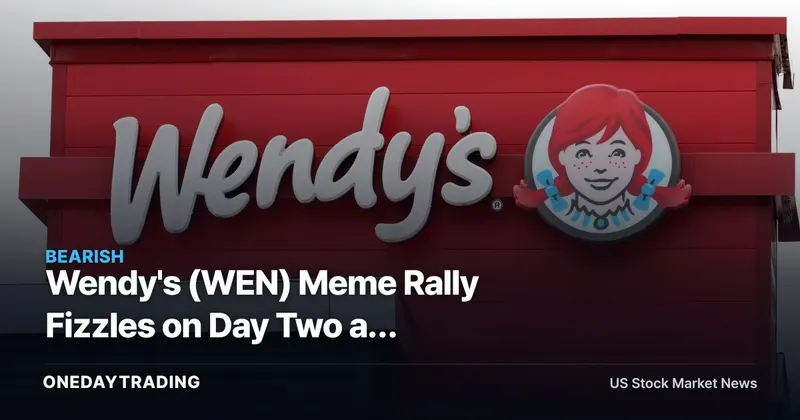
Wendy's (WEN) reversed lower after a sudden meme-fueled spike failed to carry into a second session. The move had little to do with sales, traffic, or margins and everything to do with a short-lived burst of social-media enthusiasm. For investors, the episode is a case study in how retail-driven momentum decouples a stock from its underlying business.
Why It Matters Now
Meme rallies typically ignite in names with heavy retail ownership, recognizable consumer brands, and elevated short interest, where a coordinated wave of buying forces rapid repricing. Wendy's checks the brand-recognition box, which is precisely why it caught a bid. The problem is that a quick-service restaurant chain is valued on same-store sales growth, unit expansion, franchise royalty streams, and commodity and labor cost trends, none of which changed in a single trading day.
When the buying pressure that drives these episodes exhausts itself, price tends to snap back toward where fundamentals justify it. That is the mechanism behind Wendy's day-two fade. The broader signal for investors is that sentiment-driven spikes in consumer-discretionary names can reverse as fast as they appear, and chasing the second leg often means buying from the early crowd already taking profits.
The episode also matters because it can distort options pricing and implied volatility, raising the cost of hedging and making the stock harder to trade on a fundamental thesis until the froth clears.
FAQ
- What drove the Wendy's spike? Social-media enthusiasm and retail momentum, not a company announcement or earnings catalyst.
- Why did it fail to extend? Meme moves rely on continuous fresh buying; without a fundamental anchor, the rally faded as momentum buyers exited.
- Does this change Wendy's business outlook? No. The price action was described as largely disconnected from company fundamentals.
- Is this unique to Wendy's? No. Brand-name consumer stocks with retail followings are recurring meme-rally candidates.
Related Stocks & Sectors
- WEN (Wendy's) the direct subject; franchise-heavy model means royalty income, not viral momentum, sets the real value.
- Quick-service peers (MCD, YUM, QSR) sympathy or sentiment spillover is possible, but their fundamentals are unaffected by Wendy's trading.
- Consumer-discretionary sector sensitive to retail-sentiment swings and the same cost pressures from labor and commodities.
- Brokerage and retail-trading platforms (HOOD) benefit from elevated volume when meme episodes draw active traders.
What to Watch
- Whether trading volume normalizes back toward typical levels, signaling the speculative phase has ended.
- Wendy's next earnings report for same-store sales, traffic, and franchise development guidance, the metrics that actually set value.
- Short-interest and options-volume data for signs of renewed crowding.
- Any company statement; absent one, treat further spikes as sentiment, not substance.
Overall Outlook
The bull case for Wendy's rests on its franchise economics and brand, not on viral trading, and a fundamentals-driven re-rating would need real operating improvement. The risk is that anyone who bought the spike is now exposed to a stock trading above what current results support, with elevated volatility cutting both ways. The cleaner read is to separate the durable business from the noise and let the next earnings print, rather than the next social-media wave, define the thesis.
Market data check: WEN
WEN last traded near $7.58 (-3.51%). Our composite signal — blending price momentum and news flow — reads 🟡 neutral. Price momentum scores 22/100 (soft).
Data as of publication. Price via market feeds; for reference only, not investment advice.
📊 Analysis
Signal Bearish
Why The meme-driven surge reversed as it failed to extend, leaving the stock vulnerable to a snap-back toward fundamentals.
Tickers$WEN$MCD$YUM$QSR$HOOD
This article was independently written by OneDayTrading from public reporting. Read the original (CNBC)