Summary
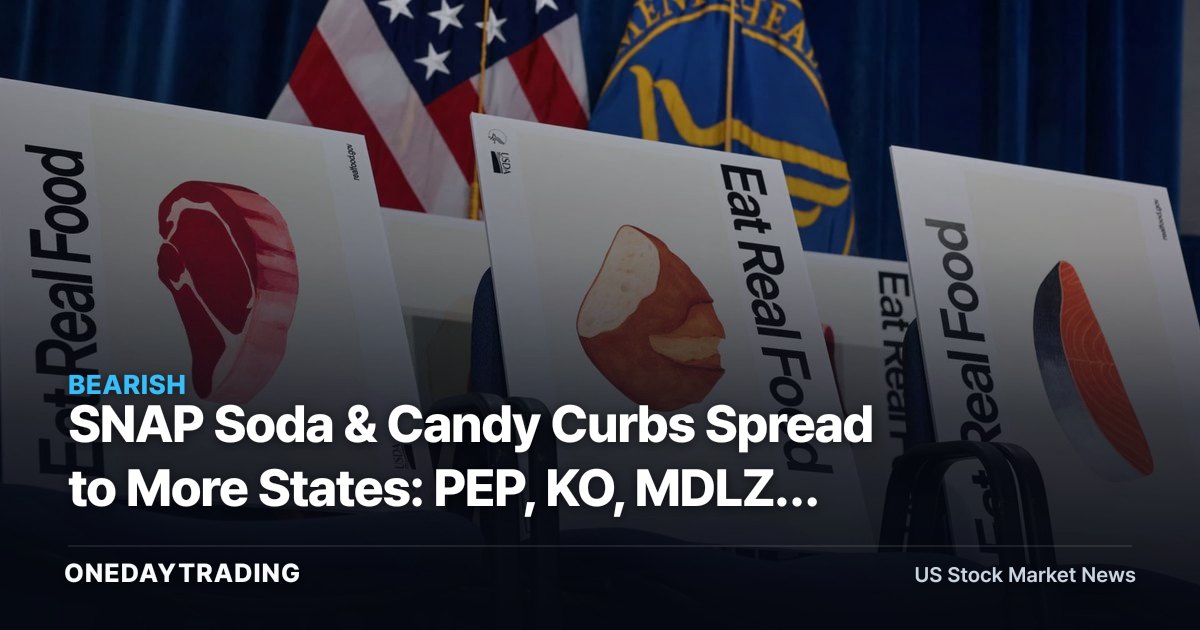
A widening wave of state-level SNAP restrictions on soda, candy and processed foods targets the exact product categories that drive margins for America's largest food and beverage companies. The risk is concentrated, not abstract: brands with heavy exposure to sugary drinks and confectionery in the low-income channel face a slow demand drag, while makers of staples and better-for-you lines are relatively insulated.
The Full Story
SNAP, the federal food-assistance program, has historically let recipients buy almost any grocery item. Several states are now moving to carve out soda, candy and other processed foods from what benefits can cover. As more states adopt these rules, the eligible-purchase universe shrinks for tens of millions of shoppers who lean on the program for a meaningful share of their grocery basket.
That matters because SNAP dollars are not a marginal revenue line for packaged-food and beverage makers. Low-income households over-index on value-priced soda, single-serve candy and shelf-stable processed goods, so a rule that pushes those purchases out of the benefit pool effectively removes guaranteed demand from the most price-sensitive consumers. Management teams across the sector are watching closely because the change hits volume in categories where they already face pressure from weight-loss drugs and a broad shift toward perceived healthier eating.
The food giants are watching because the policy channel is unusual: it does not raise their costs or tax their products directly. Instead it reshapes what eligible shoppers are allowed to buy, redirecting spending toward unprocessed foods, produce and proteins and away from the high-margin discretionary items these companies depend on.
Structural Background
Beverage and confectionery economics rely on high-frequency, habitual purchases at low unit prices. When a structural buyer like SNAP is steered away from those items, the effect compounds over time rather than appearing as a single quarter shock. It also arrives alongside other demand headwinds, including GLP-1 appetite suppression and persistent consumer trade-down, making the SNAP shift one more pressure point on volumes that were already soft.
Stock & Sector Ripple
- PepsiCo (PEP): Dual exposure through both soda and snack portfolios puts it squarely in the crosshairs, with a large slice of volume tied to value-channel, impulse purchases.
- Coca-Cola (KO): As the purest large-cap play on carbonated soft drinks, any benefit-driven decline in soda volume flows more directly to its top line.
- Mondelez (MDLZ) and Hershey (HSY): Candy and snack specialists face the confectionery-specific carve-outs, where SNAP shoppers represent a real share of impulse demand.
- Kraft Heinz (KHC) and General Mills (GIS): Processed and packaged-food exposure means some basket erosion, though staple positioning offers partial cushioning.
- Grocers and discounters: Retailers serving SNAP-heavy demographics could see basket mix shift toward fresh and produce, a margin-neutral to favorable rotation for some.
Bull vs Bear Scenarios
The bear case is a slow, multi-state erosion of guaranteed demand in the highest-margin categories, layered on top of existing volume softness. The bull case is that adoption stays patchwork and gradual, that reformulation and smaller pack sizes preserve eligibility or shift consumers to compliant products, and that affected households substitute with cash rather than abandoning the brands entirely, limiting the net hit. Pricing power and global diversification also mean U.S. SNAP volume is only one part of these companies' revenue mix.
Investor Action Points
- Track how many states enact or expand soda and candy carve-outs and the timeline for implementation, since breadth drives the size of the demand impact.
- Read upcoming PEP, KO, MDLZ and HSY earnings for North America volume trends and any management commentary quantifying SNAP exposure.
- Watch for product responses such as reformulation, pack-size changes or expanded better-for-you lines that could offset eligibility losses.
- Monitor U.S. organic volume versus price contribution, the metric that will reveal whether structural demand is genuinely softening.
Market data check: PEP
PEP last traded near $142.02 (+0.30%). Our composite signal — blending price momentum and news flow — reads 🟡 neutral. Price momentum scores 52/100.
Data as of publication. Price via market feeds; for reference only, not investment advice.
📊 Analysis
Signal Bearish
Why Spreading SNAP restrictions remove guaranteed demand in the high-margin soda, candy and processed-food categories core to these packaged-goods makers.
Tickers$PEP$KO$MDLZ$HSY$KHC$GIS
This article was independently written by OneDayTrading from public reporting. Read the original (CNBC)