At a Glance
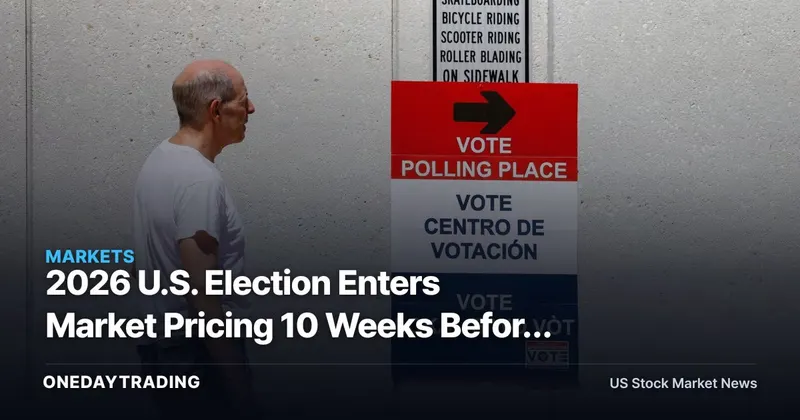
2026 U.S. election risk is starting to matter for markets because Wall Street analysts are now focused on investor outcomes 10 weeks before the Nov. 3 vote, per CNBC reporting, and the tape must price political uncertainty before the result identifies winners and losers.
Election risk means the market impact of possible policy, regulatory and fiscal changes tied to a vote; in this case, the source identifies analyst concern about investor risks depending on the U.S. election outcome.
Why It Matters Now
The market does not need a final election result to start repricing risk. The first move is usually not about which party wins; it is about whether investors demand a wider discount for uncertainty while analysts map the possible outcomes before Nov. 3.
For the S&P 500 and U.S. equities, the channel is multiples before earnings. When policy visibility falls, investors tend to scrutinize valuation, sector leadership and exposure to government-sensitive revenue more closely, even before any law or rule changes.
The source gives one hard calendar fact that matters: CNBC says the election is 10 weeks away from Nov. 3. That timing puts the vote inside portfolio managers’ near-term risk window, which means positioning, hedging and sector rotation can change before fundamentals do.
Key Debates
- What is already priced: CNBC reports that Wall Street analysts are tuning in now, so some political-risk awareness is already entering market discussion rather than arriving as a surprise on election night.
- What is not priced: CNBC does not identify a settled market consensus on the Nov. 3 outcome, so the unresolved variable is which investor risks become concrete after the vote.
- Multiples versus earnings: Election risk affects discount rates and confidence first; company earnings change only if post-election policy alters demand, taxes, regulation or capital spending.
- Risk is two-sided: A clearer result can reduce uncertainty, while a contested or policy-disruptive result can extend the risk premium investors attach to U.S. equities.
Related Stocks & Sectors
- U.S. equities: The broad market is the direct read-through because CNBC frames the issue as investor risk rather than a single-company catalyst.
- Rate-sensitive growth stocks: High-multiple shares are most exposed if political uncertainty pushes investors to demand a larger valuation discount.
- Regulated industries: Banks, healthcare, energy and large internet platforms carry policy sensitivity, so election scenarios can influence how investors value their future cash flows.
- Defensive sectors: Utilities, staples and healthcare can attract attention if investors shift from return-seeking to risk control before Nov. 3.
What to Watch
- Nov. 3 election date: CNBC identifies Nov. 3 as the vote that analysts are watching, making that date the central market calendar point.
- Sector leadership: A shift away from high-multiple groups toward defensive sectors would show investors are paying for political protection.
- Index volatility: Rising volatility before Nov. 3 would indicate that election risk is moving from research notes into actual portfolio hedging.
- Analyst revisions: Watch whether Wall Street moves from broad risk language to explicit earnings, tax, regulatory or capital-spending assumptions.
Overall Outlook
The base case is not an election-driven market break; it is a gradual repricing of uncertainty as Nov. 3 approaches. The bullish version is simple: a clean result narrows the risk premium and lets investors return to earnings, rates and margins.
The risk case is also clear. If the election result increases uncertainty or points toward policy paths investors had not discounted, the market can rotate before reported earnings change. The next trigger is not a company print; it is whether pre-election positioning starts to show up in volatility and sector leadership.
FAQ
Why are markets watching the 2026 U.S. election now?
Markets are watching the 2026 U.S. election now because CNBC reports that Wall Street analysts are focusing on investor risks 10 weeks before the Nov. 3 vote. Investors price uncertainty before outcomes become official, especially when policy paths can affect valuation.
How can the Nov. 3 election affect U.S. stocks?
The Nov. 3 election can affect U.S. stocks through valuation, regulation, taxes, spending expectations and sector rotation. CNBC does not name a specific policy outcome, so the immediate market issue is uncertainty rather than a confirmed earnings impact.
What should investors track before the 2026 election?
Investors should track volatility, sector leadership and analyst scenario work before the 2026 U.S. election. If Wall Street moves from general concern to specific earnings assumptions, election risk will have shifted from narrative to numbers.
📊 Analysis
Signal Neutral
Why CNBC reports rising Wall Street attention to election-related investor risks, but the source does not identify a specific outcome or directional policy shock.
This article was independently written by OneDayTrading from public reporting. Read the original (CNBC)