At a Glance
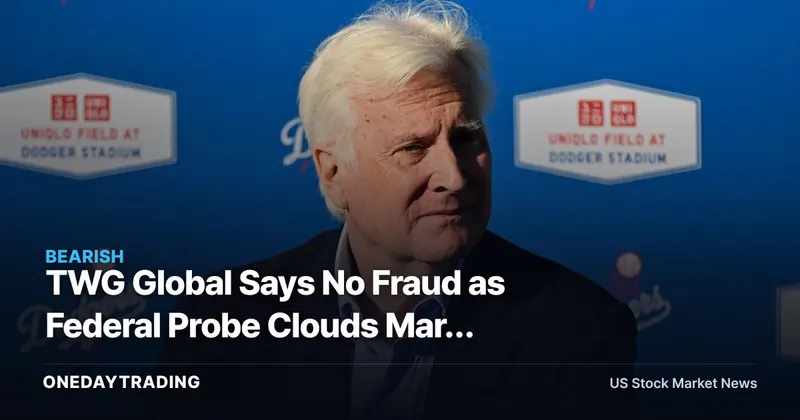
TWG Global and Mark Walter sit at the center of a governance overhang, not a clean public-equity catalyst, after CNBC reported that Walter's investment empire rejected media attacks and said there was no fraud amid a federal probe.
Mark Walter is the billionaire owner of the Los Angeles Dodgers, and CNBC reported that scrutiny intensified after Mark Walter said he would sell his majority share of the Los Angeles Lakers.
Why It Matters Now
For investors, the immediate read-through is not earnings but trust. TWG Global is not presented in the source as a U.S.-listed company, so the market issue is reputational contagion across private capital, sports ownership, and any financing partners tied to high-profile franchise transactions.
A federal probe changes the discount rate investors apply to any transaction narrative because legal uncertainty can slow diligence, tighten lending terms, and make counterparties ask for stronger protections. TWG Global's denial of fraud matters, but denial is not resolution; the investable question is whether the probe affects transaction timing or asset valuation.
The Lakers angle matters because sports franchises depend on scarcity value, media rights, sponsorship demand, and buyer confidence. If scrutiny delays a majority-share sale, the pressure lands first on deal execution rather than on fan demand or team economics.
Key Debates
- Legal risk versus marketability: CNBC reported a federal probe, and TWG Global said there was no fraud; the gap between those facts is where valuation uncertainty lives.
- Asset quality versus owner scrutiny: The Los Angeles Lakers remain a globally recognized sports asset, but a seller-side investigation can still complicate financing and closing conditions.
- Private empire versus public stocks: The source names TWG Global, Mark Walter, the Dodgers, and the Lakers, but the source does not identify a directly listed equity security.
- Media pressure versus legal outcome: TWG Global blasted attacks, yet investor relevance depends on formal findings, not public messaging.
Related Stocks & Sectors
- Financials: Private-capital platforms and lenders can feel tighter underwriting when high-profile asset sales face legal uncertainty.
- Media: Sports media rights remain the economic bridge between franchise values and public entertainment companies, though the source names no specific media counterparty.
- Consumer and leisure: Team brands monetize fan behavior through tickets, sponsorships, merchandise, and local attention, but the source provides no operating figures.
- Real estate and venues: Franchise transactions can influence adjacent arena and sponsorship economics, but CNBC's item does not specify any venue exposure.
What to Watch
- Whether CNBC or official filings identify the scope, target, or timing of the federal probe involving TWG Global or Mark Walter.
- Whether Mark Walter's planned sale of a majority share of the Los Angeles Lakers proceeds, slows, or changes structure.
- Whether financing partners, counterparties, or league approval processes add conditions tied to legal resolution.
- Whether TWG Global issues more specific denials beyond saying there was no fraud.
Overall Outlook
The bull case is that TWG Global's denial proves sufficient for counterparties to keep the Lakers transaction moving and for scarcity value to dominate the negotiation. The bear case is that a federal probe adds a diligence burden that lowers buyer urgency, extends timing, or shifts risk back to the seller.
Olivia Bennett's read: this is a balance-sheet story before it is a brand story. The Lakers brand may still command attention, but legal uncertainty can decide whether attention converts into clean capital.
FAQ
Why is TWG Global under scrutiny?
CNBC reported that Mark Walter's TWG Global faced media scrutiny and that TWG Global rejected attacks while insisting there was no fraud amid a federal probe. CNBC's source item links the scrutiny to the period after Mark Walter said he would sell his majority share of the Los Angeles Lakers.
Is TWG Global a publicly traded stock?
The CNBC source item provided for this analysis does not identify TWG Global as a U.S.-listed company or provide a tradable ticker. Investors should treat the TWG Global news as a private-market and transaction-risk story unless a listed counterparty is formally named.
What does Mark Walter's Lakers sale mean for investors?
Mark Walter's planned sale of a majority share of the Los Angeles Lakers matters because legal scrutiny can affect diligence, financing terms, and closing timelines. If the federal probe stays unresolved, the key market variable is whether buyers demand stronger protections or a changed deal structure.
📊 Analysis
Signal Bearish
Why A federal probe and transaction scrutiny create legal and financing uncertainty even though TWG Global denies fraud.
This article was independently written by OneDayTrading from public reporting. Read the original (CNBC)