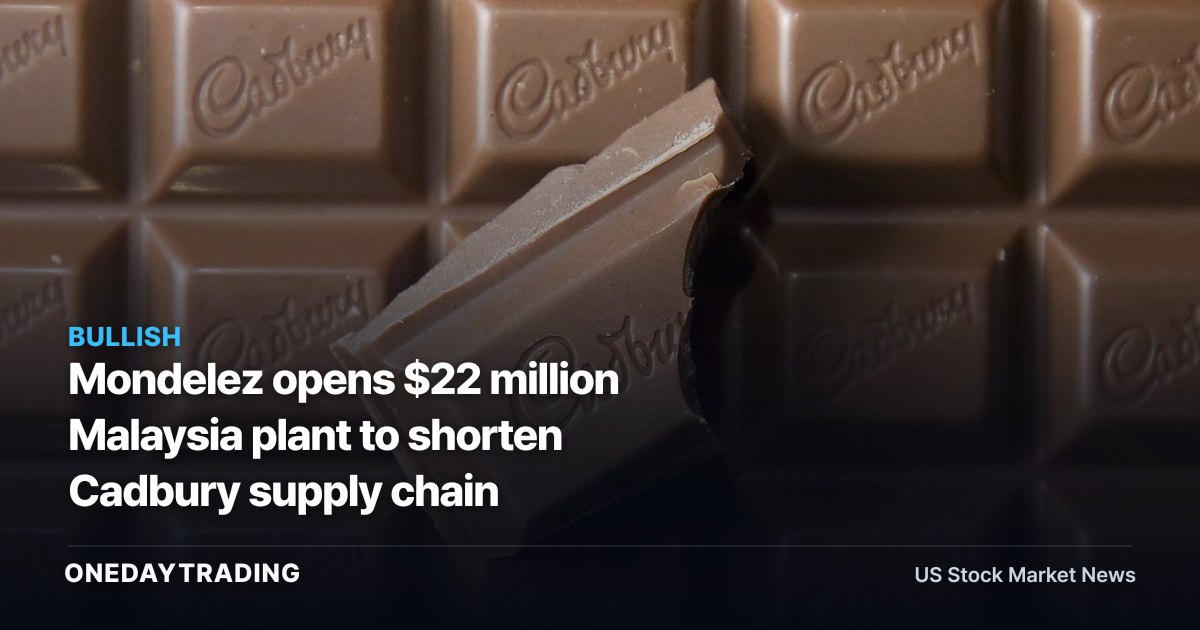
Mondelez’s Malaysia move puts supply-chain control behind Cadbury growth
Mondelez International’s $22 million investment in Shah Alam, Malaysia, is a bullish operational signal for the company’s consumer portfolio: it brings a key Cadbury ingredient closer to the products and shoppers it serves across Southeast Asia. The facility opened on Friday and will make chocolate crumb locally, replacing imports from Australia and South Africa. That change addresses a specific constraint—ingredient lead time—while giving Mondelez a regional base from which to support volume growth.
Chocolate crumb is an intermediate ingredient that contributes to Cadbury chocolate’s taste and texture. Because it is part of the product’s formulation rather than a finished item, sourcing it nearer to the manufacturing hub can affect production scheduling, transport requirements and the ability to replenish local markets. The investment does not establish a new consumer brand; it strengthens the physical system behind an existing one.
Lead time is the first measurable benefit
Nitin Binnani, Mondelēz International’s vice president of integrated supply chain for Southeast Asia, told CNBC that producing crumb in Shah Alam removes at least two months from the supply-chain lead time. For investors, that is the clearest near-term operating read-through: a shorter interval between ingredient planning and usable supply can make Cadbury production more responsive to demand changes.
The company also says the facility is intended to reduce import and transportation costs and support volume growth across Southeast Asia. CNBC did not report the precise dollar savings, production capacity or staffing level, so the financial contribution cannot be sized from the disclosed facts. The mechanism is nevertheless direct: fewer imported crumb shipments should reduce dependence on long-distance inbound logistics, while local output can support the region’s sole Cadbury manufacturing hub.
That hub already produces more than 130 varieties of chocolate and around 100 million bars annually, according to Binnani. The plant therefore sits inside a substantial existing network rather than a start-up operation. Whether the new ingredient line adds material margin depends on utilization, procurement economics and demand—variables the company has not quantified in the available report.
Shah Alam anchors a wider Southeast Asian network
Mondelez’s regional footprint extends beyond Malaysia. Binnani said the Cikarang plant in Indonesia supplies products to nearly 40 countries, including Australia and Japan, while Thailand operates as an export-oriented hub for gum and candy. The pattern matters because it shows how the company uses Southeast Asian factories for both domestic and international distribution.
Shah Alam’s role is more specific: it is Mondelez’s sole Cadbury manufacturing hub for Southeast Asia. Local crumb production can therefore influence the reliability of a concentrated regional node. A disruption at that hub would still matter, but the new facility may reduce one external dependency by moving a critical input inside the operating region.
Mondelez is also exporting crumb to Pakistan to help address supply disruptions caused by interrupted shipping channels. That flow demonstrates optionality in the network, although the report does not identify the channels involved or indicate how long the arrangement will last. Investors should treat it as evidence of network flexibility, not as a quantified new revenue stream.
Consumer economics: availability before margin expansion
For a branded-food company, the shopper-level benefit of supply reliability is continuity. Cadbury products span more than 130 varieties, and the Shah Alam hub produces around 100 million bars annually. If local crumb availability helps the plant maintain that assortment and output, retailers may face fewer replenishment interruptions and Mondelez can respond more quickly when regional demand shifts.
That operating advantage can support sales execution, but it does not guarantee higher earnings. The company’s stated goals—lower import and transportation costs and support for volume growth—are intentions attached to the investment, not reported outcomes. No precise cost reduction or incremental Southeast Asian volume was disclosed.
Cocoa prices had eased after a record-breaking rally over the past two years, a period in which adverse weather and poor harvests drove higher costs for chocolate makers, CNBC reported. Softer cocoa costs could relieve input pressure, while the Malaysian facility addresses a different part of the cost structure: the movement and timing of chocolate crumb. The two factors should not be conflated. Ingredient logistics may improve even as cocoa-market volatility remains a separate risk.
By the numbers: what the investment changes
The disclosed figures define the scale and intended transmission of the move. Mondelez invested $22 million in the Shah Alam facility; local production removes at least two months from crumb supply-chain lead time; and the site serves a hub producing more than 130 chocolate varieties and around 100 million bars annually.
The broader network supplies products to nearly 40 countries from Cikarang, while Thailand serves as an export hub for gum and candy. These figures support a regional-manufacturing thesis, but they are not guidance for consolidated revenue or profit. The exact calendar date of the Friday opening, facility capacity, staffing, savings and volume outcome remain undisclosed.
Who benefits—and where the read-through stops
- Mondelez International (MDLZ): The direct beneficiary is the company’s supply chain. Local crumb production may lower import and transportation costs, shorten replenishment cycles and support Cadbury output, but the earnings impact is not quantified.
- Cadbury operations in Southeast Asia: Shah Alam gains an internal source for an ingredient tied to taste and texture, reducing reliance on crumb imported from Australia and South Africa.
- Regional manufacturing: Cikarang’s nearly 40-country reach and Thailand’s export role indicate that Southeast Asia is already integrated into Mondelez’s global network. The Malaysian investment deepens that manufacturing model.
- Cargill: Cargill expanded its specialty fats facility in Port Klang earlier this year, including capacity for chocolate-manufacturing ingredients. That establishes another chocolate-related investment in Malaysia, but the available facts do not establish a direct commercial link to Mondelez’s project or a stock-market impact.
Risk check for MDLZ investors
- The facility’s production capacity and staffing are unknown, so investors cannot determine how much imported crumb it can replace.
- The precise import and transportation savings have not been disclosed; a shorter lead time does not automatically translate into a material margin gain.
- Mondelez’s Southeast Asian volume-growth outcome remains unspecified. More manufacturing capability may not produce more bars if consumer demand or distribution limits growth.
- Cocoa prices have eased after a two-year rally, but the report provides no forecast for future commodity costs. Input-price volatility remains separate from the logistics benefit.
What to monitor next
The next useful checkpoints are operational disclosures from Mondelez: any indication of Shah Alam utilization, the share of crumb production shifted from Australia and South Africa, and quantified import or transport savings. Cadbury volume trends in Southeast Asia would test whether the investment is supporting demand rather than merely rearranging supply.
Investors should also track how the regional network handles cross-border demand, including crumb exports to Pakistan and output from Cikarang and Thailand. Those observations can show whether the company is gaining resilience and flexibility or simply adding fixed infrastructure without measurable throughput.
Bottom line
Mondelez’s $22 million Shah Alam facility gives Cadbury a nearer, more controllable source of chocolate crumb and removes at least two months from the stated supply-chain lead time. That supports a constructive view of MDLZ’s Southeast Asian execution and could reduce logistics friction, but the company has not disclosed the savings, capacity or resulting volume growth. The investment is a tangible operational catalyst; its stock significance will depend on utilization, realized costs and Cadbury demand in subsequent company updates.
📊 Analysis
Signal Bullish
Why Local crumb production should improve Cadbury’s supply-chain responsiveness and potentially lower import and transport costs, although the earnings effect is not quantified.
This article was independently written by OneDayTrading from public reporting. Read the original (CNBC)