Why PSA’s Label Changes the Seller’s Calculation
PSA, or Professional Sports Authenticator, entered Oct. 29 with its Value service reopened after suspending cheaper submission services in June. For collectors, dealers and investors, the key issue is not simply whether capacity returns. It is whether the expected resale advantage of a PSA label remains large enough to compensate for fees, waiting time and uncertainty over the final grade.
Card grading is the process of verifying authenticity and condition before assigning a grade and sealing the card in a protective case. PSA uses a 10-point scale, with Gem Mint 10 as its highest grade. The label gives buyers and sellers a shared condition benchmark, while records for comparable cards and grades help frame a resale decision.
The Charizard transactions show why label choice can dominate that decision. CNBC’s PriceCharting review tied a PSA 9 sale of about $3,440 and a CGC 9 sale of roughly $1,890 to the same Sept. 29 date. That comparison does not establish the premium for every card, though it illustrates the commercial incentive behind Geoff Wilson’s assessment that secondary-market values drive grader selection.
Wilson, founder and CEO of CardsHQ, also said more raw cards were being traded at card shows. The implied pressure point is straightforward: when grading costs rise or affordable service becomes unavailable, a seller must decide whether the potential price attached to a slab justifies submitting the card at all. The exact financial effect on the overall resale market is unknown.
PSA Capacity Improved, Demand Still Sets the Pace
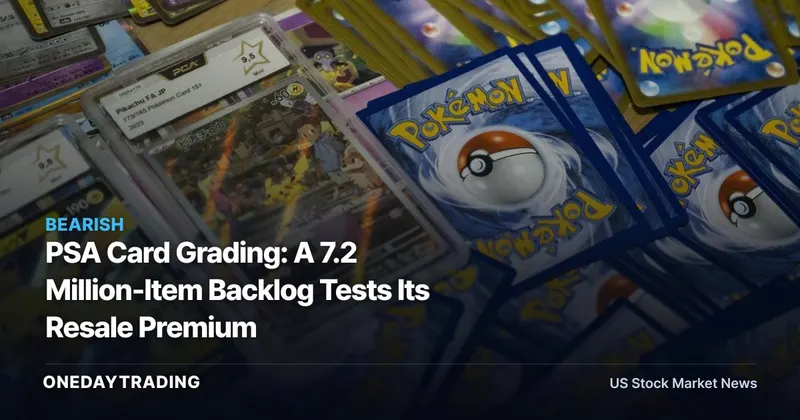
The backlog fell to 7.2 million items on Oct. 20 from 12.4 million in July, according to CNBC. That reduction is meaningful for operating capacity, but it does not erase the queue or establish how quickly individual submissions will be completed. PSA’s Oct. 28 update said new Value submissions would be processed behind existing orders.
PSA said April and May submissions reached 2.5 times the volume received in the same months a year earlier. Ryan Hoge, president of PSA and grading at Collectors, said the company had added substantial capacity while acknowledging that further work remained. For the business, heavy submissions validate demand; for customers, the same demand can extend the period before a card becomes available for resale.
The next operating checkpoint is the backlog reported after the Oct. 29 Value reopening. A continued decline would indicate that added capacity is absorbing both existing orders and renewed lower-priced submissions. A renewed increase would suggest that access to Value service is restoring intake faster than the queue can be cleared.
Fees Put the Resale Premium Under a Harder Test
PSA raised its Value Bulk fee from $21.99 to $24.99 and its Value fee from $27.99 to $32.99 in February. Those increases matter most where a grading charge represents a larger part of the card’s potential resale value. Higher fees can make customers more selective even when they still prefer the PSA label.
The fee decision also exposes the tension inside the model. PSA can benefit from strong label demand, while restrictions designed to manage that demand may reduce access to its cheaper services. Reopening Value expands access again, though the placement of new submissions behind existing orders keeps turnaround risk in the customer’s calculation.
Amber Chuah, operations manager of TCG Marketplace, highlighted the added burden for sellers facing long waits, especially when shipping is involved or a grade disappoints. A disputed outcome can require further time and expense. That friction matters because the card cannot complete its intended resale journey while grading or review remains unresolved.
Collectors’ Reach Extends Beyond the PSA Slab
Collectors owns PSA, Beckett and SGC. GemRate data cited by CNBC showed that those three card-grading brands accounted for roughly 71% of August grading volume among major firms it tracked; PSA alone represented about 65%, compared with about 28% for CGC.
The parent company also owns Card Ladder, the PSA Vault and financial services. The PSA Vault connects storage with sales through external marketplaces including eBay. Taken together, those relationships place Collectors across grading, pricing data, storage and resale access, although the supplied evidence does not quantify the financial contribution of any operation.
A proposed class action filed in April challenges Collectors’ acquisitions of Beckett and SGC. The allegations have not been proven in court. Nat Turner, CEO of Collectors, said in the company’s 2025 acquisition announcement that well-supported brands could broaden access to the hobby.
CGC Growth Tests the Strength of PSA’s Resale Loop
CGC accounted for about 28% of August grading volume and processed more than double its year-earlier volume that month, according to GemRate. This establishes that an alternative can attract submissions even while PSA retains the larger share among the tracked firms. Geoff Wilson also identified CGC, Beckett and TAG as alternatives available to collectors.
The competitive question is whether submission growth develops into wider buyer acceptance. If buyers assign greater value to competing labels, sellers gain a stronger reason to choose them on service, cost or timing. If PSA-graded cards continue to command the preferred resale outcome, faster rival growth may coexist with PSA’s dominant share rather than displace it.
Oxley Grading, a Singapore-based submission dealer, estimated that roughly 90% of graded cards offered to it for purchase carried PSA labels. That estimate is not a market-wide share measure, but it illustrates how existing resale inventory can reinforce buyer recognition and seller preference. Whether buyers will value a newcomer’s grading label as highly as PSA’s remains unknown.
Who Gains and Who Bears the Friction
- PSA and Collectors: High submission demand, the resale comparison and roughly 65% of tracked August grading volume support the brand’s position. The offset is a multimillion-item backlog that has already required service restrictions and capacity additions.
- CGC: August grading volume was more than double its year-earlier level, providing evidence of customer uptake. Its roughly 28% share and the Sept. 29 Charizard sale comparison show the remaining challenge in matching PSA’s resale acceptance.
- Card sellers: A PSA label may support a stronger resale price for comparable grades, while higher fees and waiting time raise the hurdle for submitting lower-value cards.
- Raw-card buyers and sellers: Wilson’s observation of more raw-card transactions at card shows indicates an alternative route when grading economics or timing become unattractive.
Risks and the Next Evidence to Check
- Backlog direction: Track whether PSA’s reported queue continues falling after Value service reopened on Oct. 29.
- Capacity conversion: Compare future turnaround estimates and submission updates with the 2.5-times prior-year volume recorded in April and May.
- Competitive acceptance: Watch whether CGC sustains its more-than-double year-over-year grading volume and whether comparable resale records narrow PSA’s observed advantage.
- Legal uncertainty: Follow the proposed class action concerning Collectors’ acquisitions without treating its unproven allegations as established conduct.
The Investment Read on PSA’s Grading Power
PSA’s position rests on a behavior loop: buyers recognize the label, sellers pursue the resale value associated with it, and submission demand reinforces the label’s presence. The 7.2 million-item backlog and February fee increases show the cost of that demand for customers. The live test is whether capacity can reduce waiting times without weakening the resale premium that makes collectors tolerate the wait; PSA had not answered CNBC’s detailed questions or the sources’ claims by publication time.
📊 Analysis
Signal Bearish
Why PSA’s backlog, higher fees and service restrictions create pressure for customers, although its resale premium and grading-volume share support demand.
This article was independently written by OneDayTrading from public reporting. Read the original (CNBC)