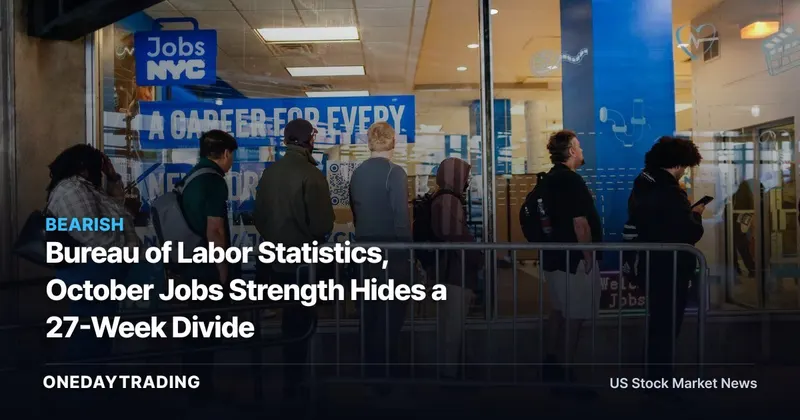
Bureau of Labor Statistics Data Reveal a Split Labor Market
The Bureau of Labor Statistics delivered an October jobs report that supports macro-sensitive stocks at first glance but carries a weaker signal underneath: payrolls expanded while unemployed Americans took longer to return to work. For investors, the tension matters more than either headline alone because it separates continued employment growth from the deteriorating experience of people already outside the workforce.
CNBC reported that nonfarm payrolls added 165,000 jobs in October and that the unemployment rate declined to 4.1%. In the same report, the average jobless worker’s unemployment duration surpassed 27 weeks on a seasonally adjusted basis, its longest comparable reading outside the pandemic period since 2016.
Long-term unemployment means being without work for at least 27 weeks. About 2 million Americans met that definition in October, according to CNBC’s account of the Bureau of Labor Statistics release, and they represented 27.6% of all jobless workers.
Why the 27-Week Threshold Changes the Investment Read
A payroll increase measures jobs added across the economy; it does not show how easily a person who loses work can secure another position. October therefore produced two valid signals at once: employers added jobs in aggregate, while the average unemployed person’s search extended beyond 27 weeks.
The threshold also intersects with household finances. Government unemployment benefits generally stop after 26 weeks in a year, meaning the average unemployment spell now lasts longer than that benefit window. Cory Stahle, a senior economist at Indeed, emphasized this mismatch, saying the average unemployed person now searches longer than benefits last.
That gap is a potential transmission channel from labor data to consumer-facing earnings. A longer search can leave an unemployed household with less benefit support before new wages begin. The supplied evidence does not quantify changes in spending, credit performance or company revenue, so those outcomes remain scenarios rather than reported results.
The deeper issue is persistence. Research cited from the Federal Reserve Bank of Richmond said time without work may itself make finding work less likely as skills weaken, networks narrow or employers interpret a long absence negatively. That mechanism can turn an initially temporary job loss into a more durable constraint on earning capacity.
The Debate Behind October’s Strong Headline
- Payroll growth versus reemployment speed: October nonfarm payrolls rose by 165,000 jobs, while the average jobless spell exceeded 27 weeks. The first measure captures aggregate hiring; the second describes the difficulty facing people seeking to reenter employment.
- A lower unemployment rate versus a larger long-term share: The unemployment rate fell to 4.1%, while long-term unemployed people accounted for 27.6% of all jobless workers. Neither measure invalidates the other, but their divergence makes the headline rate an incomplete guide to labor-market accessibility.
- Low layoffs versus visible workforce reductions: Layoffs and discharges fell to their lowest volume in more than a year. Disney was planning to cut thousands of jobs, and American Express said last month that it was reducing head count by 5%.
- Monthly noise versus a broader pattern: Cory Stahle cautioned that the unemployment-duration series can fluctuate from month to month. He also said the direction becomes unmistakable when viewed over a longer horizon, framing October as part of a trend rather than a self-contained signal.
Openings and Quits Complicate the Bearish Case
The report does not support a simple labor-downturn thesis. September job openings exceeded economists’ expectations, while layoffs and discharges reached their lowest volume in more than a year. Worker quits also rose to a level not seen since March 2025, a development that can be read as confidence among employees willing to leave existing roles.
These indicators provide the countercase to the long-duration warning. Employers may be reluctant to dismiss current workers even as job seekers struggle to match with available positions. If openings, quits and low layoffs remain firm while unemployment duration retreats, October’s split could prove less damaging than the long-term share suggests.
Yet the exact number of September openings and the exact number of workers who quit were not supplied. The evidence establishes direction and comparison points, not the magnitude needed to judge whether those improvements are sufficient to offset prolonged job searches.
Disney and American Express Put Company Names on the Macro Risk
- Disney: The company was planning to cut thousands of jobs. The exact planned reduction is unknown, so the announcement supports scrutiny of workforce direction but not a precise estimate of savings, restructuring costs or earnings impact.
- American Express: The company said last month that it was reducing head count by 5%. That disclosed percentage makes the workforce action concrete, though the supplied facts do not establish how the reduction affects expenses, customer activity, credit outcomes or profit.
- Consumer and financial sectors: Longer unemployment spells could matter through household income and spending capacity, particularly after benefits expire. No sector revenue, delinquency or spending figures were provided, preventing a direct company-level earnings conclusion.
- Media: Disney’s planned cuts show that company-specific workforce actions can coexist with aggregate payroll growth and low economy-wide layoffs. The facts do not establish whether the company’s plan reflects the broader labor trend or a separate corporate decision.
What the Next Labor Releases Must Resolve
- Average unemployment duration: Check whether the measure remains above 27 weeks or reverses. The exact October average beyond that threshold was not reported in the supplied evidence.
- Long-term unemployment: Track whether about 2 million Americans and the 27.6% share of all jobless workers rise or fall in the next report. These measures show whether hiring is reaching people with the longest searches.
- Payrolls and the unemployment rate: Compare the next readings with October’s 165,000-job increase and 4.1% unemployment rate. Continued headline strength would carry more weight if unemployment duration also improves.
- Openings, quits and layoffs: Test whether higher-than-expected openings, stronger quits and the low volume of layoffs persist. Together, those indicators can distinguish a temporary mismatch from a labor market becoming harder to enter.
October’s Balanced Outlook for Markets
The bullish interpretation rests on confirmed job creation, a lower unemployment rate, stronger-than-expected openings and reduced layoffs. Those facts describe an economy still generating positions and retaining many existing workers, limiting the evidence for a broad employment contraction.
The bearish interpretation is narrower but consequential: once workers lose jobs, the route back appears slower. An average spell above 27 weeks, a 27.6% long-term-unemployed share and a benefit window of 26 weeks create a pressure point that the payroll total does not capture.
Elizabeth Renter, lead economist at Life360, described why upbeat national statistics may conflict with what people see through layoffs and extended searches around them. For markets, the decisive next signal is not another strong headline in isolation. It is whether future Bureau of Labor Statistics releases show payroll growth reaching the long-term unemployed before the divergence becomes more persistent.
📊 Analysis
Signal Bearish
Why Longer unemployment spells and announced workforce reductions weaken the quality of an otherwise firm October labor report.
This article was independently written by OneDayTrading from public reporting. Read the original (CNBC)